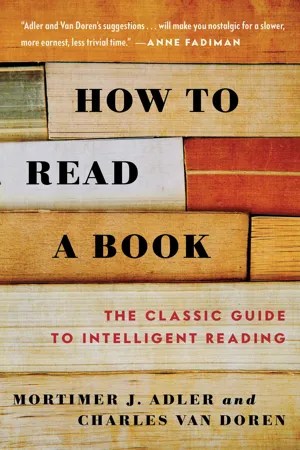
By the time we hit middle age or finish our degrees or even advanced degrees, it’s easy to assume we’ve mastered the art of reading. After all, we’ve devoured hundreds of books, from dense academic texts to breezy novels. But picking up How to Read a Book by Mortimer J. Adler and Charles Van Doren was a humbling experience. It reminded me that there’s so much more to reading than just flipping through pages and absorbing information. The book turned something I thought I’d perfected into a skill I realized I could refine and deepen.
One of the most refreshing takeaways was the concept of different levels of reading. Adler and Van Doren lay out a roadmap that moves from simply understanding words on a page (what they call “elementary reading”) to truly engaging with a text on an analytical or even comparative level. For instance, I’d never consciously thought about how my approach to reading a novel differs from reading a self-help book or a historical analysis. This book nudges you to be deliberate about those distinctions, and suddenly, your bookshelf feels less like a collection and more like a map of intellectual possibilities.
What really stuck with me was the idea of setting intentions for every book. It’s not about treating reading like a checklist, but about asking yourself, “What do I want to gain from this?” With some books, it might be knowledge. With others, it might be inspiration, entertainment, or even a challenge to your worldview. That simple question—“Why am I reading this?”—changed the way I pick up books and, more importantly, the way I engage with them.
This book also made me more mindful about how to deepen engagement with books. Instead of passively consuming what’s in front of me, I’m now asking questions, marking up margins, and taking the time to connect ideas. I’ve started treating books like conversations, with the author on one side and me on the other. It’s funny how something as seemingly simple as reading—a skill most of us assume we’ve mastered—can be reimagined into a lifelong art.
How to Read a Book isn’t just a guide for becoming a better reader. It’s an invitation to slow down, reflect, and bring more thoughtfulness to the way we approach knowledge, stories, and ideas. For anyone who feels like reading is already second nature, this book will surprise you—it’s like finding a new layer to something you thought you already knew inside and out.
[Written by ChatGPT]
Summary of How to Read a Book by Mortimer J. Adler and Charles Van Doren
How to Read a Book is a guide to improving reading skills and understanding different types of texts more deeply. Originally published in 1940 and revised in 1972, the book teaches readers how to approach various types of reading materials, from novels and newspapers to philosophical and scientific works. The authors outline methods for achieving deeper comprehension and becoming more effective, analytical readers.
Key Concepts and Takeaways
1. Four Levels of Reading
The authors divide reading into four progressive levels:
- Elementary Reading:
- Basic literacy, focusing on understanding the literal meaning of words and sentences.
- Inspectional Reading:
- Skimming and scanning a book to get an overview of its content and structure.
- Goals: Determine if the book is worth reading and identify key points.
- Analytical Reading:
- A thorough and systematic approach to deeply understand the book.
- Involves asking questions like:
- What is the book about as a whole?
- What are the main arguments and ideas?
- Is the author right or wrong, and why?
- Syntopical Reading (or Comparative Reading):
- Reading multiple books on the same subject and synthesizing their ideas.
- Helps form a comprehensive view of the topic and generate original insights.
2. Rules of Analytical Reading
The authors outline key steps to effectively analyze a book:
- Classify the book: Determine its subject matter and category (e.g., fiction, history, science).
- State the author’s purpose: Identify the primary questions the author seeks to answer.
- Outline the structure: Understand how the content is organized and how the arguments progress.
- Define key terms: Clarify important concepts and terms used by the author.
- Critique the book: Engage critically by questioning assumptions, evaluating evidence, and forming your own judgments.
3. Active Reading
- Emphasizes the importance of engaging actively with the text by:
- Asking questions while reading.
- Taking notes and underlining key points.
- Summarizing ideas in your own words.
4. Approaching Different Types of Books
The authors provide tailored strategies for various genres:
- Practical Books: Focus on how-to guides or manuals. Ask how the book can help solve specific problems.
- Imaginative Literature: Enjoy and analyze themes, characters, and narrative techniques in novels, poetry, and plays.
- History: Pay attention to timelines, causes, and the historian’s perspective.
- Science and Mathematics: Understand key principles and the logic behind formulas and theorems.
- Philosophy: Engage deeply with arguments, examining their logic and assumptions.
5. Becoming a Lifelong Learner
The book stresses the importance of reading as a lifelong skill:
- Reading broadens knowledge, stimulates critical thinking, and fosters intellectual growth.
- Syntopical reading allows for deep dives into complex subjects, fostering expertise and creativity.
Key Takeaways
- Reading is an active process that requires effort and engagement.
- Different types of texts demand different reading strategies.
- Mastering the four levels of reading leads to greater comprehension, insight, and intellectual growth.
- Critical reading allows readers to challenge ideas and form independent opinions.
Conclusion
How to Read a Book is both a practical guide and an intellectual manifesto, encouraging readers to approach books as tools for learning and self-improvement. By mastering its techniques, individuals can unlock the full potential of reading, transforming it into a powerful means of understanding the world and themselves.
About the Authors
Mortimer J. Adler and Charles Van Doren are the authors of How to Read a Book. Here’s a brief overview of their backgrounds:
Mortimer J. Adler (1902–2001)
- Profession: Philosopher, educator, and writer.
- Key Contributions:
- A leading figure in the development of the Great Books of the Western World series, which aimed to make classic texts accessible to the general public.
- Advocate for lifelong learning and the importance of a liberal education.
- Promoted the idea that philosophy and critical thinking should be accessible to everyone, not just academics.
- Other Notable Works:
- The Paideia Proposal: A framework for educational reform.
- Ten Philosophical Mistakes: A critique of common errors in modern philosophy.
- Philosophy: Rooted in Aristotelian and Thomistic traditions, Adler believed in the power of dialogue and reasoning to discover universal truths.
Charles Van Doren (1926–2019)
- Profession: Writer, editor, and educator.
- Background:
- Van Doren became famous in the late 1950s as a contestant on the television quiz show Twenty-One, later embroiled in a cheating scandal that overshadowed much of his early career.
- After the scandal, he dedicated himself to intellectual and literary pursuits, eventually collaborating with Adler.
- Key Contributions:
- Played a significant role in revising and expanding How to Read a Book in 1972.
- Worked as an editor for the Encyclopaedia Britannica, contributing to its educational outreach.
- Philosophy: Advocated for clear communication of complex ideas and the democratization of knowledge.
Collaboration on How to Read a Book
- Mortimer J. Adler first published How to Read a Book in 1940 as a standalone guide to improving reading skills.
- Charles Van Doren collaborated with Adler to revise and expand the book in 1972, incorporating new insights and strategies, making it more accessible to modern audiences.
The combined efforts of Adler and Van Doren have made How to Read a Book a timeless guide for readers seeking to deepen their understanding and mastery of the written word.
Other Books on Reading
Books Specifically About Reading and Engagement
- The Pleasures of Reading in an Age of Distraction by Alan Jacobs
- Focuses on how to rediscover the joy of reading in a world filled with distractions. Jacobs advocates for reading at your own pace and for personal enjoyment, rather than obligation.
- How to Talk About Books You Haven’t Read by Pierre Bayard
- A humorous yet insightful book that challenges conventional notions of reading, offering ways to engage in literary conversations even if you haven’t read the text in full.
- Why Read? by Mark Edmundson
- Explores the transformative power of literature and how reading shapes our identity, values, and outlook on life.
- Reading Like a Writer by Francine Prose
- Geared toward writers but valuable for any reader, this book teaches how to read closely, paying attention to language, structure, and the choices authors make.
- How to Read Literature by Terry Eagleton
- Aimed at demystifying literary analysis, Eagleton explores how to interpret and enjoy literature by examining key aspects like narrative, character, and style.
Books on Critical Thinking and Interpretation
- They Say / I Say: The Moves That Matter in Academic Writing by Gerald Graff and Cathy Birkenstein
- While focused on writing, this book teaches how to engage critically with texts by identifying arguments and responding effectively.
- Critical Reading and Writing for Postgraduates by Mike Wallace and Alison Wray
- A practical guide for developing critical reading and writing skills, particularly useful for students and researchers.
- The Art of Thinking Clearly by Rolf Dobelli
- Helps readers identify cognitive biases and think critically, which also enhances how they engage with texts.
- How to Think by Alan Jacobs
- Encourages thoughtful engagement with ideas, teaching readers how to process arguments critically while remaining open to different perspectives.
- The Elements of Style by William Strunk Jr. and E.B. White
- While primarily a guide for writing, this classic work helps readers understand and appreciate clarity and precision in language.
Books for Deeper Intellectual Engagement
- The Intellectual Life: Its Spirit, Conditions, Methods by A.G. Sertillanges
- A guide to cultivating a disciplined and thoughtful intellectual life, including approaches to reading and learning.
- The Well-Educated Mind: A Guide to the Classical Education You Never Had by Susan Wise Bauer
- Offers a structured approach to self-education through the “great books” of Western literature, history, and philosophy.
- Amusing Ourselves to Death by Neil Postman
- Explores how media influences public discourse and reading habits, encouraging readers to think critically about the sources they consume.
- Thinking, Fast and Slow by Daniel Kahneman
- While not directly about reading, it enhances comprehension by teaching how the mind processes information and decisions.
Books on Learning and Lifelong Growth
- Make It Stick: The Science of Successful Learning by Peter C. Brown, Henry L. Roediger III, and Mark A. McDaniel
- Focuses on effective learning strategies that improve retention and comprehension, applicable to reading and studying.
- Deep Work: Rules for Focused Success in a Distracted World by Cal Newport
- Encourages cultivating focus and concentration, skills that are invaluable for deep reading.
- Mortimer Adler’s Great Books of the Western World Series
- Though not a single book, this series encourages systematic engagement with classic works of philosophy, science, and literature.
 UpLive.Life
One thought on “Book Club: How to Read a Book by Mortimer J. Adler and Charles Van Doren”