[Written by ChatGPT]
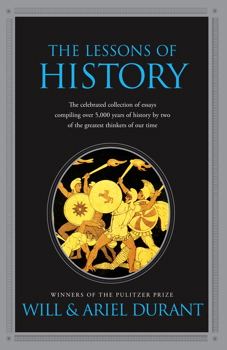
When I picked up The Lessons of History by Will and Ariel Durant, I wasn’t quite prepared for how much this slim volume would pack into its 100 pages. This is no mere summary of their monumental The Story of Civilization—it’s a masterpiece of wit, humility, and deep reflection. The prose sparkles with poetic observations like “a fragment of the smiling sun may … fall upon us in a wild embrace ending all grief and pain.” The Durants don’t just recount historical facts; they explore the forces shaping human history with a kind of intellectual playfulness that invites the reader into their reflections.
Their humility is disarming: “Most of history is guessing, the rest is prejudice,” they quip, acknowledging the limitations of even the most meticulous scholarship. And yet, their reflections dig deep, grappling with the ultimate question: “what use have your studies been?“
Despite its brevity, this is not a breezy read. The references to historical figures and events had me frequently pausing to look up names and timelines, but those interruptions only deepened my appreciation. This is a book to savor, not speed through, especially for those of us who don’t consider ourselves history buffs. Because my blog often centers on biology and human development, I’ll focus on the chapter Biology and History, which offered some of the most striking lessons.
Key Takeaways from Biology and History
- Life Is Competition
The Durants remind us that life’s fundamental nature is competitive. Survival and success, whether for individuals, families, or nations, hinge on this basic struggle. While our “group”—family, community, nation—offers protection, the lesson is stark: unless we begin to see all of humanity as part of our group, we “will continue to act like individuals and families in the hunting age.” Tribalism, whether in politics, religion, or nationalism, remains one of the most persistent barriers to global harmony. - Life Is Selection
One of the most humbling and unsettling truth from this chapter is the idea that we are not born free or equal. Our “physical and psychological heredity” sets the stage for our lives, and while some constraints can be softened, they can’t be erased. The Durants suggest that the best we can hope for is approximate equality—not of outcomes, but of legal justice and educational opportunity. - Life Must Breed
The Durants emphasize that reproduction is essential for the survival of life and civilization. They tie population dynamics to historical and economic trends, suggesting that societies in decline often exhibit declining birth rates. This lesson is particularly relevant today, given global variations in population growth.
Current Population Statistics and Trends
To understand what the Durants’ insights mean for us today, let’s look at population growth and its implications:
- Global Population Growth:
The world population reached 8 billion in 2022, but growth rates are slowing. According to the United Nations, the global fertility rate has fallen to 2.4 children per woman in 2020, down from 5.0 in 1950. It’s projected to drop below replacement levels (2.1) by the end of the century. - Regional Trends:
- Sub-Saharan Africa: Fertility rates remain high (4–5 children per woman), driving rapid population growth. This region is expected to double in population by 2050.
- Europe and East Asia: Facing population decline due to aging populations and fertility rates below 1.5. Countries like Japan, Italy, and South Korea are shrinking demographically.
- North America: Moderate growth, largely driven by immigration rather than natural increase.
- Economic Implications:
- High-Growth Regions: Rapid population growth in regions with low educational and economic development could strain resources and hinder economic stability unless offset by investments in education, healthcare, and infrastructure.
- Low-Growth Regions: Aging populations may lead to labor shortages and slower economic growth, necessitating policies that encourage immigration or automation.
- Wealth and Education Factors:
Wealthier, more educated families tend to have fewer children, as seen in Europe and North America. This trend reflects the connection between economic development and fertility rates.
These trends highlight stark inequalities across regions and the challenges of balancing population dynamics with economic stability.
Final Reflection
The Durants conclude with a passage that captures the essence of their philosophy:
“The historian will not mourn because he can see no meaning in human existence except that which man puts into it; let it be our pride that we ourselves may put meaning into our lives, and sometimes a significance that transcends death. If a man is fortunate he will, before he dies, gather up as much as he can of his civilized heritage and transmit it to his children. And to his final breath he will be grateful for this inexhaustible legacy, knowing that it is our nourishing mother and our lasting life.”
This closing thought stays with you. It’s a call to action—not just to learn from history, but to actively shape the future by preserving and passing on the best of what we’ve inherited. Whether through education, parenting, or creating meaningful work, we are all part of the grand narrative. And in that, there is both responsibility and hope.
Summary of The Lessons of History by Will and Ariel Durant
In The Lessons of History, the Durants distill decades of historical study into a concise, thought-provoking exploration of recurring themes and patterns in human civilization. The book reflects on humanity’s political, social, economic, and moral behaviors, offering timeless lessons to help us better understand the forces shaping our world.
Key Themes and Lessons
- The Cyclical Nature of History:
- History repeats itself in patterns, such as the rise and fall of civilizations. Factors like overreach, internal decay, and external pressures contribute to these cycles.
- Progress is real, but it is not linear; setbacks and regressions are inevitable.
- Human Nature as a Constant:
- Despite cultural advancements, human nature—driven by ambition, fear, love, and greed—remains largely unchanged over time.
- Recognizing this constancy helps explain recurring conflicts and societal behaviors.
- The Role of Geography and Environment:
- Geography and natural resources significantly influence the development of civilizations.
- Environmental challenges, such as resource scarcity and climate change, often precipitate societal decline.
- The Interplay of Freedom and Order:
- Societies must balance individual freedom with the need for order and stability.
- Excessive freedom can lead to chaos, while excessive control can stifle innovation and dissent.
- Economic Forces Drive History:
- Economic inequality is a persistent theme in history. As wealth gaps widen, social unrest becomes more likely.
- Economic systems evolve over time, but no system has fully eradicated inequality.
- War and Peace:
- Conflict is a recurring aspect of history, often driven by competition for resources, power, and ideological differences.
- Peace is fragile and requires deliberate effort and strong institutions to maintain.
- Religion and Morality:
- Religion has historically been a source of unity, moral guidance, and social stability, but it has also been a catalyst for conflict.
- Societal values evolve over time, often influenced by religion, philosophy, and cultural shifts.
- Education and the Transmission of Culture:
- Education preserves and transmits cultural knowledge, shaping future generations.
- Societies that prioritize learning and adapt to new knowledge tend to flourish.
- The Fragility of Civilizations:
- Civilizations rise and fall, often due to internal corruption, complacency, or external invasions.
- The Durants argue that understanding history’s lessons can help mitigate these risks.
- Hope Through Understanding:
- While history shows humanity’s flaws, it also highlights resilience, creativity, and progress.
- By learning from the past, we can strive to build a better future.
Applying the Lessons of History to Individuals and Society Today
Will and Ariel Durant’s insights from The Lessons of History offer timeless guidance that remains deeply relevant in navigating modern challenges. Whether addressing global issues, societal structures, or personal growth, their lessons provide a framework for understanding the complexities of our world and making informed decisions. Here’s how these lessons apply today:
1. The Cyclical Nature of History
Application:
- Society: Recognizing historical patterns helps prevent repeating mistakes. For instance, the rise of authoritarianism often follows periods of economic instability or social division. Understanding this can inform policies that promote inclusion and economic stability.
- Individuals: Acknowledge cycles in personal life, such as periods of growth and setbacks. Resilience can be cultivated by understanding that challenges are temporary and part of a larger journey.
2. Human Nature as a Constant
Application:
- Society: Policies and systems should account for fundamental human behaviors like greed, fear, and ambition. For example, robust checks and balances in governance can counteract corruption.
- Individuals: Self-awareness is key. Recognizing tendencies like procrastination or overreaction allows for better self-management and personal growth.
3. The Role of Geography and Environment
Application:
- Society: The modern climate crisis echoes historical collapses caused by environmental degradation. Investing in sustainable practices and technologies is essential to avoid large-scale societal disruptions.
- Individuals: Make conscious choices to reduce environmental impact, such as adopting sustainable habits and supporting eco-friendly policies.
4. The Interplay of Freedom and Order
Application:
- Society: Striking a balance between individual freedoms and collective order is critical. Overreach in either direction—totalitarianism or unchecked anarchy—undermines stability. A strong rule of law, coupled with protections for civil liberties, ensures societal harmony.
- Individuals: In personal lives, balancing discipline with freedom fosters growth. For instance, setting routines while allowing room for spontaneity creates both structure and creativity.
5. Economic Forces Drive History
Application:
- Society: Growing economic inequality today mirrors past periods of social unrest, such as during the Gilded Age. Policymakers must address disparities through fair taxation, education access, and equitable wealth distribution to ensure long-term stability.
- Individuals: Personal financial literacy is crucial. Understanding money management, investing, and economic trends empowers individuals to navigate a rapidly changing world.
6. War and Peace
Application:
- Society: While outright global war is less likely, the lessons of war and diplomacy are critical in the face of cyber conflicts, trade wars, and ideological divides. Strengthening global cooperation through diplomacy and institutions like the UN remains vital.
- Individuals: On a smaller scale, learn to resolve conflicts peacefully. Developing empathy, communication skills, and patience can prevent disputes from escalating in personal and professional relationships.
7. Religion and Morality
Application:
- Society: As societies grow more secular, finding common ethical foundations that transcend religious divides becomes crucial. Promoting shared values like compassion, justice, and respect can build unity.
- Individuals: Reflect on personal values and moral compass. Regular introspection ensures that decisions align with a deeper sense of purpose and integrity.
8. Education and the Transmission of Culture
Application:
- Society: Investing in education ensures the preservation and advancement of cultural and scientific knowledge. Modern education systems must prioritize critical thinking, global awareness, and adaptability.
- Individuals: Lifelong learning is essential. Staying curious and continually educating oneself keeps individuals relevant in a rapidly evolving world.
9. The Fragility of Civilizations
Application:
- Society: Nations must address vulnerabilities such as political corruption, economic instability, and social division. Collaboration and long-term planning can safeguard civilizations against decline.
- Individuals: Build personal resilience by preparing for uncertainties—financially, emotionally, and socially. Adaptability is key to thriving in a rapidly changing environment.
10. Hope Through Understanding
Application:
- Society: Despite challenges, humanity has shown remarkable progress in areas like healthcare, technology, and civil rights. Focusing on collaborative efforts and innovation can ensure continued advancement.
- Individuals: Draw hope from history’s successes. While challenges persist, humanity’s capacity for resilience and reinvention is a powerful motivator to contribute positively to the world.
Key Takeaways for Today
- At the Societal Level:
- Learn from past mistakes to address modern issues like inequality, climate change, and geopolitical tensions.
- Foster global cooperation and invest in systems that promote equity, sustainability, and peace.
- At the Individual Level:
- Cultivate self-awareness, resilience, and adaptability to navigate personal and professional challenges.
- Engage in lifelong learning and contribute to community efforts that align with ethical values.
Conclusion
The lessons of history remind us that while the forces shaping humanity are complex, they are not beyond our control. By understanding the cycles and constants of history, both individuals and societies can make informed decisions that foster stability, innovation, and progress. The future is shaped not just by the events of the past but by our collective willingness to learn from them and act with foresight and purpose.
Biography of Will and Ariel Durant
Will and Ariel Durant were a husband-and-wife team of historians, writers, and philosophers best known for their monumental work, The Story of Civilization, a 10,000-page, 11-volume series that chronicles the history of humanity from ancient times to the early 19th century. Their dedication to exploring the grand sweep of history made them influential figures in popularizing history for a broad audience.
Will Durant (1885–1981)
Early Life
- Born William James Durant on November 5, 1885, in North Adams, Massachusetts.
- Raised in a devout Catholic family, he initially intended to become a priest.
- Attended St. Peter’s College in Jersey City, New Jersey, and later studied at Columbia University, where he became deeply influenced by the philosophies of Friedrich Nietzsche and Baruch Spinoza.
Career Beginnings
- Worked as a teacher at Seton Hall University and later as a journalist.
- Became a lecturer at the anarchist Ferrer Modern School, where he met his future wife, Ariel.
Philosophical Outlook
- Will Durant was an advocate for humanism and sought to synthesize knowledge across disciplines.
- Published The Story of Philosophy (1926), which became a bestseller and introduced millions to the ideas of great thinkers like Plato, Aristotle, and Nietzsche.
Ariel Durant (1898–1981)
Early Life
- Born Chaya Kaufman on May 10, 1898, in Proskurov, Russia (modern-day Ukraine), to a Jewish family.
- Immigrated to the United States at the age of three and settled in New York City.
Education and Marriage
- Ariel attended the Ferrer Modern School, where she met Will Durant, her teacher. The two fell in love and married when Ariel was 15.
- Ariel became Will’s intellectual partner, co-authoring and contributing to many of his works.
Contributions
- Ariel’s sharp intellect and perspective enriched their historical and philosophical works.
- She was instrumental in making their writings accessible to general audiences, blending scholarly rigor with engaging prose.
Collaboration and Major Works
- The Story of Civilization:
- This 11-volume series, written over four decades (1935–1975), aimed to tell the comprehensive history of humanity.
- Volumes covered topics such as ancient civilizations, the Middle Ages, the Renaissance, and the Enlightenment.
- The series earned critical acclaim for its narrative style, although some criticized it for lack of scholarly depth.
- The Lessons of History (1968):
- A concise distillation of insights from The Story of Civilization, reflecting on recurring themes in human history.
- Explores topics such as morality, government, war, and the cyclical nature of civilizations.
Awards and Legacy
- In 1968, the Durants were awarded the Pulitzer Prize for General Nonfiction for Rousseau and Revolution, the 10th volume of The Story of Civilization.
- They also received the Presidential Medal of Freedom in 1977 for their contributions to literature and history.
Personal Life and Death
- The Durants remained deeply devoted to each other throughout their lives, calling their relationship a “fifty-year conversation.”
- Both died in 1981, within two weeks of each other—Ariel on October 25 and Will on November 7—leaving behind a legacy of intellectual curiosity and accessible scholarship.
 UpLive.Life
One thought on “Book Review and Reflection: The Lessons of History by Will and Ariel Durant”