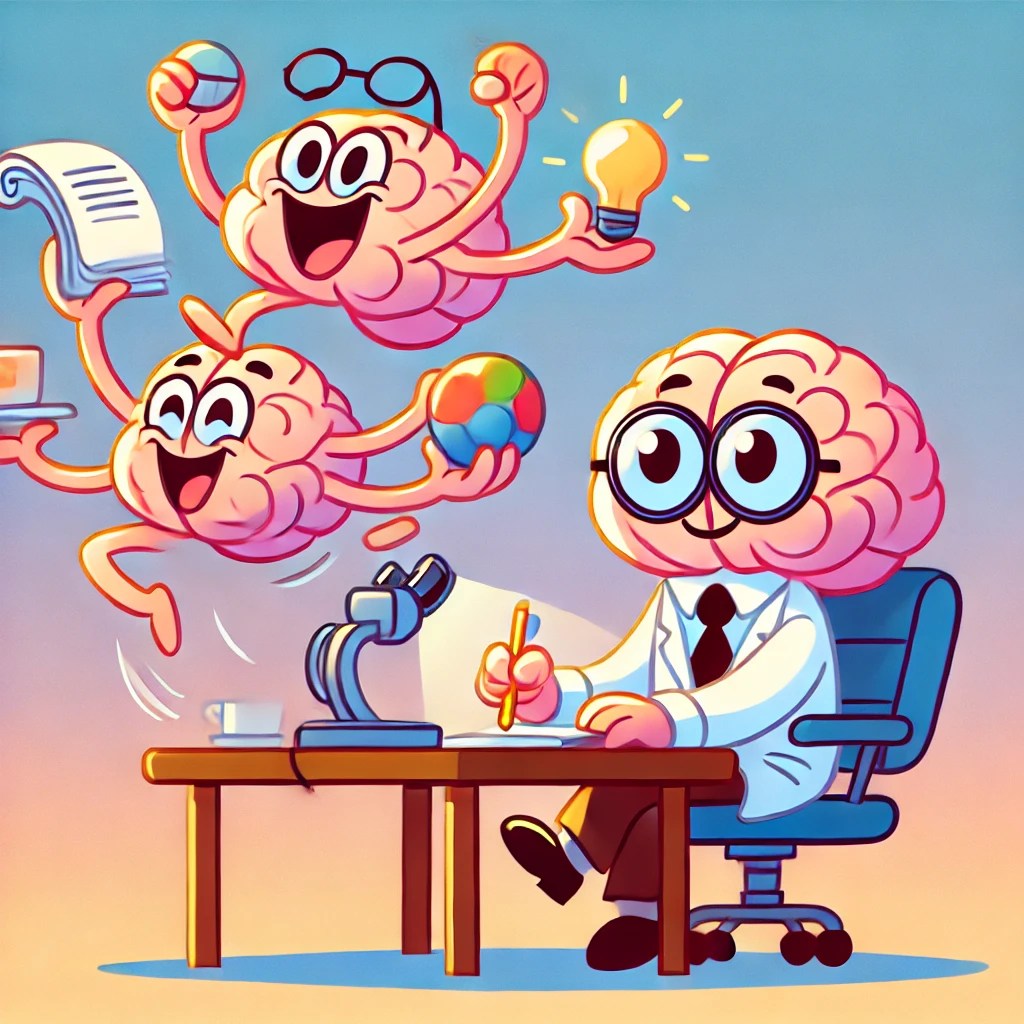
[Written with help from ChatGPT]
Thinking is one of the most fascinating aspects of being human. We all experience the constant stream of thoughts in our minds, but where do these thoughts come from? Are they deliberate creations of our conscious mind, or do they emerge from the shadows of the unconscious, bubbling up like ideas we didn’t even know we had?
Where Do Thoughts Come From?
Thoughts appear to originate from the intricate dance between the conscious and unconscious parts of the brain. Unconscious thinking operates in the background, handling tasks without us even realizing it—like recognizing a face, interpreting body language, or pulling up a gut feeling when making a quick decision. Conscious thinking, on the other hand, is deliberate and focused, like solving a math problem or planning a weekend trip.
This interplay between the two forms of thinking is driven by both external stimuli (like reacting to a sudden loud noise) and internal motivations (like planning your future). Thoughts arise from neural networks in the brain, combining sensory input, memories, emotions, and imagination. Sometimes it feels like we’re the conductor of this orchestra, but often, the unconscious may be the real maestro.
Categories of Thinking
Thinking can be categorized into distinct types, some of which are uniquely human, while others are shared with animals. Here’s a table that categorizes some of these types of thinking, their brain regions, their functions, and whether they are predominantly language-based:
What’s Uniquely Human?
Some types of thinking are deeply tied to language, making them largely unique to humans. Critical thinking, abstract thinking, and scientific reasoning rely heavily on our ability to use symbols and logic, something animals don’t do. For example, we can imagine “what if” scenarios or develop complex theories, thanks to our advanced prefrontal cortex.
But not all thinking needs language. Animals exhibit remarkable non-language-based thinking, like spatial navigation (bees finding their way to the hive), emotional reasoning (elephants mourning their dead), and even tool use (crows bending wires to access food). These are examples of the unconscious mind at work, operating quickly and efficiently in ways that parallel our own System 1 thinking.
Fast vs. Slow Thinking
Daniel Kahneman’s concepts of System 1 and System 2 provide a useful framework to understand the difference between fast thinking and slow thinking:
- System 1 (Fast Thinking):
This is unconscious, automatic, and instinctive. It’s multithreaded, meaning it can handle multiple processes at once. For example, when you’re driving a familiar route, you don’t consciously think about every turn—System 1 handles it. - System 2 (Slow Thinking):
This is deliberate, effortful, and conscious. It’s single-threaded, meaning you can only focus on one complex task at a time. For instance, solving a challenging math problem requires System 2. Its limitation comes from its dependency on working memory and its high energy consumption, which makes it slower and less efficient.
The unconscious mind is generally more efficient than the conscious mind in terms of speed, capacity, and energy usage. However, this efficiency comes at the cost of precision, deliberate control, and introspection. Here’s an in-depth comparison to understand why the unconscious is more efficient and where the conscious mind holds its advantage:
Why the Unconscious Mind Is More Efficient
- Parallel Processing:
- The unconscious mind is multithreaded, meaning it can process multiple streams of information simultaneously.
- Example: While walking down a busy street, your unconscious processes visual data, monitors sound, and maintains your balance—all at once.
- Speed:
- It operates automatically and rapidly, making decisions or triggering responses in milliseconds.
- Example: Dodging a ball headed your way happens without conscious thought, leveraging reflexes and instinct.
- Energy Efficiency:
- The unconscious consumes far less energy than the conscious mind.
- Conscious thinking, especially deliberate reasoning, places a heavy metabolic demand on the prefrontal cortex.
- Automation of Learned Behaviors:
- Repeated tasks are stored in the unconscious as habits, freeing the conscious mind for novel challenges.
- Example: Driving a familiar route without needing to think about every turn.
- Pattern Recognition:
- The unconscious excels at recognizing patterns, even when they are subtle or incomplete.
- Example: Instinctively sensing someone’s mood based on tone and body language.
Limitations of the Unconscious Mind
- Prone to Bias:
- Its reliance on heuristics (mental shortcuts) can lead to errors or biases, like stereotyping or impulsive decisions.
- Example: Misjudging someone’s intent based on limited information.
- Lack of Flexibility:
- While it’s fast, the unconscious struggles with complex or unfamiliar tasks requiring innovation or abstraction.
- Limited Self-Awareness:
- The unconscious operates without introspection or the ability to question its own processes.
Why the Conscious Mind Is Less Efficient
- Single-Threaded:
- Conscious thought operates sequentially, focusing on one task at a time.
- Example: Solving a math problem requires full attention, making it hard to focus on anything else.
- Limited Working Memory:
- Conscious thought relies on working memory, which has a limited capacity (e.g., the ability to hold 5–9 pieces of information simultaneously).
- Slow Processing:
- Conscious reasoning is deliberate and methodical, prioritizing accuracy over speed.
- Example: Planning a vacation involves considering multiple options step by step.
- High Energy Demand:
- Engaging in conscious thinking drains more energy (i.e., consumes substantial glucose during focused tasks. This energy consumption also generates heat and managing this heat is a challenge due to the brain’s limited ability to dissipate it).
Strengths of the Conscious Mind
- Deliberate Control:
- It allows for intentional and controlled decision-making, overriding unconscious biases when necessary.
- Example: Choosing to apologize despite an instinctive defensive reaction.
- Complex Problem-Solving:
- The conscious mind excels in tasks requiring logical reasoning, abstraction, and creativity.
- Example: Designing a new product or crafting a philosophical argument.
- Self-Reflection:
- The conscious mind enables self-awareness, introspection, and metacognition.
- Example: Questioning your own assumptions or evaluating past decisions.
The Complementary Roles of Conscious and Unconscious Thinking
- The unconscious mind acts as the autopilot, handling routine tasks and quick decisions efficiently.
- The conscious mind steps in as the problem-solver, tackling novel or complex challenges that require deliberate thought.
Enhancing Conscious Processing
While our unconscious mind has evolved for speed and efficiency, conscious thinking (System 2) has room for improvement with respect to both metrics. Here are some strategies:
- Train and Delegate:
- With practice, some System 2 tasks can become automatic and move into System 1. For example, learning to type without looking at the keyboard frees up your conscious mind for other tasks.
- Cognitive Tools:
- Use external tools like to-do lists, calculators, and mind maps to offload mental tasks. This mimics a kind of “external multithreading.”
- Meditation and Focus Training:
- Techniques like mindfulness meditation can improve focus and reduce cognitive overload, helping you use System 2 more effectively.
- Technical Interventions:
- Brain-Computer Interfaces (BCIs) hold promise for expanding human cognitive capacity. In the future, BCIs could enhance working memory, enable multitasking, and integrate AI to assist with complex reasoning.
The Future of Thinking
To truly enhance conscious thinking, significant progress in neuroscience and technology is needed. Innovations like BCIs or biochemical interfaces could help overcome the limitations of single-threaded conscious thought, creating possibilities for multithreaded System 2 thinking. Imagine being able to simultaneously analyze data, plan a project, and compose an email—all without breaking a sweat.
Until then, our conscious and unconscious minds will continue to work together, each playing its part in shaping our thoughts, actions, and the unique experience of being human.
What are your thoughts? Perhaps they’ve already started bubbling up from your unconscious!
 UpLive.Life
2 thoughts on “Exploring the Mystery of Conscious and Unconscious Thinking”