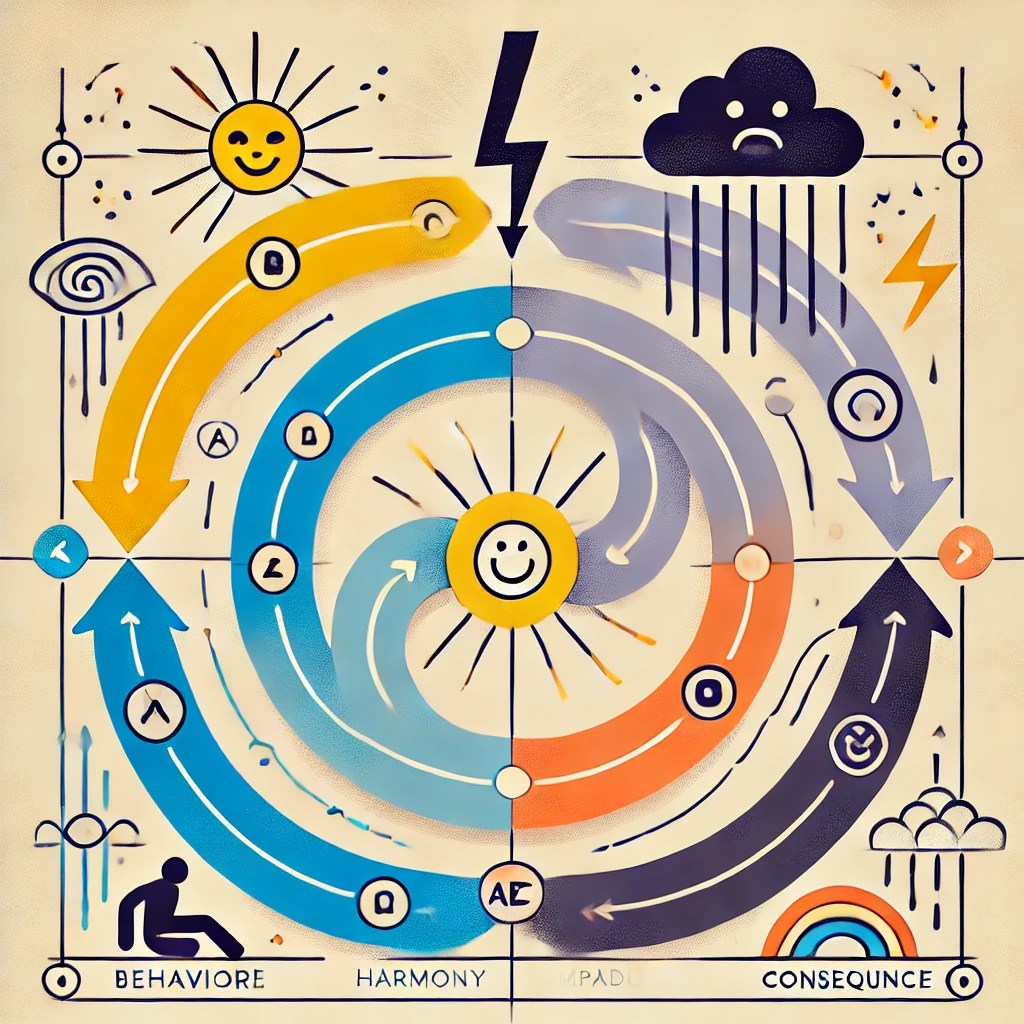
(Or how humanity pieced together the secret to living better: Actions + Behaviors = Consequences)
A few years ago, I took an emotion management class where I was introduced to the ABC model. It seemed simple enough: actions (or events) happen, our behavior shapes how we respond, and those responses lead to consequences. At the time, I somehow got it into my head that Stephen Covey came up with this idea—probably because of that famous story about him on a train:
Covey is on a train, and two kids are running wild while their father just stares blankly out the window. Irritated, Covey finally snaps and says, “Can’t you control your kids? They’re disturbing everyone.” The father looks up and, with quiet sorrow, says, “I’m so sorry. We just came from the hospital… their mother died an hour ago.” Suddenly, Covey’s perspective shifts. He realizes the father isn’t indifferent—he’s overwhelmed with grief.
I assumed this epiphany was the birth of the ABC model: how the activating event (A) of noisy kids led to Covey’s reactive behavior (B) and a regrettable consequence (C)—until he reframed his understanding. Turns out, I was wrong. The ABC model has a far richer history, shaped by centuries of philosophical, psychological, and even spiritual teachings.
[Written by ChatGPT]
Ancient Beginnings: Karma, Stoics, Taoists, the Bible, and the Qur’an
Long before modern psychology formalized the ABC model, ancient wisdom laid its foundation across cultures and faiths.
- India, 6th Century BCE: The Buddha taught that suffering is rooted in craving and aversion. His teachings on karma explained how actions (A) lead to results (C), and mindfulness (B) bridges the gap. Thoughtful behavior today shapes your destiny tomorrow.
- China, 6th Century BCE: Around the same time, Laozi, founder of Taoism, wrote the Tao Te Ching. He taught that responding (B) to life’s challenges (A) in harmony with the Tao leads to peace (C).
- Greece, 341–270 BCE: Epicurus, the philosopher of pleasure, stressed the importance of foreseeing the consequences (C) of our actions (A) and behaving (B) wisely to minimize pain and maximize long-term happiness. Epicureanism emphasized measured choices, not indulgence, to shape positive outcomes.
- Rome, 2nd Century CE: The Stoics, including Epictetus (55–135 CE) and Marcus Aurelius (121–180 CE), echoed similar ideas. Marcus’s Meditations remind us, “You have power over your mind—not outside events. Realize this, and you will find strength.” Stoicism emphasized controlling your behavior (B) in response to life’s challenges (A) to achieve better outcomes (C).
- The Bible: Across centuries, the Bible reinforced the relationship between actions, behavior, and consequences.
- Galatians 6:7: “Do not be deceived: God cannot be mocked. A man reaps what he sows.” This is an ABC framework in essence—your actions (A) and behaviors (B) dictate what you harvest (C).
- The Qur’an, 7th Century CE: The Qur’an adds a spiritual dimension to the ABC model, emphasizing personal accountability, intentions, and long-term consequences.
- “Whoever does an atom’s weight of good will see it, and whoever does an atom’s weight of evil will see it.” (Qur’an, 99:7-8)
This ties directly into the idea that behaviors (B) shape the consequences (C), both in this life and the hereafter. - “Indeed, Allah will not change the condition of a people until they change what is in themselves.” (Qur’an, 13:11)
This verse reinforces the ABC principle: changing your behavior (B) can reshape your life (C), no matter the challenges you face (A).
- “Whoever does an atom’s weight of good will see it, and whoever does an atom’s weight of evil will see it.” (Qur’an, 99:7-8)
2. The Serenity Prayer’s Modern Wisdom
- United States, 1930s: Reinhold Niebuhr, a theologian, penned the Serenity Prayer, distilling the ABC model into a timeless spiritual guide:
- “God, grant me the serenity to accept the things I cannot change, courage to change the things I can, and wisdom to know the difference.”
- This directly addresses the ABC process: The activating event (A) is often out of your control, but your behavior (B)—choosing serenity or courage—determines the outcome (C).
3. Shakespeare’s Drama and Cognitive Insight
- England, 1600s: William Shakespeare (1564–1616) had an intuitive grasp of the ABC model, as seen in Hamlet. When Hamlet says, “There is nothing either good or bad, but thinking makes it so,” he highlights how our interpretation (B) of events (A) determines emotional and practical outcomes (C). His plays are essentially case studies of the model, though often with tragic endings.
4. The Age of Reason: Cause and Effect Get Scientific
- Scotland, 1700s: Enlightenment thinkers like John Locke (1632–1704) and David Hume (1711–1776) analyzed cause and effect, emphasizing how experiences shape responses. Their work planted seeds for later behavioral theories by focusing on how past events (A) shape beliefs and behaviors (B), influencing future outcomes (C).
5. Modern Psychology Formalizes the ABCs
- United States, 20th Century: Modern psychology took these age-old ideas and gave them structure:
- B.F. Skinner (1904–1990): As a pioneer of operant conditioning, Skinner proved that behavior (B) directly influences consequences (C). By reinforcing positive actions, he formalized how we can shape outcomes through thoughtful responses.
- Albert Ellis (1913–2007): Building on this, Ellis introduced the ABC Model of Emotion in Rational Emotive Behavior Therapy (REBT). He argued that irrational beliefs (B) about events (A) are the root of emotional distress, and disputing these beliefs can lead to healthier outcomes (C).
- Victor Frankl (1905–1997): In his book Man’s Search for Meaning, Frankl demonstrated the ABC model in action: even when enduring the horrors of concentration camps (A), how he chose to think and respond (B) gave him a sense of purpose and hope (C). His famous line, “Between stimulus and response, there is a space. In that space lies our power to choose our response,” is pure ABC wisdom.
6. The Montessori Method and Childhood Learning
- Italy, 1900s: Maria Montessori (1870–1952) revolutionized education by applying the ABC model to childhood learning. She emphasized giving children the freedom to experience natural consequences (C) of their actions (A), teaching them self-regulation (B) in a supportive environment. For example, if a child spills water, they learn to clean it up themselves, reinforcing the behavior-consequence connection.
7. The Self-Help Revolution
- United States, 1989: Stephen Covey (1932–2012) brought the ABC model to the mainstream in The 7 Habits of Highly Effective People. Covey’s famous train story—where he snaps at a grieving father for letting his kids run wild—illustrates the importance of reframing your response (B) to better understand the consequences (C). Covey didn’t invent the model, but he made it practical and accessible.
8. Today: ABC Meets the Digital Age
In the 21st century, the ABC model thrives in therapy, education, and self-help. Mindfulness apps, leadership training, and emotional intelligence courses all teach us to pause, reflect, and choose behaviors (B) that lead to positive consequences (C).
Conclusion
The ABC model didn’t spring from one thinker or era—it’s a tapestry woven from Buddhism, Taoism, Stoicism, the Bible, the Qur’an, Epicureanism, Montessori education, modern psychology, and the Serenity Prayer. Each tradition contributed insights into how actions (A), behaviors (B), and consequences (C) shape our lives.
The challenge isn’t understanding it—it’s living it. So next time life throws you an activating event, pause and remember: the ABC model is your roadmap to thoughtful action and better outcomes. Choose wisely!
Why Is It So Hard to Apply
While the ABC model seems simple and intuitive, there are several reasons why applying it in real life can be a challenge:
1. Emotional Hijacking
- When we’re in the heat of the moment, emotions often take over, bypassing rational thought. This “fight, flight, or freeze” response can make it difficult to pause and think through the ABC model.
- Example: In a road rage incident, anger might surge so quickly that a person reacts impulsively, rather than considering the consequences.
2. Lack of Awareness
- Many people aren’t consciously aware of the thought processes driving their behavior. Beliefs (the “B” in the ABC model) often operate on autopilot, shaped by past experiences or habits.
- Example: Someone might lash out without realizing their belief is, “If I don’t stand up for myself, people will think I’m weak.”
3. Cognitive Distortions
- People often hold irrational beliefs or fall into cognitive traps like catastrophizing, mind-reading, or black-and-white thinking. These distortions make it harder to dispute unhelpful thoughts and adopt constructive behaviors.
- Example: “They cut me off because they hate me!” (mind-reading) leads to anger, not reflection.
4. Social and Cultural Norms
- In some contexts, emotional reactions are normalized or even rewarded. Expressing anger, for instance, might be seen as strength in one culture but as irrational in another. These norms shape whether people feel empowered to choose their behaviors.
5. Instant Gratification vs. Long-Term Thinking
- Consequences (C) are often delayed or indirect, whereas the reward for impulsive behavior can feel immediate.
- Example: Yelling at someone feels satisfying in the moment but damages relationships over time.
6. Habitual Responses
- Over time, certain behaviors become ingrained and automatic. Breaking these habits requires conscious effort, which the ABC model promotes but doesn’t guarantee.
- Example: A person might always respond to criticism defensively without considering the root of their reaction.
7. Lack of Practice and Tools
- Applying the ABC model requires practice, reflection, and often external guidance, like journaling or therapy. Without regular use, the model remains theoretical.
- Example: A person might know the model but forget to use it in high-stress situations.
8. Unseen Beliefs and Biases
- The “B” in the ABC model—our beliefs—are often shaped by unconscious biases or deep-seated values. These can be hard to identify, let alone change, without self-awareness or support.
- Example: A belief like “I must be perfect” might underlie feelings of inadequacy, but the person may not even recognize it.
How to Overcome These Challenges
- Mindfulness Training: Developing awareness of thoughts and emotions can help pause reactions and apply the model.
- Practice and Reflection: Journaling or therapy can help identify patterns in beliefs and behaviors.
- Dispute Beliefs Regularly: Use the ABCDE extension to challenge unhelpful thoughts and replace them with constructive ones.
- Build Emotional Regulation: Learn techniques like deep breathing or grounding to prevent emotional hijacking.
- Celebrate Progress: Acknowledge small wins when you successfully apply the model to build confidence.
In essence, while the ABC model is conceptually simple, applying it in real life requires emotional awareness, mental effort, and practice—all of which can be hard to cultivate, especially in stressful situations.
From “Caveman OS” to “Modern OS”
1. Evolution’s Priorities Are Different
- The human brain evolved to ensure survival, not to make us emotionally wise or calm. The amygdala, the part of the brain responsible for fear and anger, is still primed to react instantly to threats—like a predator lurking in the bushes.
- Problem: Modern stressors (like an email from your boss or someone cutting you off in traffic) aren’t life-threatening, but our brains still treat them as emergencies.
- Outcome: We act impulsively before our rational brain (the prefrontal cortex) gets a chance to chime in.
2. The Bias Toward Short-Term Gains
- Evolution favored immediate gratification because it meant survival—eating food now, avoiding danger now. Long-term thinking wasn’t as critical for survival in prehistoric times.
- Modern Problem: We struggle to pause and think about the long-term consequences of our actions (like damaging a relationship by snapping at someone) because our brains are wired to focus on the here and now.
3. Cognitive Shortcuts (Heuristics)
- The brain uses shortcuts to save energy. While efficient, these shortcuts can lead to automatic, unexamined responses, like snapping at someone when angry.
- Example: Instead of analyzing “Why am I upset?” we jump straight to behavior, skipping the critical “belief” step in the ABC model.
4. Emotional Responses Are Faster Than Rational Thought
- Emotional responses are nearly instantaneous, while rational thought takes time. This lag means that by the time your rational brain decides, “Wait, maybe I shouldn’t yell,” you might have already yelled.
- The Struggle: Wisdom requires deliberate thought, but emotion often wins the race.
5. Unconscious Beliefs Run the Show
- Much of our behavior stems from unconscious beliefs and biases formed over time. These beliefs operate in the background, influencing how we react, without us even realizing it.
- Example: A belief like “People are out to get me” might trigger anger in minor situations, but you may not even notice that belief shaping your behavior.
6. Stress and Overload
- In today’s world, we’re bombarded with stimuli and responsibilities. Chronic stress diminishes the brain’s ability to regulate emotions and apply thoughtful frameworks like the ABC model.
- Result: Under stress, we fall back on instinctive, less thoughtful reactions.
7. Wisdom Requires Effort
- Applying wisdom, like the ABC model, demands conscious effort and practice. Unfortunately, our brains prefer to save energy and stick with old habits unless we deliberately retrain them.
The Good News: The Brain Can Catch Up
Thanks to neuroplasticity, the brain can learn and adapt with practice. Here’s how we can help our brains align with the wisdom of the ABC model:
- Mindfulness Practices: Train your brain to notice triggers and pause before reacting.
- Emotional Regulation: Develop tools like deep breathing to calm the amygdala before it hijacks your actions.
- Repetition and Reflection: Regularly apply the ABC model in small, low-stakes situations to build a habit.
- Cognitive Workouts: Journaling or therapy can help uncover unconscious beliefs and rewire them for better responses.
- Self-Compassion: Acknowledge that rewiring a survival-driven brain takes time and effort.
So yes, our brain hasn’t fully caught up with the wisdom of the ABC model, but with intentional effort, we can nudge it toward greater emotional intelligence and control. Think of it as upgrading your “caveman OS” to a “modern mindfulness OS.”
 UpLive.Life