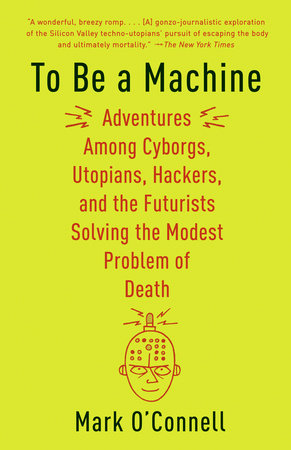
For years, I thought I was the lone weirdo harboring the dream of living forever—healthy, of course. Imagine my surprise when I discovered an entire community of people who not only share that dream but are actively working to make it a reality, transcending humanity itself. Enter the transhumanists, the fascinating subject of To Be a Machine by Mark O’Connell.
While I can’t say the book gave me much hope of achieving immortality—whether as carbon-based, silicon-based, or even a virtual being—it was an engrossing read nonetheless. O’Connell’s exploration of this strange and ambitious world introduced me to a cast of characters who are, quite frankly, way crazier than I am. Their bold ideas, quirky experiments, and relentless optimism make for a thought-provoking and wildly entertaining journey into the future (or at least their version of it).
[Written by ChatGPT]
To Be a Machine by Mark O’Connell is filled with wry humor and quirky anecdotes that showcase the eccentricity of the transhumanist community. Here are a few notable and humorous examples:
- Max More’s Cryonics Facility
O’Connell visits Alcor, a cryonics facility in Arizona, where bodies (or just heads) are preserved in liquid nitrogen with the hope of future revival. The scene is both absurd and oddly touching as he observes severed heads stored in metal cylinders like a sci-fi horror film. O’Connell humorously describes the earnest optimism of staff who casually talk about waking up centuries later, as though discussing vacation plans. - Zoltan Istvan’s “Immortality Bus”
O’Connell spends time with Zoltan Istvan, a transhumanist advocate who campaigns for immortality by driving a modified bus shaped like a coffin across America. The coffin-shaped bus is both a symbol of defiance against death and a PR stunt. O’Connell describes the awkward absurdity of Istvan’s attempts to gain attention, such as staging funerals for mortality while trying to explain his philosophy to bemused onlookers. - The Robotic Jesus
In a discussion about religion and technology, one transhumanist suggests creating a robotic version of Jesus to better understand spirituality in the age of machines. The suggestion is delivered with complete seriousness, but O’Connell’s bemused reaction underscores the absurdity of trying to mechanize divinity. - Meeting DIY Biohackers
O’Connell recounts visiting biohackers who experiment with implanting devices in their own bodies. One man demonstrates a chip in his hand that opens his front door, proudly showing off this “superpower.” The author dryly notes the lengths these people will go to for minor conveniences, like saving a few seconds by not using a key. - The Cult of the Singularity
At a conference on artificial intelligence, O’Connell listens to attendees seriously debate when humanity will achieve the “Singularity” (the moment AI surpasses human intelligence). He humorously compares the fervor of their predictions to a doomsday cult forecasting the apocalypse—except instead of fear, they are zealously optimistic about becoming digital gods.
Why They’re Funny:
O’Connell’s humor stems from his ability to find the humanity in these extreme pursuits, juxtaposing their grandiose ambitions with their everyday quirks and oddities. His dry, self-aware narration highlights the gap between lofty transhumanist ideals and the often comically mundane or bizarre realities of their efforts.
Author
The author of To Be a Machine is Mark O’Connell, an Irish writer and journalist. O’Connell is known for his engaging and witty writing style, which often blends humor with deep philosophical inquiry. His works have appeared in various esteemed publications, including The New Yorker, The Guardian, and Slate.
To Be a Machine won the 2018 Wellcome Book Prize and was also shortlisted for the Baillie Gifford Prize. It showcases O’Connell’s talent for exploring complex ideas—such as transhumanism—in an accessible, thought-provoking, and often humorous way.
Prominent Transhumanists
Prominent transhumanists are individuals who advocate for using technology to transcend human biological limitations, particularly mortality and physical constraints. Here are some of the key figures:
1. Ray Kurzweil
- Profession: Inventor, futurist, and author.
- Key Contributions:
- Author of The Singularity Is Near, where he predicts the merging of humans and machines through AI advancements.
- Popularized the concept of the “Singularity,” the moment when AI surpasses human intelligence.
- Currently works at Google, focusing on machine learning and natural language processing.
- Vision: Believes humans will achieve immortality by transferring consciousness to machines by the mid-21st century.
2. Nick Bostrom
- Profession: Philosopher and Director of the Future of Humanity Institute at Oxford University.
- Key Contributions:
- Author of Superintelligence: Paths, Dangers, Strategies, a foundational book on the risks and possibilities of AI.
- Explores existential risks to humanity from advanced technologies.
- Vision: Advocates cautious and ethical development of technologies to ensure a positive future for humanity.
3. Max More
- Profession: Philosopher and CEO of Alcor Life Extension Foundation.
- Key Contributions:
- Coined the term “transhumanism” in its modern context.
- Advocates for cryonics as a way to preserve the body until future technologies can revive and cure individuals.
- Vision: Emphasizes personal responsibility and technological solutions to extend human lifespan.
4. Zoltan Istvan
- Profession: Author, speaker, and political activist.
- Key Contributions:
- Ran for U.S. President in 2016 under the “Transhumanist Party” to raise awareness of transhumanist goals.
- Author of The Transhumanist Wager, a novel exploring the philosophical underpinnings of transhumanism.
- Vision: Advocates for government support of technologies aimed at enhancing and extending human life.
5. Aubrey de Grey
- Profession: Biomedical gerontologist and founder of the SENS Research Foundation.
- Key Contributions:
- Focuses on reversing aging by repairing cellular damage.
- Coined the concept of “longevity escape velocity,” where life expectancy increases faster than time passes.
- Vision: Believes aging is a curable disease and works on therapies to extend human lifespans indefinitely.
6. Natasha Vita-More
- Profession: Designer, theorist, and academic.
- Key Contributions:
- Focuses on human enhancement technologies and their cultural implications.
- Co-authored The Transhumanist Reader, a foundational text for the movement.
- Vision: Explores how aesthetics and design can shape the future of enhanced humans.
7. Elon Musk
- Profession: Entrepreneur and CEO of companies like Tesla, SpaceX, and Neuralink.
- Key Contributions:
- Co-founded Neuralink, a company developing brain-computer interfaces to enhance cognition and combat neurological diseases.
- Advocates for creating safe artificial intelligence to avoid existential risks.
- Vision: Views transhumanist technologies as necessary for human survival, particularly in colonizing space.
8. Anders Sandberg
- Profession: Researcher at the Future of Humanity Institute at Oxford University.
- Key Contributions:
- Works on brain emulation, ethics, and the societal implications of human enhancement.
- Vision: Believes brain uploading and advanced neural interfaces will allow humans to transcend biological limits.
These figures collectively drive the conversation around transhumanism, each contributing unique perspectives and approaches to achieving the movement’s ambitious goals.
 UpLive.Life
One thought on “Book Club: To Be a Machine: Adventures Among Cyborgs, Utopians, Hackers, and the Futurists Solving the Modest Problem of Death”