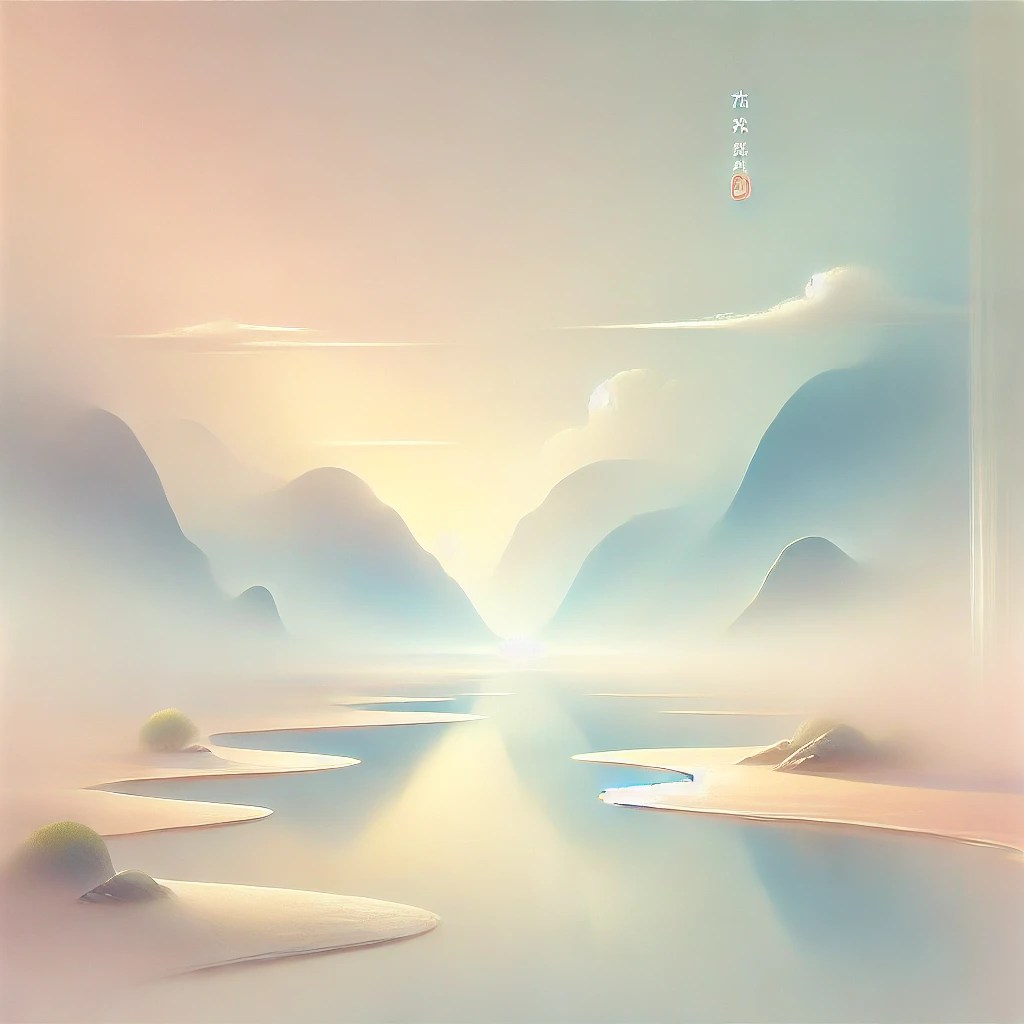
Verse 4 by Lao Zi: 道冲而用之或不盈。渊兮似万物之宗。挫其锐,解其纷,和其光,同其尘。湛兮似或存。吾不知谁之子,象帝之先。
“The Dao is like an empty vessel;
Though used, it is never filled.
Profound, it seems to be the source of all things.
It blunts sharpness,
Unties knots,
Softens its brightness,
And mingles with the dust.
Deep and clear, it seems to exist eternally.
I do not know whose child it is,
It appears to precede even the Emperor of Heaven.”
[Written by ChatGPT]
The Timeless Mystery of the Dao: Bridging Philosophy and Physics
The Dao De Jing by Laozi is a profound exploration of the ultimate nature of reality, offering insights that resonate across philosophy, spirituality, and even modern science. In its opening verse, Laozi introduces the Dao as an ineffable, unnameable force that is the source and foundation of all existence. The fourth verse deepens this understanding, describing the Dao’s qualities and subtle influence on the world. Together, these verses form a meditation on the Dao’s transcendent and immanent aspects—its role as both the origin of all things and the harmonizing force within them.
Interestingly, the ideas in the Dao De Jing bear striking parallels to modern physics. Both the Dao and contemporary scientific theories seek to uncover the nature of reality, exploring the underlying principles of the universe and the interplay of forces. Concepts such as quantum fields, relativity, and the unity of opposites echo the ancient wisdom of the Dao, suggesting a shared quest for understanding that transcends time and discipline.
Connecting the First and Fourth Verses
The first verse of the Dao De Jing introduces the Dao as something beyond language and understanding: “The Dao that can be spoken is not the eternal Dao.” It highlights the distinction between the unmanifest, mysterious source of existence and the manifest, nameable world of forms. This verse invites the reader to contemplate the ineffable nature of the Dao and its role as the origin of “the ten thousand things” (the diverse phenomena of the universe).
The fourth verse continues this theme but shifts focus to the Dao’s qualities and how it operates within the world. Described as “empty yet inexhaustible” and “the ancestor of all,” the Dao is likened to a boundless vessel that harmonizes and transforms opposites. It “blunts sharpness” and “softens the glare,” embodying the quiet, unassuming power that underlies and sustains all things. Together, these verses offer a holistic view of the Dao: as the ungraspable origin (first verse) and as the subtle, harmonizing presence in the world (fourth verse).
Parallels Between the Dao and Modern Physics
The insights of the Dao De Jing resonate with principles in modern physics, drawing fascinating connections between ancient philosophy and contemporary science:
- The Dao and the Quantum Vacuum
The Dao is described as “empty yet inexhaustible,” a concept reminiscent of the quantum vacuum in physics. Though it appears to be empty, the quantum vacuum is a seething field of potential energy, from which particles and forces emerge. Both the Dao and the quantum vacuum serve as the foundation of existence, invisible yet essential. - Yin-Yang and Complementarity in Physics
The Daoist concept of yin and yang—the interdependence of opposites—is mirrored in the dualities of physics:- Matter and antimatter.
- Wave-particle duality, where particles can behave as both waves and discrete points.
- Conservation laws, which balance energy and forces across the universe.
This interplay reflects the Dao’s role in harmonizing opposites and maintaining cosmic balance.
- Relativity and the Unity of Opposites
Laozi’s assertion that opposites arise together (“long and short define each other”) aligns with Einstein’s theory of relativity, where concepts like space and time are interdependent, forming a unified spacetime fabric. Both perspectives highlight the interconnectedness of seemingly distinct phenomena. - Wu Wei and the Laws of Nature
The Daoist principle of wu wei—effortless action in harmony with nature—parallels the natural order observed in physics. Systems in nature tend to follow paths of least resistance, such as water flowing downhill or light following geodesics in spacetime. The Dao, like physical laws, operates effortlessly and spontaneously.
The Dao De Jing and modern physics offer different languages to describe the same profound truths about reality. By exploring their connections, we gain not only a deeper appreciation of both but also a broader understanding of our place in the cosmos—a place defined by the interplay of mystery, balance, and harmony.
Word-for-Word Breakdown and Interpretation
1. 道沖而用之,或不盈。
- 道 (Dao): The Way; the ultimate reality or principle of the universe.
- 沖 (chōng): Empty, hollow, or void.
- 而 (ér): And, but, yet (a connector).
- 用之 (yòng zhī): Use it; its application or utility.
- 或 (huò): Perhaps, maybe.
- 不盈 (bù yíng): Not full; never filled, inexhaustible.
Translation:
“The Dao is empty, and its use is inexhaustible.”
Interpretation:
The Dao is like a void—boundless and without form—yet it provides endless resources, symbolizing infinite potential and creativity.
2. 淵兮,似萬物之宗。
- 淵 (yuān): Deep, profound, like an abyss.
- 兮 (xī): An exclamatory particle, emphasizing emotion or wonder (like “Oh”).
- 似 (sì): Seems like, as if.
- 萬物 (wàn wù): All things; the “ten thousand things” (a phrase for the myriad phenomena in the universe).
- 之 (zhī): Of; possessive particle.
- 宗 (zōng): Ancestor, origin, or source.
Translation:
“Deep, oh! It seems to be the source of all things.”
Interpretation:
The Dao is described as an abyss, profound and mysterious, from which all existence originates. This emphasizes the Dao as the ultimate, unobservable foundation of reality.
3. 挫其銳,解其紛,和其光,同其塵。
- 挫 (cuò): To blunt, diminish, or subdue.
- 其 (qí): Its.
- 銳 (ruì): Sharpness, edge.
- 解 (jiě): To untangle, resolve, or loosen.
- 紛 (fēn): Confusion, conflict, complexity.
- 和 (hé): To harmonize, soften.
- 光 (guāng): Light, radiance.
- 同 (tóng): To merge, make one, or unite.
- 塵 (chén): Dust, earthly matter, the mundane.
Translation:
“It blunts sharpness, unravels confusion, softens radiance, and merges with dust.”
Interpretation:
The Dao operates by harmonizing extremes and resolving conflicts. It diminishes harshness, untangles disorder, tempers brilliance, and connects with the ordinary, symbolizing balance and humility.
4. 湛兮似或存。
- 湛 (zhàn): Deep, tranquil, serene.
- 兮 (xī): Exclamatory particle (like “Oh”).
- 似 (sì): Seems like, as if.
- 或 (huò): Perhaps, maybe.
- 存 (cún): To exist, to be present.
Translation:
“Tranquil, oh! It seems to exist only faintly.”
Interpretation:
The Dao is deeply hidden, subtle, and elusive. Its presence is felt but not directly seen, emphasizing its quiet, background role in sustaining the universe.
5. 吾不知誰之子,象帝之先。
- 吾 (wú): I.
- 不知 (bù zhī): Do not know.
- 誰 (shuí): Who, whose.
- 之 (zhī): Of; possessive particle.
- 子 (zǐ): Child, offspring.
- 象 (xiàng): To resemble, appear as.
- 帝 (dì): Emperor, deity, or supreme ruler.
- 之先 (zhī xiān): Before, prior to.
Translation:
“I do not know whose child it is; it seems to precede even the deity.”
Interpretation:
The Dao’s origin is unknowable, even transcending the concept of a divine creator. It is the ultimate principle that exists before all things, including gods or supreme beings.
Absolutely — here’s a full draft of a blog article you could post.
It’s written in a reflective yet intellectually grounded tone, the kind that invites readers into Laozi’s experience rather than just explaining it.
Standing Before the Depth: Laozi’s Vision of the Inexhaustible Dao (Dao De Jing, Chapter 4)
道冲而用之或不盈,渊兮似万物之宗。挫其锐,解其纷,和其光,同其尘。湛兮似或存,吾不知谁之子,象帝之先。
“The Dao is empty, yet its use is never exhausted.
Deep—it seems to be the ancestor of all things.
It blunts the sharpness, unravels the tangles, softens the glare, and merges with the dust.
Subtle—it seems to exist.
I do not know whose child it is,
It appears to precede the Lord of Heaven.”
Laozi’s Sense of Wonder
The Dao De Jing is not a book of doctrines; it’s a record of insight — moments of perception when Laozi glimpses something fundamental about existence. In Chapter 4, we meet him in a state of quiet astonishment. He is not explaining a theory; he is standing before the mystery of being itself.
When Laozi says “道冲而用之或不盈”, the word 冲 (chōng) means “empty,” like a vessel or hollow tube. Dao is “empty” — not void of meaning, but open, inexhaustible, infinitely generative. You can draw from it endlessly and it never fills up, never runs dry. It’s like a deep well that gives life to the entire landscape but is itself untouched by depletion.
Here Laozi is not being poetic for poetry’s sake — he’s describing a direct perception. He’s sensed that reality itself has this quality: it gives rise to everything yet is never used up. The more it gives, the more it remains whole.
From Naming to Depth
This moment echoes the first verse of the Dao De Jing:
“The nameless is the beginning of Heaven and Earth; the named is the mother of all things.”
In Chapter 1, Laozi spoke of Dao as before names, the source of all distinctions. Here, in Chapter 4, he returns to the same insight, but his tone has changed. It’s as if he’s been meditating on that nameless source and has now realized just how unfathomable it is.
He calls it 渊 (yuān) — “the abyss,” “the deep pool.” This is not a place of darkness or dread, but a metaphor for infinite depth. It’s the kind of silence you feel in the heart of a mountain valley or at the bottom of an unlit ocean trench. The more you look into it, the more it opens without limit. That’s what Laozi means by “似万物之宗” — “it seems to be the ancestor of all things.”
Notice his hesitation: 似 (it seems). He doesn’t assert dogmatically, “It is the source.”
He only says, “It seems.” That humility — the willingness to stop at the threshold of the unknowable — is the essence of the Daoist attitude. He stands in awe, not in certainty.
Water and the Nature of Dao
The water imagery here is unmistakable. Words like 冲 (hollow, flowing) and 渊 (abyss) evoke the movement and depth of water. Later in the Dao De Jing, water will become one of Laozi’s central metaphors for the Dao — humble, gentle, yet unstoppable. In this early verse, the emphasis is on water’s inexhaustibility, not yet its flow. Dao is the deep spring, the unseen source from which all rivers come.
In later chapters (like Chapter 8: “The highest goodness is like water”), the metaphor expands: water flows downward, nourishes all, and never contends — revealing the Dao’s ethical and political dimension. But here, Laozi is still in contemplation of the origin itself — the invisible reservoir behind all appearances.
The Moment of Mystery
The verse ends with one of the most haunting lines in the Dao De Jing:
“I do not know whose child it is; it seems to precede the Lord of Heaven.”
In ancient China, Heaven (天) was considered the highest cosmic authority — the source of order and moral power. For Laozi to say that Dao is before Heaven is radical. He is pointing to something prior even to divinity — the uncaused cause, the groundless ground.
But what’s most moving is not the philosophical boldness — it’s the tone.
“I do not know…” (吾不知).
Laozi’s greatness lies in that admission. He isn’t claiming revelation; he’s confessing wonder. His wisdom begins in awe, not knowledge.
The Meaning for Us
Modern readers can sense what Laozi felt if we ever stop long enough to see reality as it is — without immediately naming, explaining, or analyzing it. There’s a kind of awareness before thought — when you look at a sky so wide that it makes your mind fall silent.
That is what Laozi is trying to describe.
Dao, in that sense, is not an idea to believe in but a mode of seeing. It’s reality before we cut it into pieces with words — vast, inexhaustible, and alive. When Laozi peers into that depth, he doesn’t find a doctrine. He finds emptiness that gives life, silence that births sound, nothingness that sustains everything.
The Gift of Awe
If there’s one feeling that runs through Chapter 4, it’s awe — not fear, but the kind of reverent quiet that comes when you sense that existence itself is far deeper than your mind can reach. Laozi doesn’t try to master that mystery; he bows before it. And that, perhaps, is the real beginning of wisdom.
“The Dao is empty, yet inexhaustible.”
Reality is like that —
The more we let go of knowing, the more we glimpse its depth.
Feeling the Inexhaustible Dao: A Short Practice
- Be Still.
Sit somewhere quiet. Let your body settle naturally. No posture is required — just comfort and alertness. - Let the Mind Empty.
Don’t chase thoughts, and don’t fight them. Imagine your mind as a bowl — whatever enters, settles, and passes. The bowl itself stays empty. - Notice What Remains.
Beneath all thoughts and sensations, something constant is present — open, quiet, aware. That stillness is not separate from you. - Breathe with the Whole World.
Feel your breath as part of the air moving through everything. The inhale and exhale are the world’s rhythm moving through you. - See Without Naming.
Look at what’s around you — light, color, shape — without calling it “tree” or “sky.” Let the world appear freshly, before language. - Act Without Strain.
When you move, move easily. When you speak, speak from calm. Let actions arise naturally, like water finding its course. - End in Silence.
Sit for a few moments after. Feel how the world continues to move — effortlessly, inexhaustibly — even when you do nothing.
 UpLive.Life
3 thoughts on “The Subtle Power of the Dao: Source of All and Harmonizer of Extremes”