[Written by Claude]
When we translate human lifespan into weeks, the math becomes startlingly clear: a 100-year life equals just 5,200 weeks. More sobering still is the reality that of those weeks, perhaps only 1,000 remain for me where I still have the vitality and health needed for more ambitious experiences. This finite arithmetic forces us to confront an uncomfortable truth: time, not money, is our scarcest resource.
The Time Value of Life
In finance, we understand the time value of money – a dollar today is worth more than a dollar tomorrow. Bill Perkins and Dr. Peter Attia’s discussion extends this concept to life experiences: a mountain climb at 35 holds vastly different value than the same climb at 70. This “time value of experiences” follows a curve that often peaks earlier than we’d like to admit.
Consider three distinct phases of life:
- Peak Physical Years (20-40) Here we possess maximum energy, resilience, and physical capability. These are our prime years for adventures that demand stamina and strength – hiking Machu Picchu, learning to surf, running marathons. Yet ironically, these are often the years we sacrifice entirely to career building.
- Family and Achievement Years (30-60) Our experience-making potential intersects with financial capability and family dynamics. These years offer unique opportunities for creating shared memories and investing in relationships. A family vacation when children are young yields decades of shared memories and stories.
- Wisdom Years (60+) While physical capabilities may decline, our capacity for meaningful connection and mentorship peaks. The challenge is arriving here with enough health to engage fully, and enough memories to share.
The Mathematics of Optimization
Understanding life as a finite set of weeks forces us to confront crucial questions:
- Are we saving experiences for a future that may never arrive with the health we imagine?
- How many peak physical years do we really have left?
- What experiences depreciate with age, and which appreciate?
The cruel irony is that we often delay our most ambitious plans until we have “enough” money, only to find we no longer have enough health or energy to enjoy them. This misalignment leads to what Perkins calls “dying too late” – reaching the end with unused potential for experiences.
Practical Optimization Strategies
- Front-Load Physical Adventures Don’t wait until retirement for experiences that demand peak physical condition. The memories from these adventures appreciate over decades.
- Invest in Health Each dollar and hour invested in health maintenance potentially buys more quality weeks at the end of life. This might be the highest-returning investment available to us.
- Optimize for Memory Creation Unique, novel experiences create stronger memories than routine luxuries. A challenging adventure creates stories and bonds that appreciate over decades.
- Balance Time Buckets Rather than saving everything for retirement, create a timeline of experiences optimal for different life stages. Some experiences should be scheduled for specific age ranges when they’ll deliver maximum value.
The Compound Interest of Experiences
Just as money compounds over time, so do experiences – but in reverse. Early experiences have decades to appreciate in value through memories, stories, and their influence on our life trajectory. A transformative travel experience at 25 might shape career choices, relationships, and worldview for decades to come.
Conclusion: The Urgency of Now
Understanding life in weeks creates healthy urgency. With perhaps only 1,000 healthy weeks remaining, every delayed experience represents a compound loss of potential value. This doesn’t mean abandoning prudence or financial planning, but rather optimizing for the total value of experiences across our remaining time.
The key insight from Perkins and Attia’s discussion isn’t just about spending money earlier – it’s about recognizing that time, health, and experiences follow different investment rules than money. While money can grow indefinitely, our capacity for certain experiences peaks and declines.
In the end, the mathematics of a finite life demands intentional choices about how we spend our remaining weeks. Each season of life offers unique opportunities that, once passed, may never return with the same potential for joy and meaning. The question isn’t just how to afford experiences, but how to time them for maximum lifetime value.
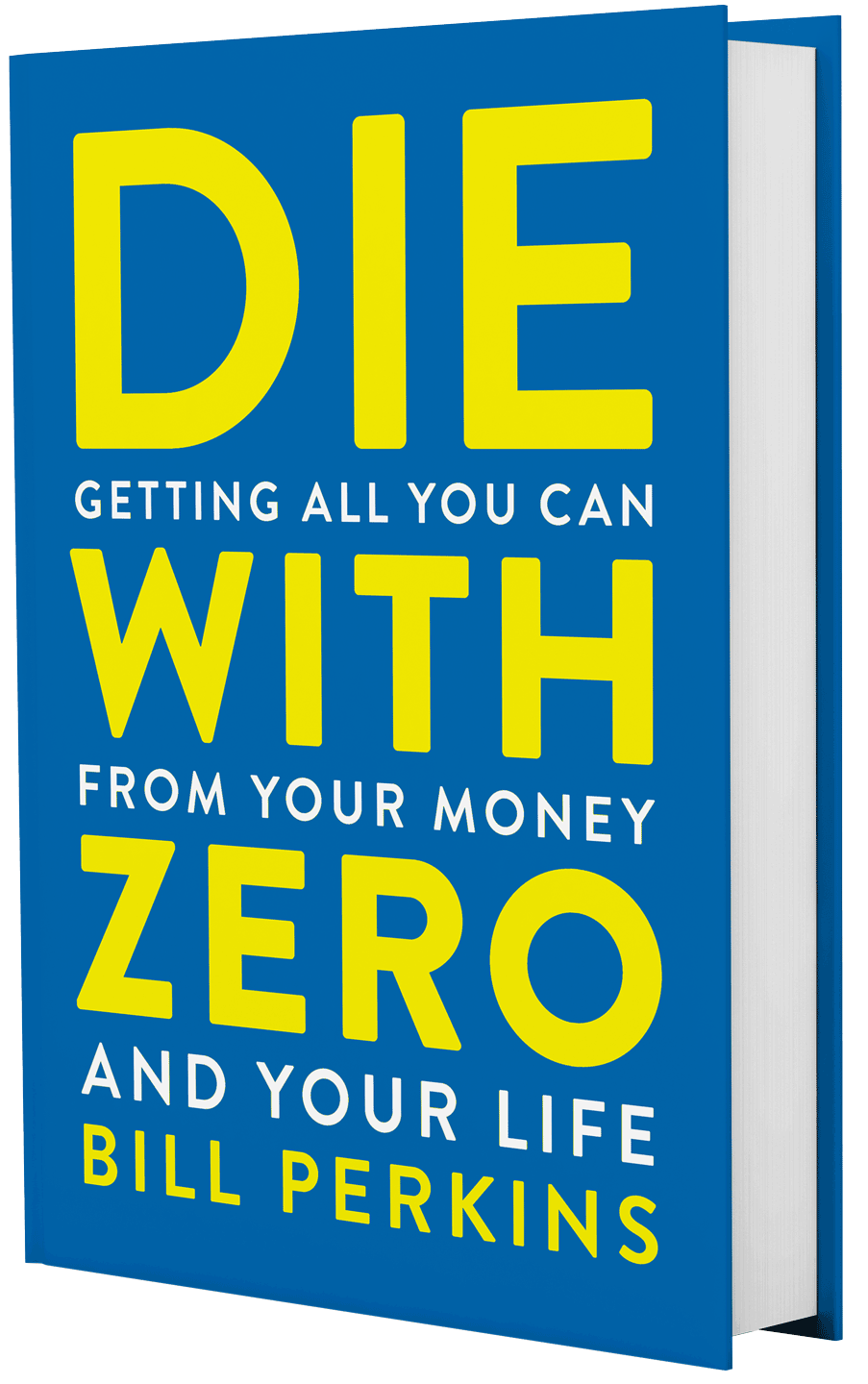
Die With Zero – Book Summary
“Die With Zero” is a book by Bill Perkins that presents a provocative approach to life and wealth management. The core philosophy is that you should aim to optimize your life experiences by spending your money and resources during your lifetime, ideally “dying with zero.”
Key principles from the book include:
- Time is more valuable than money, and its value changes throughout your life. Experiences are often more valuable when you’re younger and have the health and energy to fully enjoy them.
- There’s an optimal time to spend money on different experiences. The book encourages “time-bucketing” – planning experiences and spending for different life stages when they’ll bring maximum satisfaction.
- Instead of leaving a large inheritance at death, give “money gifts” to your children earlier in life when they can make better use of it (like during their 20s and 30s).
- Track and optimize your “life energy” – the combination of time, health, and money that allows you to have meaningful experiences.
- Avoid over-saving for retirement at the expense of enjoying life now. Many people die with substantial unused assets that could have enhanced their life experiences.
The book challenges traditional financial planning wisdom that emphasizes maximum saving and argues instead for strategic spending to maximize life satisfaction. However, it’s important to note that the author assumes readers have achieved a certain level of financial security before implementing these strategies.
The ultimate goal isn’t really about dying with exactly zero dollars, but rather about optimizing your resources to maximize life experiences and memories rather than dying with unused potential for experiences.
Examples
The book provides several practical examples to illustrate its principles. Here are some of the most memorable ones:
- The $30,000 Safari Trip Perkins describes a situation where a person has two choices: taking a $30,000 safari trip at age 40 versus age 75. He argues that the same experience is worth far more at 40 when you:
- Can fully enjoy the physical demands of the trip
- Have young children who could benefit from the experience
- Have decades to reminisce about the memories
- Are healthy enough to fully participate in activities
- The Birthday Gift Experiment He describes giving his daughter a choice between:
- $5,000 now
- $15,000 at age 25 She chose the $5,000 now, and he explains why this was rational – the money had more utility for her during college than a larger sum would have later in life.
- The Investment Banker Example He talks about a friend who worked 80-hour weeks until 65, amassing millions but developing health problems and missing his children’s youth. The friend later admitted he would have been happier working less, earning less, but spending more time with family when it mattered most.
- The Memory Dividend Perkins describes spending $10,000 on a family vacation that created lasting memories and stories his family shared for decades. He contrasts this with keeping that $10,000 invested until death, where it might grow to $40,000 but provide no experiential value.
- The Concert Timing He uses the example of concert tickets to illustrate optimal timing: seeing your favorite band in your 20s or 30s with friends is worth far more than waiting until retirement when:
- The band might not be performing anymore
- Your friends might not be able to join
- You might not have the same energy for late-night shows
- The music might not resonate the same way
- The Education Gift Instead of leaving an inheritance, he describes giving money to nephews and nieces for education when they’re in their 20s, allowing them to:
- Avoid student debt
- Choose better career opportunities
- Start their adult lives with more options
- Benefit from the money when they need it most
- The Health-Wealth Trade-off He provides examples of executives who worked so hard to accumulate wealth that they developed chronic health conditions, effectively saving money they could never fully enjoy due to physical limitations.
These examples all reinforce his central argument that the timing of experiences and spending matters as much as the amount, and that front-loading certain life experiences often provides better returns in terms of life satisfaction than saving everything for later.
A key insight from these examples is that money and experiences have different utility values at different ages, and optimal timing is crucial for maximizing life satisfaction.
Balancing Financial Freedom and Life Experience: A Reflection on Modern Wealth Philosophies
The past decade has seen the emergence of several competing philosophies about how to optimize life satisfaction through financial decisions. The FIRE (Financial Independence, Retire Early) movement and Bill Perkins’ “Die with Zero” approach represent two distinct yet interconnected perspectives on this challenge. While they might seem contradictory at first glance, they both offer valuable insights into the relationship between money, time, and happiness.
The FIRE Movement: Freedom Through Frugality
The FIRE movement, at its core, is about buying freedom. Its adherents typically save 50-70% of their income, living well below their means with the goal of achieving financial independence as early as possible. The underlying premise is powerful: by front-loading sacrifice and financial discipline, you can buy yourself decades of freedom later.
However, the movement has evolved beyond its initial extreme frugality. “Lean FIRE,” “Fat FIRE,” and “Coast FIRE” represent different approaches to the same goal, acknowledging that there’s no one-size-fits-all path to financial independence. This evolution reveals a crucial truth: the real value of FIRE isn’t necessarily in retiring early, but in gaining the freedom to make life choices without financial constraints.
Die with Zero: Optimizing Life’s Returns
Bill Perkins’ “Die with Zero” philosophy presents a different optimization problem. Instead of maximizing savings, it focuses on maximizing life experiences by spending money at the optimal time. This approach recognizes that experiences have different values at different life stages – a backpacking trip through Europe might be worth far more at age 25 than at 65.
The genius of “Die with Zero” lies in its recognition of time as a non-renewable resource. While money can be earned and saved, time only moves in one direction. This leads to some counterintuitive conclusions: sometimes spending $10,000 on an experience now is better than having $50,000 more in your retirement account later.
Finding the Sweet Spot
These philosophies might seem to conflict – one emphasizes saving, the other spending – but they share a fundamental goal: maximizing life satisfaction. The key insights from both approaches can be synthesized into a more nuanced perspective:
- Freedom Has Different Faces: Financial independence isn’t just about having enough money to never work again. It’s about having enough security to make choices based on personal fulfillment rather than necessity.
- Time is the Ultimate Currency: Both philosophies recognize that money is ultimately a tool for buying time and experiences. The question is when and how to make these purchases for optimal returns.
- Balance is Dynamic: The right balance between saving and spending changes throughout life. Early career investments in skills and experiences might yield better returns than maximal savings.
- Experience Optimization: Some experiences have an optimal window – whether it’s physical adventures while you’re young and healthy, or family time while your children are growing up.
A New Framework for Life Optimization
Perhaps the most valuable approach combines elements of both philosophies:
- Build a strong financial foundation that provides security and options
- Identify and prioritize time-sensitive experiences and investments
- Recognize that some memories and experiences appreciate in value over time
- Balance future security with present experiences
- View wealth as a tool for creating value in life, not as an end in itself
The goal isn’t to die with zero or to retire as early as possible, but to optimize the entire life journey. This might mean working longer in a fulfilling career rather than retiring early, or spending more on experiences mid-career rather than maximizing savings.
Conclusion
The dialogue between FIRE and Die with Zero reveals a deeper truth about life optimization: it’s not about following any single philosophy, but about understanding the principles behind them and applying them thoughtfully to your own life circumstances. The real challenge isn’t in choosing between saving and spending, but in deploying both your time and money in ways that maximize your life satisfaction across your entire lifespan.
The most valuable insight might be that financial decisions should be in service of life goals, not the other way around. Whether that means pursuing FIRE, following Die with Zero principles, or crafting your own hybrid approach, the key is to make conscious choices about how you use your finite resources of time and money to create the life you want to live.
 UpLive.Life
3 thoughts on “Health, Wealth and Life Optimization”