When I was pregnant with our first child, a wise man gave me some unexpected advice: “Don’t have any expectations for your child.” At the time, I was baffled. What? Of course I have expectations! I expected my kids to get an education, become independent, think for themselves, and create a life that’s better than mine.
Now that my kids are teenagers, I see things differently. While I can’t say I’m completely free of expectations, I’ve realized how complex and unpredictable parenting really is. If I could go back, I’d replace the word expectation with hope. I hope they have a great life—one that they define for themselves. Their vision of a great life may not align with mine, and that’s perfectly okay. My role isn’t to impose my version of success but to support them in discovering their own.
[Written by xAI]
Navigating the Uncharted Waters of Parenting: Theories, Anxieties, and the Quest for Success
The journey of parenthood is fraught with uncertainties and anxieties, not least because of the multitude of parenting theories that exist, each promising a path to a successful upbringing yet offering no definitive metrics for success or failure. Unlike academic or professional spheres where performance can be measured by grades or promotions, parenting lacks such clear indicators, leaving parents to navigate through a sea of advice, criticism, and self-doubt.
Anxieties of Parenting:
Parental anxiety often stems from the fear of making irreversible mistakes that could shape a child’s future negatively. This anxiety is compounded by the pressure to provide not just for physical needs but also for emotional, educational, and social development. The lack of a universal “grade” in parenting means that parents must rely on their judgment, which is often clouded by the overwhelming amount of information and conflicting theories on child-rearing.
- Fear of the Unknown: Parents worry about unforeseen challenges like mental health issues, social pressures, or educational setbacks.
- Social Comparison: With social media and community interactions, there’s constant exposure to other parenting styles, leading to comparisons that can breed insecurity.
- Long-term Impact: The awareness that parenting decisions might affect a child’s life far into the future adds a layer of existential concern.
Theories and “The Sovereign Child”:
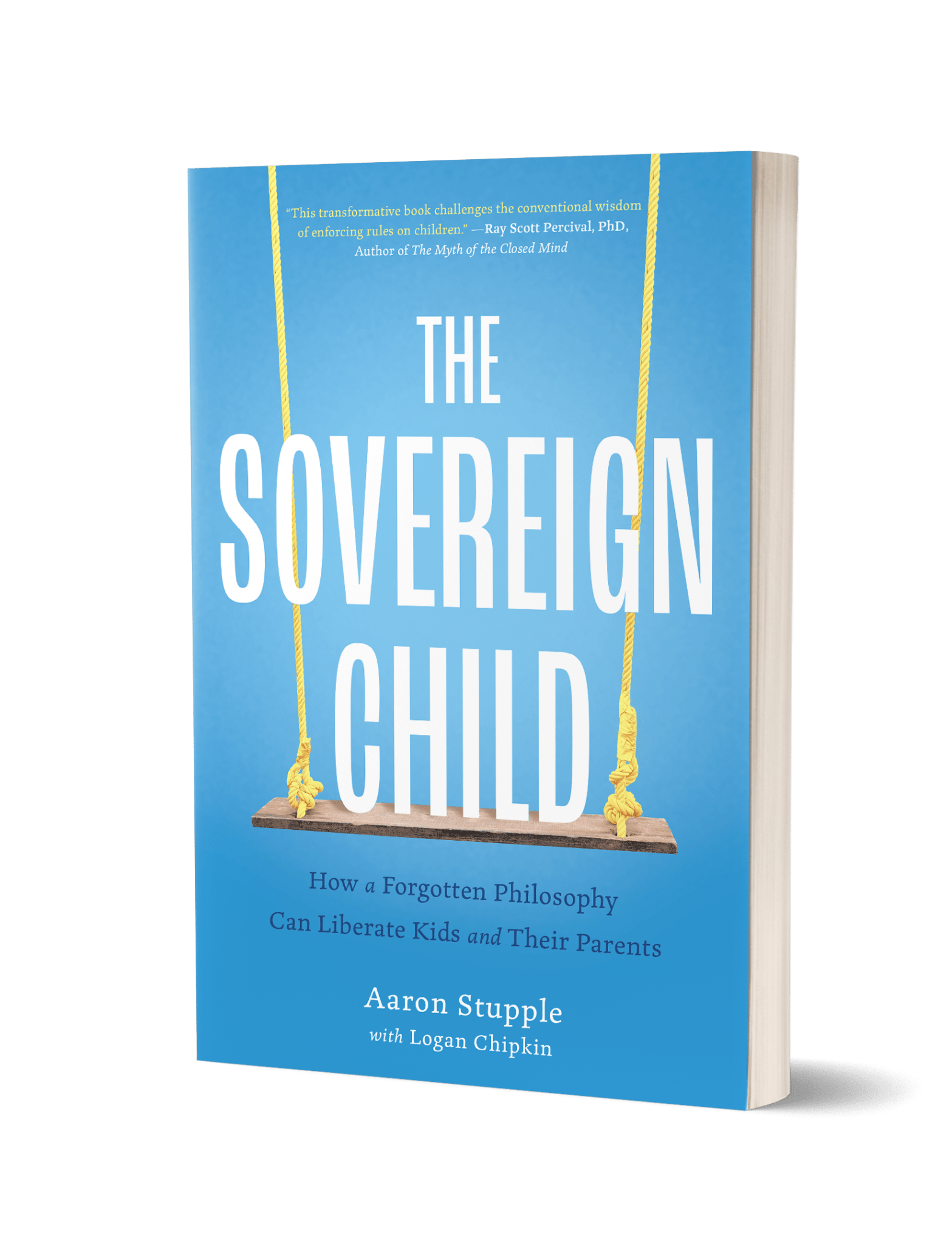
One of the more provocative theories discussed recently is found in Aaron Stupple’s book, “The Sovereign Child.” This philosophy advocates for an almost libertarian approach to child-rearing, suggesting that children should have the autonomy to make their own choices in life, from what they eat to when they sleep or what they watch. The underlying premise is that children, like adults, should be treated as sovereign beings, capable of self-regulation without the imposition of strict parental controls.
- Core Ideas:
- Autonomy: Children should have the freedom to make choices, learning from the natural consequences of those choices.
- Equality of Personhood: The book posits that children’s cognitive and emotional processes are fundamentally similar to adults’, advocating for children’s rights to self-determination.
Debate Surrounding “The Sovereign Child”:
The debate around “The Sovereign Child” is robust:
- Proponents argue:
- Empowerment: Allowing children autonomy can foster independence, creativity, and self-confidence. It’s seen as preparing children for a world where they must think critically and make decisions independently.
- Natural Learning: Children learn best from natural consequences rather than imposed rules, which might stifle their intrinsic motivation.
- Critics counter:
- Lack of Boundaries: Without guidance, children might develop habits detrimental to their health and social integration. Critics worry about the potential for chaos or harm due to a lack of supervision or structure.
- Neglect vs. Freedom: There’s a thin line between granting freedom and what might be perceived as neglectful parenting, especially in a society where safety concerns are paramount.
- Practicality: In a competitive environment where academic and social achievements are benchmarked, the laissez-faire approach might not equip children with the discipline needed to thrive.
Success or Failure in Parenting:
Without a clear metric, parents might measure success through various lenses:
- Happiness and Well-being: If children grow up to be happy, well-adjusted adults, many parents would consider this a success.
- Life Skills: The ability of children to manage life independently, from financial literacy to emotional intelligence, can be seen as markers of effective parenting.
- Relationship Dynamics: Strong, healthy relationships between parents and children might be another indicator of success.
However, failure is often more palpable, felt through signs like behavioral issues, lack of motivation, or poor social skills. Yet, even these are subjective, varying widely based on cultural, personal, and societal expectations.
In conclusion, the anxieties of being a parent are amplified by the absence of a definitive guide to success. Theories like those in “The Sovereign Child” offer new perspectives but also fuel debates. Ultimately, parenting might be one of the few endeavors where success is not measured by external validation but by the personal fulfillment and the well-being of the family unit. As parents, the journey involves constant learning, adaptation, and, most importantly, love and support tailored to each child’s unique path through life.
[Written by Claude]
The Great Parenting Philosophy Wars: A Field Guide to Contradictory Child-Rearing Advice
Welcome to modern parenting, where every expert is absolutely certain they’ve discovered the One True Way to raise children—until next week’s revolutionary approach proves them completely wrong. Let’s explore the battleground of competing parenting philosophies, where the only consistent rule is that whatever you’re doing is probably wrong according to someone.
The Free-Range Parent vs. The Helicopter
While the Free-Range parent lets their 8-year-old walk to the corner store (“It builds independence!”), the Helicopter parent is tracking their teenager’s phone with seventeen different apps (“It builds safety consciousness!”). These two spot each other at the playground and engage in a silent judgment battle that could power a small city if properly harnessed.
The Screen-Time Warrior vs. The Digital Embracer
“No screens until college!” declares the Screen-Time Warrior, while hiding their own phone under the table to check emails. Meanwhile, the Digital Embracer’s toddler is already coding Java and has more followers on Instagram than their parents combined. Both are equally convinced the other’s child will end up living in their basement at age 40.
The Routine Ritualist vs. The Flow Follower
The Routine Ritualist’s day is scheduled down to the millisecond: “It’s 6:47 PM, time for your pre-bedtime meditation followed by exactly 2.3 stories and a glass of room-temperature water!” The Flow Follower’s kids are still having breakfast at 3 PM because “we’re following their natural rhythms.” Both children somehow end up equally tired and cranky.
The Nutrition Nazi vs. The Whatever Works Parent
While one parent is meticulously measuring organic quinoa portions and sprouting their own alfalfa, the other is considering ketchup a vegetable because at least the kid is eating something. They meet at the school bake sale and pretend not to notice each other’s contributions.
The Disciplinarian vs. The Gentle Parent
The Disciplinarian believes in firm boundaries and consequences, while the Gentle Parent is still trying to negotiate with their screaming three-year-old about the emotional roots of their resistance to bedtime. Both secretly wonder if the other’s kid will end up in therapy, while knowing full well that therapy is probably inevitable either way.
The Research Devotee vs. The Intuition Follower
One arrives at playdates with highlighted studies from peer-reviewed journals about the optimal angle for pushing a swing, while the other quotes their great-grandmother’s wisdom about letting kids eat dirt for immunity. Both are equally baffled when their carefully crafted approaches are completely derailed by a toddler who refuses to wear pants.
The Great Unifying Truth
The beautiful irony of modern parenting is that despite all these contradicting approaches, somehow most kids turn out just fine. Perhaps the most reliable parenting philosophy is simply: “Try your best, expect the worst, and keep a sense of humor about the whole impossible endeavor.”
Remember, whatever style you choose, you can rest assured that:
- There’s an expert somewhere who thinks you’re doing it wrong
- There’s a Facebook group ready to validate your choices
- Your kid will probably do the exact opposite with their own children
In the end, the only certainty in parenting is uncertainty. And maybe that’s exactly as it should be—after all, if we were all parenting experts, who would keep the child psychology industry in business?
 UpLive.Life
5 thoughts on “From Expectation to Hope: A Parenting Perspective”