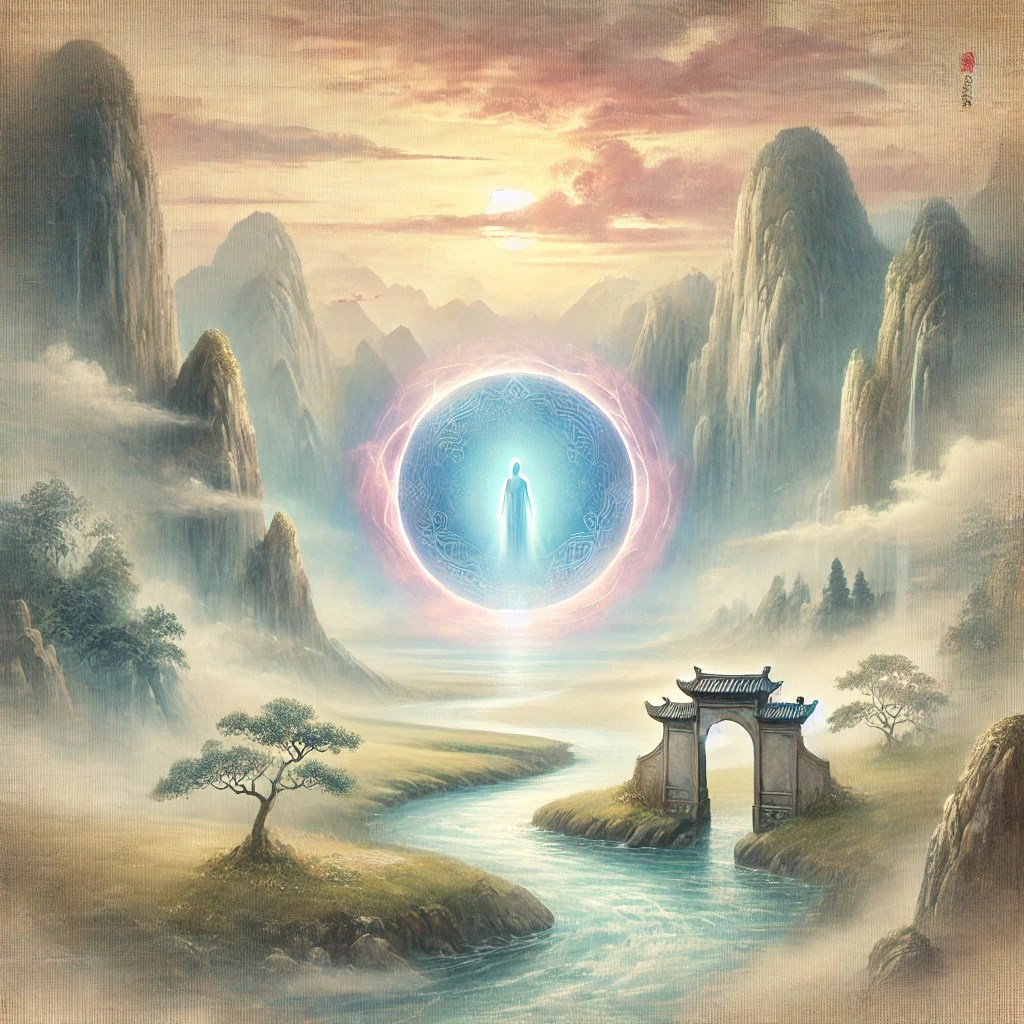
Verse 6 by Lao Zi: 谷神不死,是谓玄牝。玄牝之门,是谓天地根。绵绵若存,用之不勤。
“The valley spirit never dies—
It is called the Mysterious Female.
The gateway of the Mysterious Female—
It is called the root of Heaven and Earth.
Softly, continuously, it seems to remain—
Yet its use is never exhausted.”
Related verses:
Verse 4 by Lao Zi: 道冲而用之或不盈。渊兮似万物之宗。挫其锐,解其纷,和其光,同其尘。湛兮似或存。吾不知谁之子,象帝之先。
Verse 1 by Lao Zi: 道可道,非常道。名可名,非常名。无名天地之始;有名万物之母。故常无欲,以观其妙;常有欲,以观其徼。此两者,同出而异名,同谓之玄。玄之又玄,衆妙之门。
[Written by ChatGPT]
Interpretation:
1. “The valley spirit never dies” (谷神不死)
- 谷 (gǔ): Valley, emptiness, receptivity.
- 神 (shén): Spirit, divine essence.
- 不死 (bù sǐ): Does not die, eternal.
Laozi describes an eternal, ever-present force—often associated with the Dao, feminine energy, or the sustaining power of nature. The valley metaphor suggests emptiness, humility, and the ability to receive and nurture, much like a fertile valley that gives life without being depleted.
2. “It is called the Mysterious Female” (是谓玄牝)
- 是谓 (shì wèi): This is called.
- 玄 (xuán): Mysterious, profound, dark, infinite.
- 牝 (pìn): Female, feminine, yin energy.
The 玄牝 (xuán pìn) or “Mysterious Female” symbolizes the passive, nurturing, and creative aspect of the Dao. It represents yin energy, the generative force that gives birth to all things.
3. “The gateway of the Mysterious Female—It is called the root of Heaven and Earth.” (玄牝之门,是谓天地根)
- 玄牝之门 (xuán pìn zhī mén): The gateway of the Mysterious Female, the entrance to the great creative force.
- 是谓 (shì wèi): This is called.
- 天地 (tiān dì): Heaven and Earth, the universe, existence.
- 根 (gēn): Root, origin, foundation.
The 玄牝之门 (xuán pìn zhī mén) or “gateway of the Mysterious Female” is the doorway through which all life emerges—often interpreted as the womb, the void, or the hidden source of creation. It is described as the root of all existence, linking the Dao to the cycle of birth, growth, and return.
4. “Softly, continuously, it seems to remain—Yet its use is never exhausted.” (绵绵若存,用之不勤)
- 绵绵 (mián mián): Continuous, unbroken, soft, subtle.
- 若存 (ruò cún): As if it exists, appears to be present.
- 用之 (yòng zhī): Its use, applying it.
- 不勤 (bù qín): Never exhausted, effortless, abundant.
This line describes the Dao as an inexhaustible, subtle force—one that does not force itself upon the world but is always available, endlessly supplying energy without strain. It aligns with the concept of wu wei (无为), or effortless action, where true power comes from harmonizing with nature rather than exerting force.
Application in Life
- Embrace Receptivity and Flexibility
- Like the valley, be open and adaptable rather than rigid and forceful.
- Cultivate patience and trust in natural processes rather than forcing outcomes.
- Recognize the Power of Yin (Feminine Energy)
- The verse highlights the creative, nurturing, and generative power of stillness and receptivity, which can be more effective than direct action.
- In leadership, relationships, or decision-making, sometimes yielding is stronger than resisting.
- Understand Effortless Action (Wu Wei)
- True influence and success come not from excessive effort but from aligning with the natural flow of things.
- Instead of overworking, trust that the Dao provides what is needed in its own time.
Conclusion
This passage beautifully expresses the eternal, generative, and effortless nature of the Dao. Through the metaphor of the valley spirit and the Mysterious Female, Laozi reminds us of the power of receptivity, subtlety, and flow—qualities that sustain life and existence without force. The wisdom here encourages us to embrace patience, simplicity, and harmony with the rhythms of nature, knowing that the greatest power often lies in what seems soft, empty, or unseen.
The Origins and Evolution of Yin-Yang
The concept of Yin and Yang (阴阳) originated in ancient Chinese philosophy and evolved over time rather than being attributed to a single individual. However, its earliest known formulations and applications can be traced to early Chinese thinkers and texts.
Origins of Yin-Yang
- Early References (Shang Dynasty, c. 1600–1046 BCE)
- The dualistic nature of existence—light and dark, male and female, day and night—was already present in early Chinese thought.
- The oracle bone inscriptions from the Shang Dynasty hint at binary forces but do not explicitly articulate Yin-Yang as a philosophical system.
- Zhou Dynasty (c. 1046–256 BCE) – Formalization of Yin-Yang Theory
- The idea began taking shape during this period, influenced by natural observations (such as seasonal changes and celestial patterns).
- The I Ching (Book of Changes) (易经), a foundational text of Chinese philosophy (written around the 9th–8th century BCE), contains one of the earliest systematic discussions of Yin and Yang.
- It presents hexagrams composed of broken (Yin) and solid (Yang) lines, representing dynamic opposites in constant interaction.
- Zou Yan (邹衍, 305–240 BCE) – The Yin-Yang School
- The philosopher Zou Yan, associated with the School of Yin-Yang (阴阳家), played a crucial role in systematizing Yin-Yang theory.
- He integrated Yin-Yang with the Five Elements (五行, Wuxing)—Wood, Fire, Earth, Metal, and Water—providing a framework for cosmology, medicine, and governance.
- Daoism and Confucianism – Further Development
- Laozi (老子, c. 6th–4th century BCE) and the Daodejing (道德经) incorporated Yin-Yang principles into Daoist thought.
- Confucianism, particularly through thinkers like Dong Zhongshu (董仲舒, 179–104 BCE), applied Yin-Yang theory to ethics, social structure, and governance.
Meaning and Application of Yin-Yang
- Yin (阴): Dark, feminine, passive, cold, moon, receptive.
- Yang (阳): Light, masculine, active, hot, sun, creative.
- Dynamic Balance: Yin and Yang are not opposites in conflict but complementary forces in constant transformation. Each contains the seed of the other, leading to harmony.
Conclusion
The Yin-Yang concept evolved over centuries, with Zou Yan playing a significant role in formalizing it, but its roots can be traced back to early Chinese cosmology, Daoism, and the I Ching. It remains a fundamental principle in philosophy, medicine, martial arts, and Chinese metaphysics, influencing perspectives on health, nature, and human relationships.
 UpLive.Life
One thought on “The Eternal Flow of the Dao”