[Written by Grok. Image credit]
The concept of “unthinkable thoughts” delves into the boundaries of human cognition, exploring ideas or concepts that seem to lie beyond our mental grasp. Philosophers, mathematicians, scientists, and cognitive psychologists have long pondered these limits, with figures like Kurt Gödel in mathematics showing through his incompleteness theorems that there are truths in any formal system that cannot be proved within that system, hinting at the limits of logical thought.
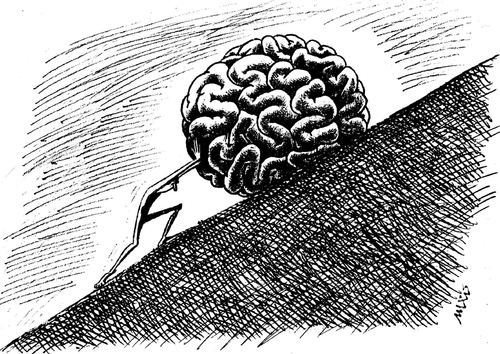
This exploration into unthinkable thoughts reveals much about our brain’s capabilities and its limitations. It suggests that our cognitive processes are not only shaped by our biology, culture, and experience but are also constrained by them. Our brains are marvelously adept at pattern recognition, logical reasoning, and problem-solving within certain parameters, yet when faced with concepts that defy these parameters—whether due to logical incoherence, sensory limitations, or the infinite and abstract—our minds hit a wall.
This acknowledgment of cognitive boundaries not only humbles us by illustrating the vastness of what we cannot comprehend but also inspires us to push these limits through creativity, technology, and collective knowledge, expanding what we once thought was unthinkable.
- Logically Incoherent Thoughts – The Square Circle Dance-Off:
These are thoughts where concepts inherently contradict each other within our logical framework. Logic dictates that certain things cannot exist together because they negate one another’s definitions.
Here, you’re at the most baffling dance competition ever. You’re supposed to twirl like a circle while also doing the sharp, right-angled moves of a square. Your brain starts the dance, but halfway through, it’s like trying to tie your shoelaces with mittens on – it just doesn’t compute! Your brain’s DJ scratches the record, realizing that this beat is just too wacky to follow. - Experiences Beyond Human Sensory Limits – The Bat’s Secret Party:
This refers to experiences or perceptions that are beyond the range of human sensory capabilities. Our brains are wired to interpret the world through a specific set of senses, and anything outside this is truly alien.
Imagine crashing a bat’s party where they’re all seeing through sound waves. They’re grooving to rhythms we can’t hear, navigating a dance floor we can’t see. You show up with your human senses, and it’s like bringing a candle to a laser light show – you’re just not on the same wavelength. Your brain’s like, “I can understand the concept, but experiencing it? No way, José!” - Higher Dimensional Thinking – The 4D Cube Escape Room:
We typically think in three dimensions, but higher or different dimensional spaces challenge our visualization and comprehension abilities beyond what our brains are evolutionarily adapted to handle.
You step into this escape room where the walls are playing 4D hopscotch. You’re trying to solve puzzles where pieces can move in ways your brain can’t even picture. It’s like playing Tetris, but the blocks keep jumping into dimensions your eyes can’t follow. Your brain gives up, saying, “I’ll stick to 3D, thanks!” - Infinite and Eternal Concepts – The Infinite Pizza Buffet:
The human mind struggles with concepts that have no end or beginning because we’re accustomed to thinking within boundaries and limits. Infinity stretches our comprehension to its limits.
Here’s a buffet where every slice you eat magically reappears. Your brain tries to wrap itself around the idea of endless pizza but ends up in a loop, like a hamster on an infinite wheel of cheese. You’re thinking, “How do I even begin to eat forever?” Your mind laughs at itself, knowing it’s a delicious paradox. - Complete Absence of Thought or Self – The Non-Existence Costume Party:
Trying to conceptualize the absence of self or thought is like trying to imagine a void where there’s nothing to imagine; it’s a paradox because to think about non-existence, you must exist to think.
You show up to this party dressed as “nothing,” and when someone asks you how you feel, you’re stumped. It’s like trying to describe the taste of clear water or the color of air – it’s there by not being there. Your brain does a double-take, trying to conceptualize the concept of non-being, only to end up in a philosophical giggle. - Consciousness of Other Beings – The Insect Disco:
Understanding the subjective experience of creatures with vastly different cognitive structures or sensory inputs is nearly impossible for us, given our human-centric perspective on consciousness.
At this insect rave, everyone’s dancing to vibrations we can’t feel. You’re trying to join in, but it’s like trying to dance to a song played in reverse while blindfolded. Your brain’s attempting to understand this alien party, but it’s like trying to read a book in a language where each word is a different buzz or chirp. - Beyond Language and Culture – The Language of the Unicorns:
Language and culture shape our thoughts so profoundly that concepts outside our cultural or linguistic framework can seem incomprehensible or unthinkable.
You’re visiting a place where language is a symphony of smells, colors, and feelings. You try to chat, but it’s like trying to understand a conversation in emojis only. You nod along, pretending you get it, but your brain’s like, “This is beautiful, but what the heck are they saying?” - Paradoxical Thoughts – Time Travel Twister:
Paradoxes, especially those involving time, causality, or logic, challenge our understanding because they lead to contradictions or loops that our sequential, cause-and-effect thinking can’t resolve.
This game of Twister involves not just arms and legs but also past, present, and future selves. One wrong move, and you might erase your own existence before you even started playing. Your brain’s trying to untangle this knot of causality, but it’s like trying to solve a puzzle where the pieces keep time-traveling. - Unlimited Complexity – The Ultimate Jenga Game:
Dealing with systems of immense complexity where every variable interacts with countless others is beyond the computational capacity of the human mind due to our limited processing power and memory.
You’re playing Jenga with every variable in the world’s economy or climate. Pull one block, and you might cause a financial crisis or a tornado in your living room. Your brain’s doing mental gymnastics, trying to predict the fall of each block, but with so many pieces in play, it’s like playing chess where the board is also alive. - Consciousness Without a Physical Basis – The Ghostly Thought Cloud:
The idea of consciousness or thought existing independently of a physical body or brain challenges our materialistic view of the mind, leading to philosophical and metaphysical conundrums.
Here, you’re trying to think about thought itself, without any physical anchor. It’s like trying to catch a dream with your hands; you feel it, but when you try to grasp it, it slips away. Your brain enjoys the chase, like trying to paint the sky with your breath – an exercise in futility that’s oddly poetic.
Each of these scenarios illustrates how our cognitive framework is bounded by logic, senses, and the physical world, making some thoughts truly “unthinkable” within our current capabilities.
 UpLive.Life