[Image credit]
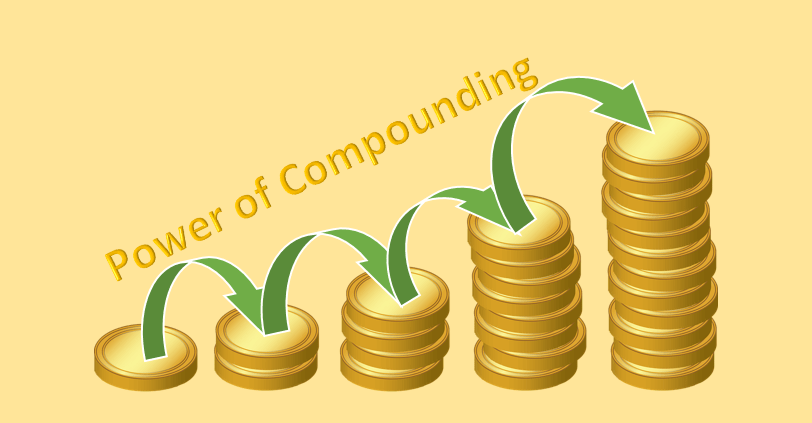
I’ve recently come to realize that I never truly grasped the magic of compounding—even though I’ve known about it for decades. Imagine this: if $1 million grows at 15% annually for 50 years, it transforms into roughly $1 billion! However, this impressive result is extremely sensitive to the growth rate. Lowering the rate to 12% results in about $280 million, 10% yields around $117 million, and at 8%, you’d end up with roughly $47 million. Each of these figures is significant in its own right, but they’re a far cry from the billion-dollar mark.
If the leap to $1 billion seems overly ambitious, consider Charlie Munger’s thought experiment: how would you turn $2 million into $2 trillion? Apple, Amazon, Microsoft, and Google have all done it, all well within the span of a single generation! What’s your trillion dollar idea?
Related Posts: Die with Zero, Beyond financial freedom
[Written by Claude]
Magic of Compounding
Hey there! Let’s talk about something mind-blowing – how rich people can get SUPER rich just by letting their money grow. Imagine having a million dollars (yeah, we’re dreaming big here!) and watching it multiply like crazy over time.
The Million-Dollar Snowball
Think of starting with a HUGE snowball worth $1 million. As it rolls down the hill, it doesn’t just get a little bigger – it turns into an absolute monster! That’s compound growth for you, and it’s how wealthy families can become incredibly wealthy.
Let’s See Some Mind-Blowing Numbers
Starting with $1 million at a 7% return each year:
- After 10 years: $1.97 million (nearly doubled!)
- After 20 years: $3.87 million
- After 30 years: $7.61 million
- After 50 years: $29.46 million
- After 100 years: $867.72 million
- After 200 years: $752.92 billion (that’s billion with a B!)
- After 300 years: $653.39 trillion (now we’re just getting silly!)
The Three Money Multipliers
- The Starting Amount (In This Case, $1 Million)
- Double your starting amount, double your results
- $1 million → $7.61 million (after 30 years)
- $2 million → $15.22 million (after 30 years)
- Time (Your Money’s Best Friend) Watch what happens to $1 million over different time periods at 7%:
- 30 years = $7.61 million (nice!)
- 50 years = $29.46 million (getting serious!)
- 100 years = $867.72 million (now we’re talking!)
- Growth Rate (The Speed Boost) Here’s what happens to $1 million over 30 years at different rates:
- At 5%: $4.32 million
- At 7%: $7.61 million
- At 10%: $17.45 million
Why Aren’t There More Trillionaires?
You might be thinking, “Wait a minute… why doesn’t every rich family just leave their money alone for a couple hundred years and become super-ultra-mega rich?” Great question! Here’s why it doesn’t usually work out that way:
- Rich People Problems 😅
- Even wealthy families need to spend money (those private jets aren’t cheap!)
- More family members = more spending
- Kids and grandkids might not be as good with money
- Sometimes they make bad investments
- Real Stories of Rich Families
- The Winners:
- The Rockefellers: Started with oil money, but were smart enough to spread their investments around
- The Rothschilds: Been rich for hundreds of years because they kept teaching their kids about money
- The Not-So-Winners:
- The Vanderbilts: Had like $300 billion in today’s money but spent WAY too much on massive houses
- The Strohs: Lost their beer fortune by making bad business decisions
- The Winners:
- Why Money Disappears
- Inflation makes everything more expensive over time
- Market crashes can wipe out huge amounts of money
- Taxes take a big bite (even in Canada!)
- Family drama can mess things up
- Sometimes people just make terrible decisions
What We Can Learn From This
- Big Money Needs Time Even with a million dollars, you need decades to see truly astronomical growth. The magic really happens after 50+ years!
- Growth Rate Matters… A LOT The difference between 5% and 10% returns might not seem huge, but over decades it can mean billions of dollars!
- Why Most Rich Families Don’t Stay Super Rich
- They spend too much
- They split the money between too many people
- They make bad investments
- They don’t teach their kids about money
Fun Fact About Those Crazy Numbers
If someone from the 1700s had invested $1 million and their family had never touched it, they theoretically could have trillions today. But here’s the thing – even the richest families in history couldn’t resist spending their money or ran into problems along the way.
The Canada Question
Even though Canada doesn’t have inheritance tax (unlike the US), they’ve got other ways of taxing big money:
- They treat your investments like you sold them when you die (and tax that)
- Trust funds get taxed every 21 years
- Each province has its own rules about money transfers
Think of it like this: there’s no such thing as a perfect money-hiding spot – the government always finds a way to get their share!
Remember: While most of us won’t start with a million dollars, the principles are exactly the same whether you’re starting with $100 or $100 million. The key is understanding how money can grow and being patient enough to let it happen!
ChapGPT’s Trillion Dollar Idea
One feasible trillion-dollar idea over the next 50 years is to develop an integrated, AI-driven personalized healthcare and longevity platform. This would be a comprehensive ecosystem that uses breakthrough technologies to fundamentally transform how we manage our health. Here’s an in-depth look at the concept:
The Concept: A Personalized Health and Longevity Ecosystem
Imagine a platform that continuously monitors your health, predicts potential issues before they arise, and provides personalized, proactive treatment plans—all powered by advanced artificial intelligence. This ecosystem would combine several cutting-edge technologies:
- Genomic and Molecular Analysis:
Every individual’s genetic blueprint, along with proteomic and metabolomic data, would be analyzed to identify predispositions to diseases and optimal health strategies. - Continuous Real-Time Monitoring:
Wearable and implantable sensors, along with IoT-enabled biosensors, would constantly track key health metrics—such as heart rate, blood sugar levels, and other biomarkers—to create a dynamic, real-time health profile. - Predictive and Preventative AI:
Advanced machine learning algorithms would integrate historical and real-time data to predict health risks before they manifest. This would enable preemptive interventions that could prevent disease onset or manage conditions at their earliest stages. - Nanotechnology and Advanced Diagnostics:
Nanodevices and state-of-the-art diagnostic tools could offer precise, minimally invasive methods to monitor internal body processes, delivering insights previously unavailable in traditional medicine. - Personalized Treatment and Lifestyle Optimization:
Based on continuous data input, the platform would provide tailored recommendations—from dietary changes and exercise routines to personalized medication regimens—optimizing both healthspan and lifespan.
Why It Could Reach Trillion-Dollar Scale
- Massive Market Potential:
With aging populations worldwide and an increasing focus on health and wellness, a solution that not only extends lifespan but also enhances quality of life has the potential to tap into a multi-trillion-dollar global healthcare market. - Cost Savings and Efficiency:
By shifting healthcare from reactive treatments to proactive prevention, the platform could dramatically reduce the enormous costs associated with chronic diseases, hospitalizations, and long-term care. Savings on a societal level could be transformative. - Data-Driven Innovation:
The continuous flow of personalized health data would spur ongoing innovation, leading to new medical discoveries, drug developments, and more effective public health policies. This creates a self-reinforcing cycle of improvement and market growth. - Technological Convergence:
The convergence of AI, biotechnology, nanotechnology, and IoT creates a powerful platform where advancements in one field can rapidly accelerate progress in others. This synergy could drive exponential growth in the value and capabilities of the ecosystem.
The Long-Term Vision
Over the next 50 years, this platform could evolve from a high-tech healthcare tool into an indispensable part of daily life—integrating with everything from smart homes to personalized education and even workplace wellness programs. As adoption spreads globally, the cumulative effects of improved health, increased productivity, and reduced healthcare costs could generate economic value on a scale rivaling the world’s largest industries.
While this idea is ambitious, the ongoing advances in AI, data analytics, and biomedical research make it a tangible possibility. By addressing one of humanity’s most pressing challenges—health and longevity—this integrated ecosystem has the potential to reshape society and achieve trillion-dollar market valuations.
 UpLive.Life
One thought on “The Magic of Compound Growth: How a Million Dollars Can Turn Into Billions!”