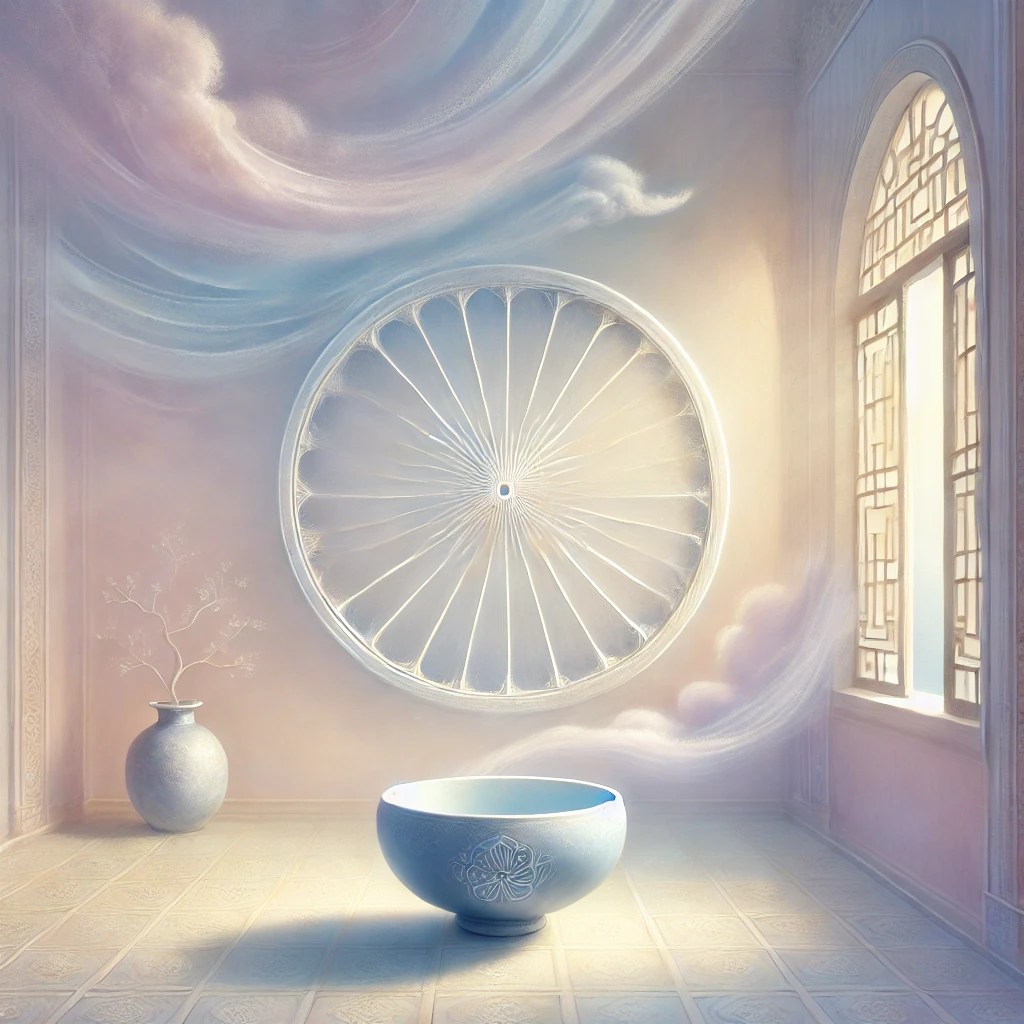
Verse 11 by Lao Zi: 三十辐共一毂,当其无,有车之用。埏埴以为器,当其无,有器之用。凿户牖以为室,当其无,有室之用。故有之以为利,无之以为用。
Thirty spokes share one hub,
But it is the empty space that makes the wheel useful.
Clay is shaped into a vessel,
But it is the empty space inside that makes it useful.
Doors and windows are cut to make a room,
But it is the empty space that makes the room useful.
Therefore, what exists provides benefit,
But what does not exist makes it useful.
[Written by ChatGPT]
Verse 11 of Daodejing is most closely related to several themes found in Verses 1–10 of the Dao De Jing, particularly those that discuss the paradox of presence (you, 有) and absence (wu, 无), as well as the concept of non-attachment and the usefulness of emptiness. Here are the most relevant connections:
- Chapter 1 (道可道,非常道)
- “The Dao that can be spoken is not the eternal Dao.”
- Connection: This passage emphasizes the limits of material forms and names, aligning with the idea that emptiness (wu) is what brings true function.
- Chapter 2 (天下皆知美之为美,斯恶已;皆知善之为善,斯不善已。)
- “When people recognize beauty as beauty, there is already ugliness. When they recognize good as good, there is already evil.”
- Connection: The contrast between you (existence) and wu (non-existence) mirrors the way usefulness arises from what is seemingly “not there.”
- Chapter 4 (道冲,而用之或不盈。渊兮,似万物之宗。)
- “The Dao is empty, yet its use is inexhaustible. It is like an abyss, the source of all things.”
- Connection: This chapter reinforces the idea that emptiness is not a lack, but rather a source of infinite potential—just as the empty spaces in a wheel, vessel, or room give them purpose.
- Chapter 5 (天地不仁,以万物为刍狗。圣人不仁,以百姓为刍狗。)
- “Heaven and Earth are impartial; they treat all things as straw dogs. The Sage is also impartial; he treats the people as straw dogs.”
- Connection: This impersonal perspective aligns with the idea that we should not overly value material form (you), as true function often lies in the unseen (wu).
- Chapter 6 (谷神不死,是谓玄牝。玄牝之门,是谓天地根。绵绵若存,用之不勤。)
- “The spirit of the valley never dies—this is called the mysterious female. The gateway of the mysterious female is the root of Heaven and Earth. It is continuous and everlasting; its use is inexhaustible.”
- Connection: The “valley” (a metaphor for emptiness) is the source of all things, reinforcing the idea that usefulness comes from the void.
- Chapter 9 (持而盈之,不如其已。揣而锐之,不可长保。金玉满堂,莫之能守。富贵而骄,自遗其咎。功遂身退,天之道也。)
- “Holding and filling it to the brim is not as good as stopping in time. Honing a blade too sharp cannot be long preserved. Filling a hall with gold and jade cannot be kept safe. Wealth and pride lead to downfall. Achieve success, then withdraw—this is the way of Heaven.”
- Connection: This highlights the idea that material accumulation (focusing only on you) is not sustainable, whereas embracing emptiness (wu) leads to balance.
Summary:
The key themes in Chapters 1–10 that connect to Chapter 11 are:
- The paradoxical relationship between presence and absence.
- The utility of emptiness (wu), as seen in Dao’s inexhaustible nature.
- The idea that attachment to material things (you) is limiting.
- The value of non-action (wuwei, 无为), which aligns with the idea that usefulness often comes from what is not explicitly present.
Thus, Chapter 11 serves as a direct application of these earlier Daoist principles.
How to Apply This in Daily Life
- Embracing Silence and Space in Conversations
- People often feel the need to fill silences with words—but true wisdom comes from listening and leaving space for others to speak.
- Just like a wheel needs an empty center to function, a conversation needs pauses and openness to allow genuine understanding.
- Decluttering and Minimalism
- Many people accumulate too many possessions, believing that more stuff equals more happiness.
- But a room is useful because of its empty space, not because it’s full of things.
- Applying this principle: Declutter your space, and you’ll find clarity and freedom.
- The Value of Rest and Doing Less
- In modern life, people equate busyness with productivity. However, doing too much can be counterproductive.
- Just as a pot is useful because of its empty space, our minds work best when given moments of rest.
- Applying this principle: Take breaks, meditate, and let your mind be still—your creativity and energy will flow better.
- Non-Attachment in Relationships
- Love and friendship flourish when there is space—not when they are smothered.
- A house is livable because it has empty rooms; similarly, relationships are healthy when people give each other freedom and breathing room.
- Applying this principle: Avoid controlling or clinging to people—allow them to grow and thrive independently.
- Being Open to Change and Uncertainty
- Many people fear the unknown and try to control everything. But the most valuable things in life—opportunities, creativity, and growth—come from embracing uncertainty.
- A room is useful because of the space inside it; likewise, leaving room for the unexpected brings new possibilities.
- Applying this principle: Let go of rigid plans and be open to change—you’ll find life flows more naturally.
Word-for-Word Breakdown & Translation
| Chinese | Pinyin | Word-for-Word Meaning | Translation |
|---|---|---|---|
| 三十 | sān shí | thirty | Thirty |
| 辐 | fú | spokes (of a wheel) | spokes |
| 共 | gòng | together | share |
| 一 | yī | one | one |
| 毂 | gǔ | hub, axle | hub |
| 当 | dāng | at, in, when | but it is |
| 其 | qí | its, that | its |
| 无 | wú | nothing, absence, emptiness | empty space |
| 有 | yǒu | have, exist, presence | that |
| 车 | chē | vehicle, cart | the wheel |
| 之 | zhī | possessive particle | (possessive, omitted in English) |
| 用 | yòng | use, function | useful |
Translation:
“Thirty spokes share one hub, but it is the empty space that makes the wheel useful.”
| Chinese | Pinyin | Word-for-Word Meaning | Translation |
|---|---|---|---|
| 埏 | yán | shape, mold | Clay is shaped |
| 埴 | zhí | clay, earth | (from) clay |
| 以 | yǐ | in order to, with | in order to |
| 为 | wéi | make, form, become | make |
| 器 | qì | vessel, utensil | a vessel |
| 当 | dāng | at, in, when | but it is |
| 其 | qí | its, that | its |
| 无 | wú | nothing, absence, emptiness | empty space |
| 有 | yǒu | have, exist, presence | that |
| 器 | qì | vessel, utensil | the vessel |
| 之 | zhī | possessive particle | (possessive, omitted in English) |
| 用 | yòng | use, function | useful |
Translation:
“Clay is shaped into a vessel, but it is the empty space inside that makes it useful.”
| Chinese | Pinyin | Word-for-Word Meaning | Translation |
|---|---|---|---|
| 凿 | záo | chisel, carve, cut | Doors and windows are cut |
| 户 | hù | door | (into a) door |
| 牖 | yǒu | window | (and) window |
| 以 | yǐ | in order to, with | in order to |
| 为 | wéi | make, form, become | make |
| 室 | shì | room, house | a room |
| 当 | dāng | at, in, when | but it is |
| 其 | qí | its, that | its |
| 无 | wú | nothing, absence, emptiness | empty space |
| 有 | yǒu | have, exist, presence | that |
| 室 | shì | room, house | the room |
| 之 | zhī | possessive particle | (possessive, omitted in English) |
| 用 | yòng | use, function | useful |
Translation:
“Doors and windows are cut to make a room, but it is the empty space that makes the room useful.”
| Chinese | Pinyin | Word-for-Word Meaning | Translation |
|---|---|---|---|
| 故 | gù | therefore, thus | Therefore |
| 有 | yǒu | have, exist, presence | what exists |
| 之 | zhī | possessive particle | (possessive, omitted in English) |
| 以 | yǐ | in order to, with | provides |
| 为 | wéi | make, form, become | benefit |
| 利 | lì | benefit, advantage | benefit |
| 无 | wú | nothing, absence, emptiness | but what does not exist |
| 之 | zhī | possessive particle | (possessive, omitted in English) |
| 以 | yǐ | in order to, with | makes |
| 为 | wéi | make, form, become | useful |
| 用 | yòng | use, function | useful |
Translation:
“Therefore, what exists provides benefit, but what does not exist makes it useful.”
 UpLive.Life
One thought on “The Utility of Emptiness: How Absence Gives Function to Form”