[Written by ChatGPT. Image credit]
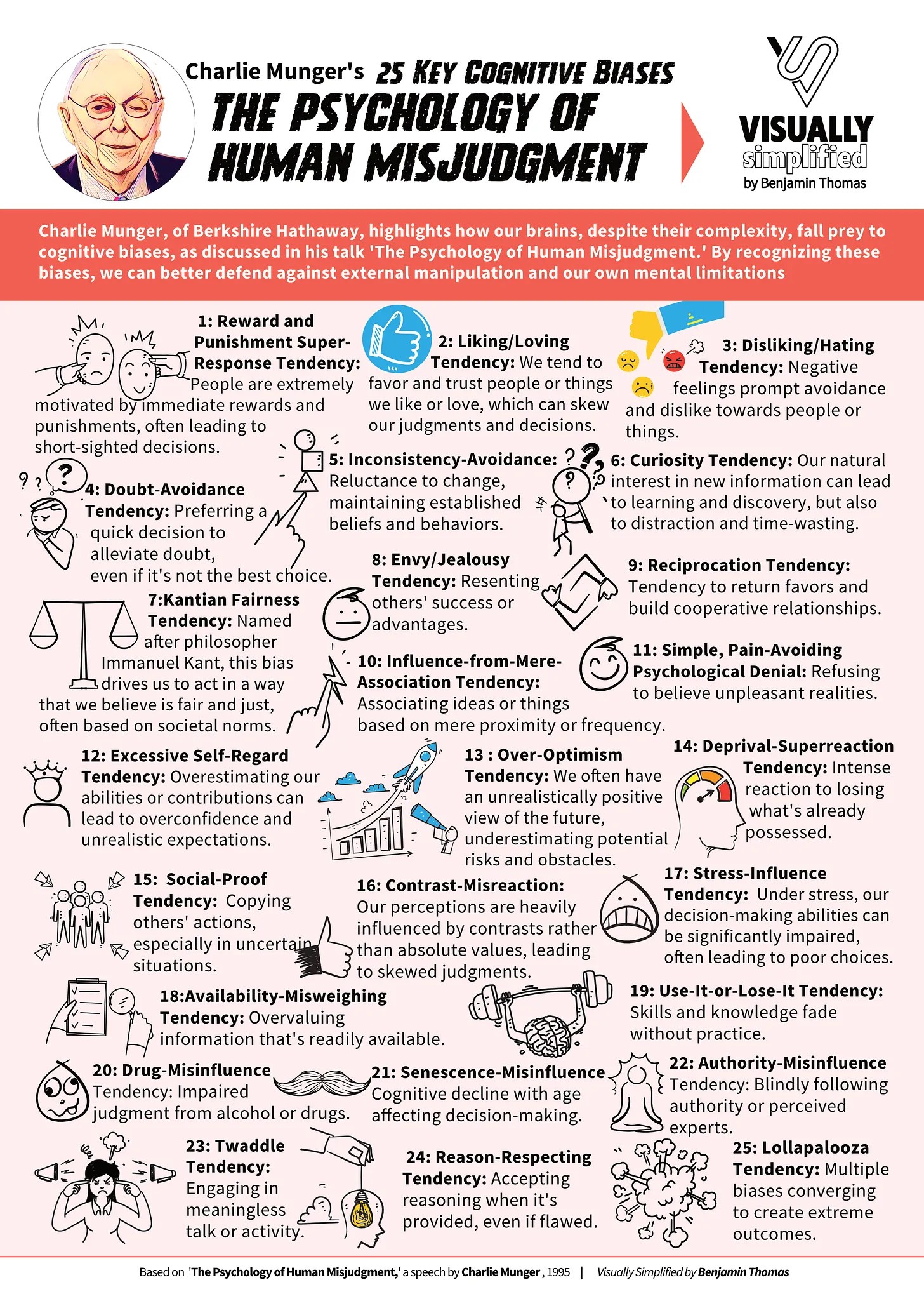
In Poor Charlie’s Almanack, Charlie Munger, Warren Buffett’s longtime business partner, introduces his “Psychology of Human Misjudgment,” a framework of 25 cognitive biases—or human tendencies—that frequently steer people toward irrational or suboptimal choices. Drawing from psychology, behavioral economics, and his own rich experience, Munger unpacks these mental patterns with clarity and wit, offering a lens to see how our minds can betray us in decision-making.
This lens becomes especially powerful when applied to parenting, one of life’s greatest rewards and toughest tests. Beneath the surface of our daily decisions as parents lie these same psychological tendencies, quietly shaping our actions in ways we rarely notice. Taking inspiration from Munger’s “25 Human Misjudgments,” this guide delves into how each bias manifests in the everyday moments of raising children—sometimes offering a helping hand, but more often throwing up roadblocks. By examining these mental shortcuts, we can better understand when they support our intentions and when they quietly work against us.
Related Post: Thinking, Fast and Slow, Munger’s Harvard Speech, Cognitive Biases
Here’s a list and explanation of each of the 25 tendencies:
1. Reward and Punishment Superresponse Tendency
People behave in ways that are strongly influenced by incentives (rewards) and punishments. Even small incentives can powerfully shape behavior.
“Show me the incentive, and I will show you the outcome.”
2. Liking/Loving Tendency
We tend to favor and agree with people, products, or ideas we like or love—often ignoring their faults.
3. Disliking/Hating Tendency
Conversely, we are biased against people or things we dislike, making us blind to their good qualities and prone to unfair judgments.
4. Doubt-Avoidance Tendency
Humans dislike uncertainty. When faced with doubt, they seek quick closure—even at the cost of accuracy.
5. Inconsistency-Avoidance Tendency
We resist changing our minds, especially when we’ve publicly committed to a stance. We seek consistency even when it’s irrational.
6. Curiosity Tendency
Humans are naturally curious. This tendency drives learning and discovery but varies in strength across individuals.
7. Kantian Fairness Tendency
We have an innate sense of fairness and expect others to follow the same rules we follow. Violations of fairness trigger strong reactions.
8. Envy/Jealousy Tendency
People are highly sensitive to relative advantage or disadvantage. We’re more upset about being outdone than about absolute outcomes.
9. Reciprocation Tendency
We feel obligated to return favors, whether or not they were asked for. This can be exploited (e.g., in marketing and negotiations).
10. Influence-from-Mere-Association Tendency
We’re influenced by what something is associated with. Positive or negative associations shape our perception, even if unrelated.
11. Simple, Pain-Avoiding Psychological Denial
People often deny painful truths to protect their ego or avoid discomfort, leading to poor decisions or procrastination.
12. Excessive Self-Regard Tendency
We consistently overestimate our own abilities, knowledge, and virtue. This leads to overconfidence and flawed decisions.
13. Over-Optimism Tendency
We tend to believe that things will turn out well—even when the facts suggest otherwise. Hope can distort judgment.
14. Deprival-Superreaction Tendency
Losses are felt more strongly than gains. People often overreact to potential or actual loss (loss aversion).
15. Social-Proof Tendency
People look to others to decide what is correct or acceptable, especially in ambiguous situations (herd behavior).
16. Contrast-Misreaction Tendency
We judge things based on relative comparison rather than absolute value. E.g., a $1000 suit might seem cheap next to a $5000 one.
17. Stress-Influence Tendency
Under stress, people revert to instinctual or habitual responses and make poorer decisions.
18. Availability-Misweighing Tendency
People give undue weight to information that is readily available, recent, or vivid, rather than what’s most relevant or important.
19. Use-It-or-Lose-It Tendency
Skills and knowledge deteriorate without practice. Regular use maintains and enhances ability.
20. Drug-Misinfluence Tendency
Substances (like alcohol or drugs) distort judgment and increase risk-taking, often with devastating results.
21. Senescence-Misinfluence Tendency
As people age, cognitive decline can lead to poor judgment and resistance to change or learning.
22. Authority-Misinfluence Tendency
People are inclined to obey authority figures—even against their own judgment or ethics (e.g., Milgram experiment).
23. Twaddle Tendency
Humans enjoy engaging in meaningless talk or activity (twaddle), especially if it provides social comfort or entertainment.
24. Reason-Respecting Tendency
People like having reasons for their actions—even if the reasons are weak or irrational. Just having a “because” can increase compliance.
25. Lollapalooza Tendency—The Tendency to Get Extreme Consequences from Confluences of Psychological Tendencies Acting in Favor of a Particular Outcome
When multiple biases combine, they can produce massively irrational or extreme behavior—leading to bubbles, manias, or disasters.
“It’s the lollapalooza effect you’ve got to watch out for.”
Charlie Munger’s 25 human tendencies, as outlined in Poor Charlie’s Almanack, can be mapped to corresponding cognitive biases detailed in Thinking, Fast and Slow by Daniel Kahneman and those listed in The Decision Lab’s cognitive biases index. Below is a comprehensive mapping:
- Reward and Punishment Superresponse Tendency
- Thinking, Fast and Slow: Incentive-caused bias; the profound influence of rewards and punishments on behavior.
- The Decision Lab: Incentivization; the tendency to work harder when promised a reward.The Decision Lab
- Liking/Loving Tendency
- Thinking, Fast and Slow: Halo effect; the tendency for an initial positive impression to influence subsequent judgments.Wikipedia+2The Decision Lab+2The Decision Lab+2
- The Decision Lab: Halo effect; our overall impression of a person influences how we feel and think about their character.Latest news & breaking headlines+12The Decision Lab+12The Decision Lab+12
- Disliking/Hating Tendency
- Thinking, Fast and Slow: Negativity bias; the propensity to focus more on negative information than positive.
- The Decision Lab: Negativity bias; the tendency to pay more attention to negative experiences over neutral or positive ones.
- Doubt-Avoidance Tendency
- Thinking, Fast and Slow: Ambiguity effect; avoiding options with missing information.
- The Decision Lab: Ambiguity effect; preferring options where the probability of a favorable outcome is known.The Decision Lab+2Wikipedia+2Latest news & breaking headlines+2
- Inconsistency-Avoidance Tendency
- Thinking, Fast and Slow: Cognitive dissonance; the discomfort from holding conflicting beliefs.
- The Decision Lab: Commitment bias; persisting with past decisions despite new evidence.
- Curiosity Tendency
- Thinking, Fast and Slow: System 1’s innate drive for novelty and exploration.
- The Decision Lab: Curiosity bias; the desire to fill gaps in knowledge, sometimes leading to suboptimal decisions.
- Kantian Fairness Tendency
- Thinking, Fast and Slow: Fairness heuristic; intuitive judgments about fairness influencing decisions.
- The Decision Lab: Fairness bias; expecting equitable treatment and reacting negatively to perceived injustices.
- Envy/Jealousy Tendency
- Thinking, Fast and Slow: Social comparison theory; evaluating oneself in relation to others.
- The Decision Lab: In-group bias; favoring one’s own group over others, leading to envy or jealousy.
- Reciprocation Tendency
- Thinking, Fast and Slow: Reciprocity principle; responding to actions with similar actions.
- The Decision Lab: Reciprocity bias; feeling obligated to return favors or concessions.
- Influence-from-Mere-Association Tendency
- Thinking, Fast and Slow: Association bias; linking unrelated information based on superficial similarities.
- The Decision Lab: Association bias; evaluating something based on its association with positive or negative contexts.
- Simple, Pain-Avoiding Psychological Denial
- Thinking, Fast and Slow: Denial; rejecting reality to avoid psychological discomfort.
- The Decision Lab: Ostrich effect; avoiding negative information by ignoring it.
- Excessive Self-Regard Tendency
- Thinking, Fast and Slow: Overconfidence effect; overestimating one’s abilities or knowledge.
- The Decision Lab: Overconfidence bias; having excessive confidence in one’s judgments.
- Over-Optimism Tendency
- Thinking, Fast and Slow: Optimism bias; expecting more favorable outcomes than warranted.
- The Decision Lab: Optimism bias; overestimating the likelihood of positive events.
- Deprival-Superreaction Tendency
- Thinking, Fast and Slow: Loss aversion; feeling losses more intensely than gains.
- The Decision Lab: Loss aversion; the preference to avoid losses over acquiring equivalent gains.
- Social-Proof Tendency
- Thinking, Fast and Slow: Conformity; aligning behavior with group norms.
- The Decision Lab: Bandwagon effect; adopting beliefs or behaviors as they become more popular.
- Contrast-Misreaction Tendency
- Thinking, Fast and Slow: Contrast effect; perceiving differences between sequential stimuli as more pronounced.
- The Decision Lab: Contrast effect; enhancing or diminishing perception when compared with a contrasting object.
- Stress-Influence Tendency
- Thinking, Fast and Slow: Stress-induced cognitive narrowing; reduced decision-making quality under stress.
- The Decision Lab: Decision fatigue; deteriorating quality of decisions after a long session of decision-making.
- Availability-Misweighing Tendency
- Thinking, Fast and Slow: Availability heuristic; overestimating the likelihood of events based on memory ease.
- The Decision Lab: Availability heuristic; relying on immediate examples that come to mind when evaluating a topic.
- Use-It-or-Lose-It Tendency
- Thinking, Fast and Slow: Skill atrophy; decline of abilities without practice.
- The Decision Lab: Use-it-or-lose-it bias; the necessity of regular practice to maintain skills.
- Drug-Misinfluence Tendency
Thinking, Fast and Slow: Substance-induced impairment; reduced reasoning under influence.
The Decision Lab: Restraint bias — we overestimate our ability to control impulses, especially under the influence. - Senescence-Misinfluence Tendency
Thinking, Fast and Slow: Cognitive aging; reduced processing speed, flexibility.
The Decision Lab: Cognitive decline — not a formal bias but relevant to biases like status quo bias and conservatism bias (tendency to stick to prior beliefs even when new evidence arises). - Authority-Misinfluence Tendency
Thinking, Fast and Slow: Obedience to authority (e.g., Milgram experiment).
The Decision Lab: Authority bias — tendency to attribute greater accuracy to authority figures. - Twaddle Tendency
Thinking, Fast and Slow: System 1 default to effortless, shallow thinking.
The Decision Lab: Information bias — seeking unnecessary info; also fluency heuristic — preferring information that’s easy to process. - Reason-Respecting Tendency
Thinking, Fast and Slow: Illusion of validity; we’re more likely to comply if given a reason—even if meaningless.
The Decision Lab: Justification bias — tendency to provide (or accept) weak or irrelevant reasons. - Lollapalooza Tendency (confluence of multiple biases)
Thinking, Fast and Slow: When multiple System 1 heuristics stack, leading to extreme misjudgment.
The Decision Lab: Bias stacking (not a named bias but recognized as compounding effects), also Lollapalooza effect is acknowledged in behavioral economics.
Applied to Parenting
1. Reward and Punishment Superresponse Tendency
Application: Parents use rewards (like dessert or screen time) or punishments (like time-outs) to modify behavior.
Does it work? ✅ Yes—short-term. But overuse can lead to extrinsic motivation only. Ideally paired with positive reinforcement and explanation.
2. Liking/Loving Tendency
Application: You may favor a child you “like” more in the moment (e.g., the easier or more affectionate one).
Does it work? ❌ No. This can lead to favoritism and sibling rivalry. Be mindful to stay equitable and consistent.
3. Disliking/Hating Tendency
Application: When frustrated, you may ignore a child’s good behavior or misinterpret their actions negatively.
Does it work? ❌ No. Leads to negative feedback loops. Parents should reset emotionally and assess behavior fairly.
4. Doubt-Avoidance Tendency
Application: Jumping to conclusions to resolve uncertainty (e.g., blaming one child without checking facts).
Does it work? ❌ No. Knee-jerk decisions can damage trust. Slowing down helps.
5. Inconsistency-Avoidance Tendency
Application: Refusing to change parenting strategies that aren’t working because you’ve “always done it this way.”
Does it work? ❌ No. Parenting requires adaptability. Rigidity hurts effectiveness.
6. Curiosity Tendency
Application: Embracing your child’s endless “why” questions and supporting exploration.
Does it work? ✅ Yes. Fosters learning, bonding, and intellectual development.
7. Kantian Fairness Tendency
Application: Treating children equally and teaching them the value of fairness.
Does it work? ✅ Yes. Builds trust and moral development. But equity may sometimes need to outweigh equality.
8. Envy/Jealousy Tendency
Application: Children may compare attention or rewards; parents might unconsciously feel envy between siblings’ talents.
Does it work? ❌ No. Needs active management. Emphasize individual strengths and fairness in attention.
9. Reciprocation Tendency
Application: Feeling extra generous or permissive because a child helped or was affectionate.
Does it work? 🤷♂️ Sometimes. Can build warmth, but don’t let it cloud rules or boundaries.
10. Influence-from-Mere-Association Tendency
Application: Disliking a child’s friend might cause you to unfairly judge your child’s behavior.
Does it work? ❌ No. Be aware of your associative biases and assess based on individual actions.
11. Simple, Pain-Avoiding Psychological Denial
Application: Ignoring warning signs (e.g., bullying, anxiety) because they’re too hard to face.
Does it work? ❌ No. Avoidance delays intervention. Lean into discomfort for long-term well-being.
12. Excessive Self-Regard Tendency
Application: Believing you’re always right about parenting, dismissing others’ input.
Does it work? ❌ No. Makes growth difficult. Humility is key to evolving as a parent.
13. Over-Optimism Tendency
Application: Assuming everything will “just work out” with your child without effort or guidance.
Does it work? ❌ No. Hope is important, but planning and engagement are better bets.
14. Deprival-Superreaction Tendency
Application: Overreacting when a child breaks or loses something valuable.
Does it work? ❌ No. Teaches fear, not responsibility. Calm consequences work better.
15. Social-Proof Tendency
Application: Copying what other parents do just to fit in—even if it’s not right for your child.
Does it work? ❌ No. Trust your values and what works for your family.
16. Contrast-Misreaction Tendency
Application: Thinking one child is messier or louder because you just dealt with the quieter sibling.
Does it work? ❌ No. Be aware of how comparisons distort perception.
17. Stress-Influence Tendency
Application: Snapping or making poor decisions when overwhelmed or tired.
Does it work? ❌ No. Self-care and stress regulation are essential for parenting clarity.
18. Availability-Misweighing Tendency
Application: Worrying excessively about rare dangers (like kidnapping) because of vivid news stories.
Does it work? ❌ No. Can lead to overprotective or fear-based parenting. Use data, not headlines.
19. Use-It-or-Lose-It Tendency
Application: Letting parenting skills (like patience, communication) deteriorate without regular practice.
Does it work? ❌ No. Intentional daily engagement keeps you sharp and responsive.
20. Drug-Misinfluence Tendency
Application: Poor judgment when parenting under the influence of alcohol or meds.
Does it work? ❌ No. Impairs clarity, patience, and responsiveness.
21. Senescence-Misinfluence Tendency
Application: Relying on outdated parenting ideas or becoming less open to new methods with age.
Does it work? ❌ No. Stay curious and keep learning—even from your kids.
22. Authority-Misinfluence Tendency
Application: Accepting advice from experts (doctors, teachers) without question, even when it conflicts with your instincts.
Does it work? 🤷♂️ Sometimes. Respect authority, but also advocate for your child.
23. Twaddle Tendency
Application: Wasting time on trivial talk or distractions rather than engaging meaningfully with your child.
Does it work? ❌ No. Prioritize presence and intentional conversation.
24. Reason-Respecting Tendency
Application: Giving kids reasons (“because it’s safer”) works better than “because I said so.”
Does it work? ✅ Yes. Even weak reasons can improve compliance—but honest explanation builds long-term reasoning skills.
25. Lollapalooza Tendency
Application: When multiple biases (stress, favoritism, loss aversion) combine, leading to parenting meltdowns.
Does it work? ❌ No. These moments cause regret and misjudgment. Recognizing the storm helps de-escalate.
 UpLive.Life