[Written by Claude]
In our current democratic landscape, we’ve mastered the art of speaking but forgotten the power of listening. Our institutions are structured around adversarial debates and passionate protests, methods that often entrench divisions rather than resolve them. But what if we could reshape how we engage with different perspectives? What if our educational system prioritized understanding as much as persuasion?
The Problem with Our Current Approach
Today’s democratic discourse often resembles a battlefield rather than a conversation. Political debates focus on scoring points and exposing weaknesses in opposing arguments. Public protests, while powerful expressions of collective voice, can sometimes deepen the divide between different viewpoints. Television news segments feature “debates” where participants talk over each other, never truly engaging with the substance of opposing positions.
These approaches share a fundamental flaw: they prioritize expression over understanding. When we’re focused solely on making our point heard, we miss the opportunity to truly comprehend why others believe what they do. Each side becomes further convinced of its rightness and the other’s wrongness, creating an ever-widening chasm of misunderstanding.
Reimagining Education for Democratic Engagement
Imagine a different approach to civic education—one that balances advocacy with understanding. In this vision, students would still learn how to articulate their views persuasively, but they would spend equal time developing skills to genuinely understand perspectives they disagree with.
This educational model would teach:
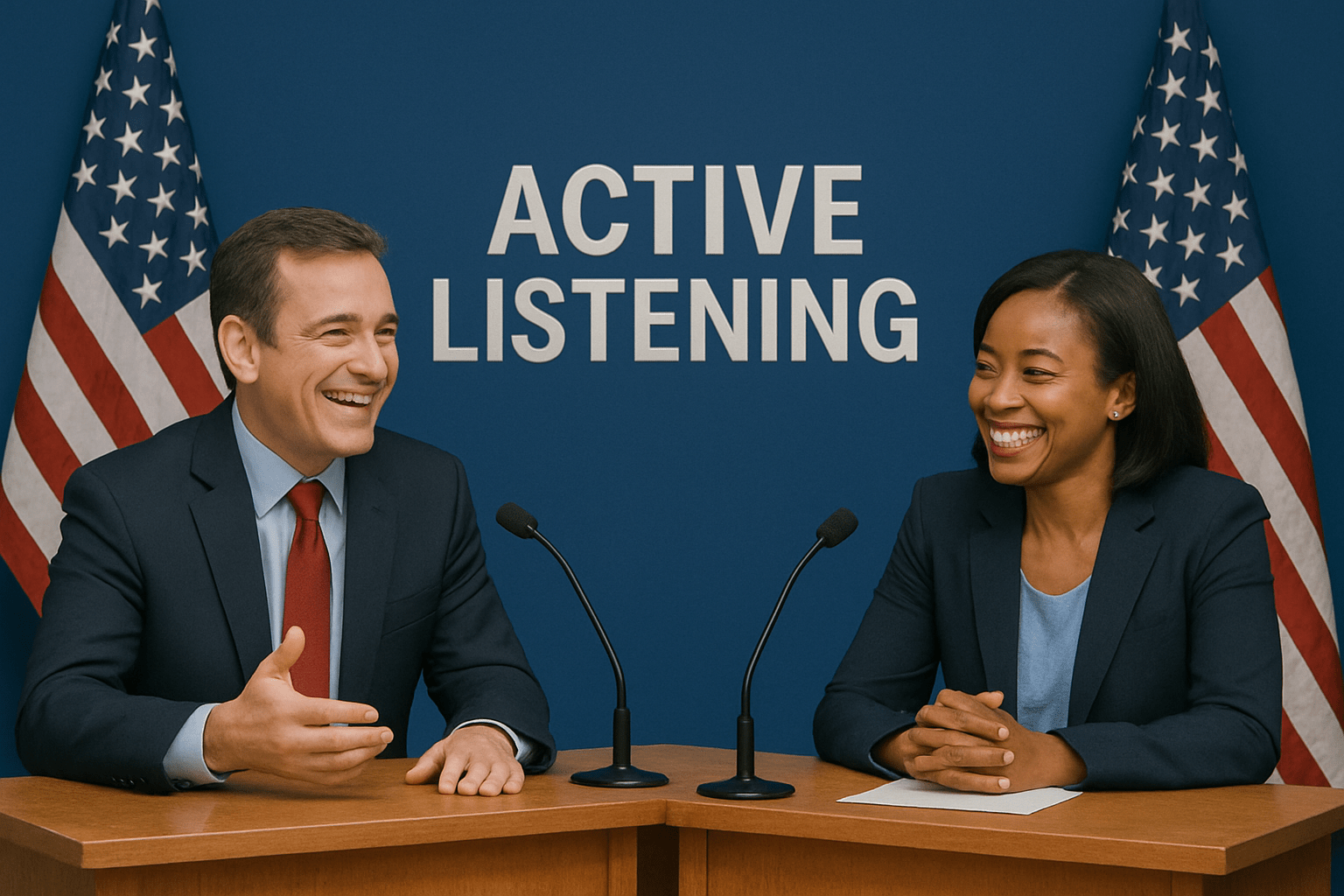
Active Listening: Beyond simply waiting for one’s turn to speak, students would learn to listen with genuine curiosity and without immediate judgment.
Reflective Looping: After hearing someone’s position, students would practice restating that position in their own words until the original speaker confirms, “Yes, that’s what I meant.” Only then would they offer their response.
Perspective-Taking: Students would regularly practice articulating positions they personally disagree with, presenting them in their strongest form rather than as straw men.
Identifying Common Ground: Before addressing disagreements, students would habitually identify shared values and areas of agreement.
What This Looks Like in Practice
Picture a high school classroom where controversial topics aren’t avoided but approached differently. Instead of traditional debates where teams try to “win,” students engage in structured dialogues where success is measured by how well they understand opposing viewpoints.
A teacher might present a divisive issue—say, immigration policy—and assign students to research multiple perspectives. But rather than immediately diving into advocacy, students would first engage in “understanding rounds” where they must demonstrate they can articulate views different from their own to the satisfaction of those who hold those views.
Only after this foundation of mutual understanding is established would students move to expressing their own positions and seeking solutions that acknowledge the legitimate concerns on all sides.
The Transformative Potential
The implications of this shift extend far beyond the classroom. Young people trained in these methods would bring these skills to voting booths, community meetings, and eventually, legislative chambers. They would approach disagreement not as combat but as an opportunity to expand understanding.
Over time, this could fundamentally transform our democratic institutions. Imagine:
- Political debates where candidates regularly demonstrate their understanding of opponents’ views before explaining why they disagree
- Town halls where citizens practice reflective listening before sharing their own perspectives
- Legislative sessions where finding common ground is as important as advancing partisan agendas
The Challenges Ahead
This vision isn’t without obstacles. Our current media environment rewards conflict over comprehension. Many political careers are built on rigid adherence to partisan positions rather than bridge-building. And there’s a legitimate concern that over-emphasizing understanding could sometimes delay necessary action on urgent issues.
Yet these challenges don’t diminish the value of the vision. We can teach understanding without abandoning conviction. We can practice listening without compromising our values. We can build a democracy where different perspectives enrich rather than threaten our collective decision-making.
Starting Small, Thinking Big
This transformation won’t happen overnight. It begins with small changes in classrooms, community organizations, and family dinner tables. It requires teachers willing to experiment with new models of dialogue, parents who model curiosity about differing viewpoints, and young people open to seeing beyond the polarized discourse that surrounds them.
But from these small beginnings, significant change can grow. Each person who masters the dual skills of advocacy and understanding becomes a potential bridge-builder in their community. Each dialogue that prioritizes comprehension over conversion creates space for new solutions to emerge.
Conclusion
Our current democratic crisis isn’t primarily about what we believe—it’s about how we engage with those who believe differently. By reimagining education to emphasize understanding alongside persuasion, we can raise a generation equipped to transform conflict into collaboration.
The skills of reflective listening and perspective-taking aren’t just nice additions to our civic toolbox—they’re essential instruments for addressing the complex challenges we face. By teaching young people to truly hear different perspectives, we’re not just improving discourse; we’re laying the groundwork for more effective problem-solving across all domains of democratic life.
The future of democracy depends not just on passionate advocates but on skilled listeners who can find pathways through seemingly intractable conflicts. By balancing our emphasis on speaking up with a renewed commitment to understanding others, we can build a democratic culture worthy of our highest aspirations.
 UpLive.Life