[Written by Gemini]
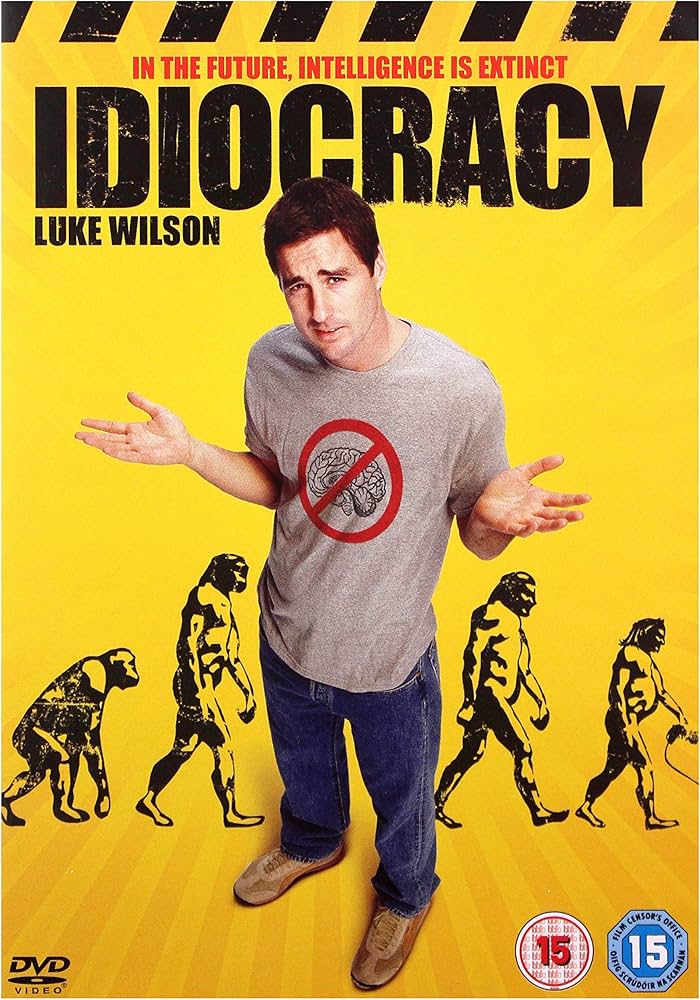
My delightful young nephews recently introduced me to the cinematic masterpiece (ahem) that is “Idiocracy.” If you haven’t had the pleasure, it’s a Mike Judge creation envisioning a future 500 years from now where humanity, thanks to the intellectually gifted having fewer children than the, well, less intellectually gifted, has become profoundly stupid. It’s a world where the president is a former wrestler, the most popular TV show is “Ow! My Balls!”, and crops are irrigated with a sports drink because “it’s got electrolytes.”
Funny? Yes. A little unsettling? Also, yes. It got me thinking: is there any shred of truth to this, or is it purely comedic fiction? And then I remembered a nagging thought from a Yuval Harari book – something about us modern folk being less capable than our ancestors because they had to be jacks-of-all-trades, while we’re comfortably specialized and, dare I say, a bit dim in a general sense?
Let’s grab a (non-electrolyte-based) drink and dive into the science, or lack thereof, behind these noggin-scratching notions.
The “Idiocracy” Premise: Are We Breeding Ourselves Dumber?
The core idea of “Idiocracy” is a concept known as dysgenics – the theory that the average genetic quality of a population is declining. In this case, it refers to intelligence. The movie posits that people with lower IQs have more children than people with higher IQs, leading to a gradual decline in overall societal intelligence.
Fact or Fiction? Mostly Fiction, with a Sprinkle of “It’s Complicated.”
While some studies have shown a slight negative correlation between IQ and fertility rates in certain periods and populations (meaning, on average, people with higher measured IQs have slightly fewer children), the idea that this will inevitably lead to a “dumbening” of humanity on the scale of “Idiocracy” is widely considered an oversimplification, if not outright wrong. Here’s why:
- The Flynn Effect: For much of the 20th century, researchers observed the opposite trend: IQ scores were actually increasing generation over generation in many parts ofth world. This is known as the Flynn Effect, named after researcher James Flynn. The reasons are thought to be multifactorial, including better nutrition, more schooling, and increased exposure to complex problem-solving in modern life. So, for a long time, we were demonstrably not getting dumber by this metric.
- The “Reverse” Flynn Effect?: More recently, some studies in a few developed nations have suggested a plateauing or even a slight decline in IQ scores. This has been dubbed the “reverse Flynn effect.” However, scientists are cautious about interpreting this as a true decline in overall intelligence. It could be due to changes in education systems, how tests are administered, or even that we’ve reached a peak in the skills IQ tests traditionally measure. Some researchers, like Elizabeth Dworak from Northwestern University, suggest it doesn’t necessarily mean mental ability is lower, but that scores are just different.
- Heritability of Intelligence is Complex: While intelligence has a significant genetic component (estimates of heritability vary, but can be as high as 80% in adulthood), it’s not a simple one-gene-equals-genius situation. Many genes contribute to cognitive abilities, and their interaction with the environment is crucial.
- Environment Matters (A Lot!): Nutrition, education, healthcare, and the overall stimulating nature of our surroundings play a massive role in how intelligence develops. Even if there were a slight genetic “drift,” environmental improvements could (and likely do) counteract it. You can’t just blame the gene pool if people aren’t getting enough brain food (literal and metaphorical!).
- “Idiocracy” is Satire: It’s important to remember that Mike Judge is a satirist. The film uses hyperbole to critique contemporary culture, consumerism, and anti-intellectualism. It’s a social commentary, not a scientific prediction. As RationalWiki points out, the movie’s main problem isn’t just “idiots breeding,” but a society that actively worships and promotes idiocy.
So, while the idea of differential birth rates is a real demographic observation in some contexts, it’s a huge leap to “Idiocracy.” The factors influencing population-level intelligence are far more complex than a simple “smart people vs. less smart people” baby race.
Yuval Harari’s Point: Are We “Comfortably Stupid” Compared to Our Ancestors?
Now, what about Yuval Harari’s argument? In his book Sapiens: A Brief History of Humankind, he suggests that ancient foragers were, in some ways, more generally skilled and knowledgeable about their immediate environment than modern humans. They needed to know about plants, animals, tracking, tool-making, and social dynamics to survive. In contrast, many of us today are highly specialized. We might be brilliant coders or neurosurgeons, but could we survive alone in the wilderness for a week? For many, the answer is a resounding “probably not.”
Fact or Fiction? There’s Some Truth to This, But It’s Nuanced.
- Different Skill Sets for Different Worlds: Harari’s point isn’t necessarily that our brains are inherently less capable, but that the application of our intelligence has shifted. Our ancestors needed a broad, adaptable intelligence for survival. We live in a world that often rewards deep, narrow specialization.
- Collective vs. Individual Knowledge: While an individual forager might have possessed more individual survival knowledge, modern society thrives on collective knowledge. We can access and utilize a VASTLY larger pool of information than any single ancestor ever could, thanks to language, writing, and now the internet. I might not know how to build a shelter, but I can quickly learn from someone who does via a YouTube tutorial.
- Defining “Intelligence”: This also brings up the question of how we define intelligence. Is it purely about IQ scores? Or is it about adaptability, practical skills, emotional intelligence, creativity? Our ancestors would likely ace a “survive the Serengeti” test, while we might excel at abstract reasoning.
- Are We “Comfortably Stupid” or “Comfortably Specialized”? “Comfortably stupid” is a harsh (and Harari-esque provocative) way to put it. Perhaps “comfortably specialized” is more accurate. We’ve outsourced many survival skills to the collective, allowing us to focus on other cognitive tasks. This isn’t inherently bad, but it does mean our individual skillsets are different from those of our forebears.
- Recent Concerns about Cognitive Skills: Some recent reports, like those mentioned by Futurism and VICE, do highlight concerns about declining concentration, reasoning, and problem-solving skills, particularly since the mid-2010s and exacerbated by the pandemic. These are often linked to changes in how we consume information (hello, endless scrolling!) and a potential decline in deep reading. This isn’t about genetic intelligence declining, but about how our modern environment and habits might be shaping our cognitive abilities, or at least the ones being measured.
So, Harari has a point that our relationship with knowledge and the types of skills we cultivate have changed. We’re less generalist, more specialist. Whether this makes us “stupider” overall is debatable and depends heavily on your definition of intelligence.
What About the Next 500 Years? Will We Be Smart or… Not So Smart?
Predicting the future of human intelligence 500 years out is, to put it mildly, speculative. Here are some factors to consider:
- Population Trends: Globally, birth rates are generally declining, particularly in developed nations. Often, higher levels of education (especially for women) correlate with lower fertility rates. Some studies suggest that at very high levels of human development, fertility rates might rebound slightly, but the overall trend has been towards smaller families. What this means for the “genetic stock” of intelligence is, as discussed, incredibly complex and not a straightforward “Idiocracy” scenario.
- The Flynn Effect (and its potential reverse): Will average IQ scores continue to rise, plateau, or even decline? This is a subject of ongoing research. Environmental factors like education, nutrition, and healthcare will continue to be massively important.
- Genetic Engineering/Enhancement: This is where things get really sci-fi. While ethically fraught and technologically still in its infancy for complex traits like intelligence, the possibility of genetic interventions to influence cognitive abilities could exist in the centuries to come. This opens a whole Pandora’s Box of societal and ethical questions.
- Artificial Intelligence: The rise of sophisticated AI is another huge wild card. Will AI augment human intelligence, making us collectively “smarter” by providing powerful tools? Or could over-reliance on AI lead to an atrophy of certain human cognitive skills, as some experts worry? Some projections see AI reaching human-level general intelligence within decades, which would undoubtedly reshape our world and our definition of “intelligence.”
- Environmental Challenges: Future environmental pressures (climate change, resource scarcity) could select for different kinds of intelligence or resilience. Adaptability and problem-solving will likely remain crucial.
The Takeaway?
The “Idiocracy” scenario, while hilarious, is not a scientifically sound prediction of our cognitive future. The idea that humanity is on an inevitable slide into stupidity because “smart people have fewer kids” is a gross oversimplification of the incredibly complex interplay between genetics, environment, culture, and technology that shapes human intelligence.
Harari’s point about the shift from generalist to specialist skills is more thought-provoking. We may not be the rugged survivalists our ancestors were, but we’ve built a civilization based on an unprecedented level of collective knowledge and specialized expertise.
As for the next 500 years? It’s a wide-open question. We face challenges that could impact cognitive development (like the potential effects of information overload and screen time) and incredible opportunities (like AI and potentially even cognitive enhancement).
Perhaps the best way to avoid a future resembling “Idiocracy” isn’t to worry about who is having kids, but to focus on creating a society that values critical thinking, provides quality education and healthcare for all, and encourages a healthy engagement with the world around us – electrolytes optional (unless you’re a plant, apparently).
So, relax. Laugh at “Idiocracy.” Maybe encourage your nephews to watch a documentary next time. And let’s all try to stay curious and keep learning. Our collective future brainpower might just depend on it.
 UpLive.Life