[Written by Grok]
I first discovered Dr. Shefali Tsabary through a friend who raved about her transformative approach to parenting. Intrigued, I dove into her work and quickly realized why she resonates with so many. Dr. Shefali, a clinical psychologist with a Ph.D. from Columbia University, blends Western psychological principles with Eastern mindfulness practices, creating a unique philosophy that emphasizes conscious living. Born in India and now based in the United States, she draws from her cross-cultural experiences to guide parents, individuals, and even children toward authentic relationships and self-awareness. With over two decades of clinical practice and a series of bestselling books, including The Conscious Parent and A Radical Awakening, Dr. Shefali has become a leading voice in mindful parenting and personal growth, inspiring countless people to break free from inherited patterns and embrace a more present, connected life.
Dr. Shefali Tsabary’s approach to discovering the authentic self, as outlined in books like The Conscious Parent and A Radical Awakening, can be profoundly challenging for parents because it demands deep self-reflection and personal growth, processes that are often uncomfortable and time-intensive. Unlike traditional parenting methods that focus on controlling a child’s behavior, her philosophy requires parents to confront their own unresolved emotional wounds, inherited patterns, and ego-driven reactions, which can feel daunting amidst the daily demands of parenting. For instance, recognizing that a harsh reaction to a child’s tantrum stems from personal insecurities requires vulnerability and introspection, often necessitating tools like journaling or therapy that busy parents may struggle to prioritize. This ongoing commitment to self-awareness and change, while transformative, places a significant emotional and practical burden on parents, especially those navigating external pressures like work, finances, or societal expectations, making the journey toward authenticity both rewarding and arduous.
However, embracing Dr. Shefali Tsabary’s approach to discovering the authentic self, though demanding deep self-reflection and personal growth, is a profoundly worthwhile endeavor for parents, as it holds transformative value for both themselves and their children. By investing time in mindfulness practices and confronting their own emotional triggers, parents not only heal their own wounds but also model authenticity, resilience, and emotional honesty for their children, fostering deeper, more genuine connections. This journey, as emphasized in The Conscious Parent and The Parenting Map, empowers parents to break free from inherited patterns, creating a nurturing environment where children can thrive as their true selves, unburdened by parental expectations or societal pressures. The effort, while challenging amidst busy schedules, cultivates a legacy of emotional well-being and self-awareness that benefits both parent and child for generations.
Related Posts: The Sovereign Child
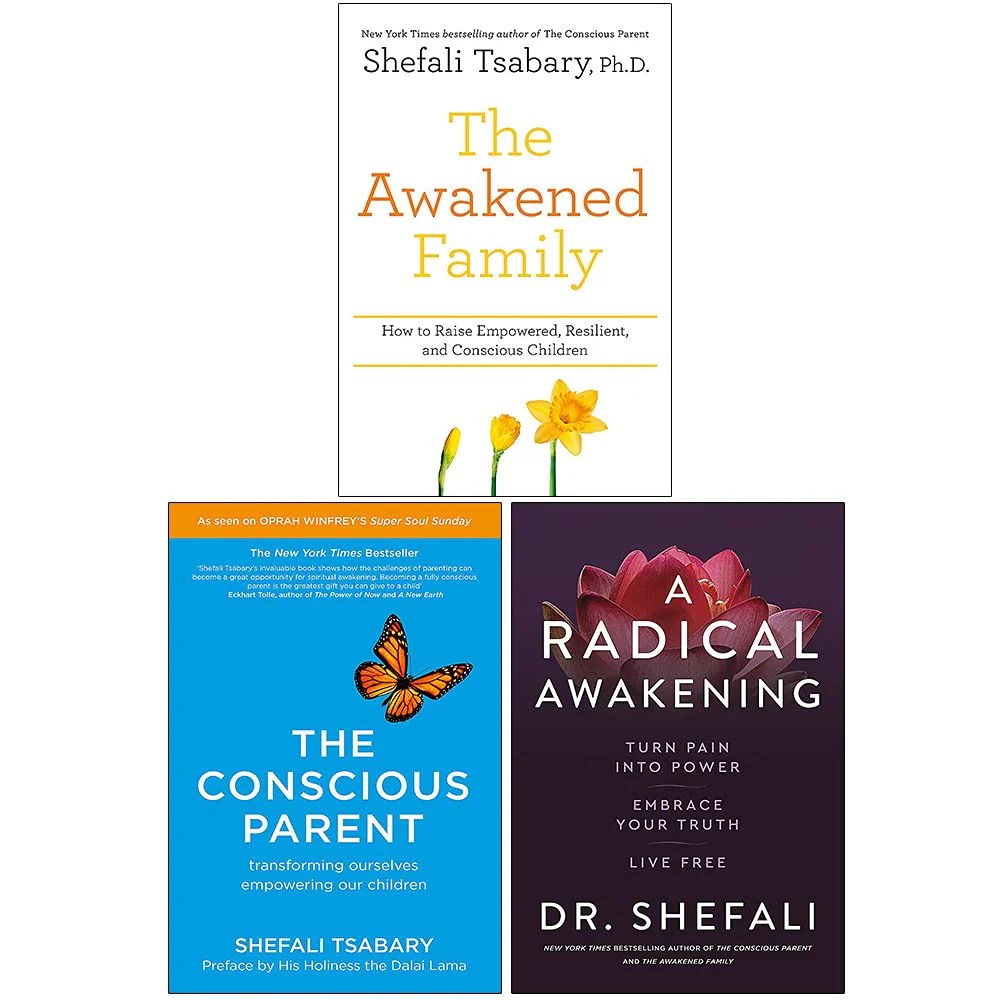
Dr. Shefali Tsabary’s books form a cohesive body of work centered on conscious parenting, personal growth, and mindful living, blending Western psychology with Eastern philosophy. Her core titles—The Conscious Parent (2010), Out of Control (2014), The Awakened Family (2016), The Parenting Map (2023), A Radical Awakening (2021), and SUPERPOWERED (2020, co-authored with Renee Jain)—build on each other thematically, each exploring interconnected ideas about self-awareness, authentic relationships, and breaking free from inherited patterns.
Key Themes and Relationships:
- Conscious Parenting as a Foundation:
- The Conscious Parent introduces Dr. Shefali’s revolutionary approach, emphasizing that parenting is a mutual journey where children act as mirrors for parents’ unresolved issues. It urges parents to transform themselves to foster authentic connections with their children, moving away from control-based, ego-driven parenting.
- This concept is the backbone of her subsequent works, particularly The Awakened Family and The Parenting Map, which deepen the focus on raising emotionally resilient children by addressing parental baggage and societal expectations.
- Challenging Traditional Discipline:
- Out of Control critiques conventional discipline methods, arguing they perpetuate dysfunction rather than fostering growth. It builds on The Conscious Parent by offering alternatives centered on connection and presence, a theme revisited in The Parenting Map with practical, evidence-based strategies.
- Family Dynamics and Emotional Resilience:
- The Awakened Family expands on The Conscious Parent by providing tools for a symbiotic family relationship, reducing anxiety for both parents and children. It integrates mindfulness to help families embrace authenticity, a thread continued in The Parenting Map, which offers step-by-step solutions for navigating modern parenting challenges like social media and generational pressures.
- Personal Transformation Beyond Parenting:
- A Radical Awakening shifts focus to individual growth, particularly for women, encouraging them to transcend societal norms and heal personal wounds. While not exclusively about parenting, it connects to her earlier works by emphasizing self-awareness as the key to authentic relationships, including those with children.
- Empowering Children:
- Early Motherhood:
Progression and Interconnection:
- Chronological Development: Her books progress from laying the groundwork (The Conscious Parent) to critiquing traditional methods (Out of Control), offering family-wide solutions (The Awakened Family), providing actionable guides (The Parenting Map), and addressing personal liberation (A Radical Awakening). Each builds on the prior, refining her conscious parenting framework.
- Shared Philosophy: All books emphasize self-reflection, breaking toxic cycles, and fostering authentic connections. Parenting books focus on the parent-child dynamic, while A Radical Awakening applies these principles to personal growth, particularly for women. SUPERPOWERED extends the philosophy to children.
- Practical Application: The Parenting Map synthesizes her earlier ideas into a structured guide, drawing on over two decades of clinical experience, client anecdotes, and evidence-based practices, making it a culmination of her parenting-focused work.
Differences and Complementary Nature:
- Audience Focus: While The Conscious Parent, Out of Control, The Awakened Family, and The Parenting Map target parents, A Radical Awakening is geared toward women seeking personal transformation, and SUPERPOWERED is for children. It’s a Mom! is specific to new mothers.
- Scope: Parenting books focus on family dynamics, while A Radical Awakening broadens the scope to societal conditioning and personal empowerment. SUPERPOWERED is unique in its direct engagement with kids through interactive tools like quizzes.
Critical Perspective:
Dr. Shefali’s books are interconnected through her consistent advocacy for mindfulness and authenticity, but they can feel repetitive to some readers, as they reiterate core ideas across different contexts. Her reliance on blending Eastern and Western philosophies is distinctive but may not resonate with those skeptical of mindfulness-based approaches. The progression from broad concepts to practical guides reflects her response to modern parenting challenges, though the evidence base for some claims (e.g., breaking “toxic cycles”) is often anecdotal rather than rigorously scientific.
In summary, Dr. Shefali’s books form a layered exploration of conscious living, with each title building on her core philosophy while addressing specific aspects of parenting, personal growth, or children’s empowerment. They are best read sequentially to trace the evolution of her thought, starting with The Conscious Parent and culminating in The Parenting Map for parenting, or A Radical Awakening for personal transformation.
Understanding the Authentic Self and the Journey to Discover It
Dr. Shefali Tsabary’s concept of the authentic self, prominently featured in books like A Radical Awakening and The Conscious Parent, refers to the core essence of who you are—untainted by societal expectations, cultural conditioning, or inherited patterns. It’s the version of you that exists when you strip away external roles (parent, employee, spouse), ego-driven desires, or the need for validation. Living from your authentic self means aligning your actions, relationships, and choices with your true values, emotions, and inner truth, fostering a life of presence, honesty, and fulfillment.
Discovering your authentic self is a deeply introspective process that requires courage, mindfulness, and a willingness to confront uncomfortable truths. Below, I’ll outline what the authentic self entails in Dr. Shefali’s framework, provide a step-by-step guide to uncovering it, and address practical challenges, grounded in her philosophy of blending Western psychology and Eastern mindfulness.
What Is the Authentic Self?
- Core Definition: The authentic self is your innate, unfiltered being—free from the masks you wear to fit into society or meet others’ expectations. It’s the part of you that feels alive when you express your true emotions, follow your passions, or act without fear of judgment.
- In Dr. Shefali’s Work: In A Radical Awakening, she emphasizes that most people live inauthentically, shaped by childhood wounds, parental expectations, or cultural norms. For example, a parent might push their child to pursue a prestigious career to fulfill their own unachieved dreams, ignoring their authentic desire to support the child’s unique path. In The Conscious Parent, she argues that reconnecting with your authentic self allows you to parent from presence, not control, fostering genuine connections.
- Key Characteristics:
- Emotional Honesty: Acknowledging and expressing your true feelings, like admitting fear instead of masking it with anger.
- Alignment with Values: Making choices that reflect what truly matters to you, not what society deems “successful.”
- Vulnerability: Embracing imperfection and letting go of the need to appear “perfect” or “in control.”
- Presence: Living in the moment, free from ruminating on the past or worrying about the future.
- Why It Matters: Dr. Shefali teaches that living inauthentically creates inner conflict, anxiety, and disconnected relationships. By embodying your authentic self, you model authenticity for others (especially children), cultivate self-acceptance, and live with greater peace.
How to Discover Your Authentic Self
Discovering your authentic self is not a one-time event but an ongoing journey of self-awareness and unlearning. Dr. Shefali’s approach, drawn from mindfulness practices and psychological introspection, involves peeling back layers of conditioning. Here’s a practical, step-by-step guide based on her teachings:
A Step-by-Step Guide to Discovering Your Authentic Self
Inspired by Dr. Shefali Tsabary’s teachings in A Radical Awakening and The Conscious Parent, this guide outlines practical steps to uncover your true essence, free from societal conditioning and ego-driven patterns.
Step 1: Cultivate Self-Awareness Through Mindfulness
- What to Do: Begin by observing your thoughts, emotions, and behaviors without judgment. Mindfulness practices like meditation or breathwork help you notice when you’re acting from habit or external pressure versus your true self.
- How to Start:
- Set aside 5–10 minutes daily for mindfulness. Sit quietly, focus on your breath, and observe thoughts as they arise. Apps like Headspace or Dr. Shefali’s guided meditations can help.
- Ask: “What am I feeling right now? Am I reacting out of fear, guilt, or a need to please?”
- Example: If you snap at your child for spilling juice, pause and notice if your anger stems from exhaustion or a deeper fear of being an “imperfect” parent.
- Why It Works: Mindfulness creates space to distinguish your authentic impulses from conditioned responses, revealing patterns that obscure your true self.
Step 2: Reflect on Your Conditioning
- What to Do: Identify the beliefs, roles, or expectations you’ve inherited from family, culture, or society that don’t align with your inner truth. Dr. Shefali emphasizes that childhood experiences often shape inauthentic behaviors.
- How to Start:
- Journal prompts:
- “What did my parents or culture teach me about success, love, or worthiness?”
- “What roles (e.g., ‘good parent,’ ‘high achiever’) do I play that feel forced?”
- “What would I do differently if no one was judging me?”
- Reflect on moments you felt truly alive or free—these hint at your authentic self.
- Journal prompts:
- Example: You might realize you pursued a corporate job to meet parental expectations, but your authentic self craves creative work like writing or art.
- Why It Works: Uncovering conditioning helps you separate external “shoulds” from your genuine desires, a cornerstone of Dr. Shefali’s teachings.
Step 3: Embrace Your Emotions
- What to Do: Allow yourself to feel and express emotions without suppression or judgment. Dr. Shefali teaches that denying emotions (e.g., sadness, anger) disconnects you from your authentic self.
- How to Start:
- Practice naming your emotions daily: “I feel anxious because…” or “I feel joyful when…”
- Express emotions safely through journaling, talking to a trusted friend, or therapy.
- Avoid “fixing” emotions; sit with them to understand their message.
- Example: Instead of hiding frustration at work to seem “professional,” acknowledge it and explore its root (e.g., feeling undervalued).
- Why It Works: Emotions are a direct link to your inner truth. Honoring them builds self-trust and authenticity.
Step 4: Question Your Ego
- What to Do: Examine when your ego—driven by pride, control, or validation—overrides your authentic self. Dr. Shefali highlights that ego creates inauthentic behaviors like people-pleasing or perfectionism.
- How to Start:
- Notice ego-driven actions: “Am I saying yes to this obligation to avoid conflict?” or “Am I pushing my child to excel for my own pride?”
- Practice small acts of vulnerability, like admitting a mistake or asking for help.
- Example: If you’re upset because your child didn’t win a competition, reflect on whether your disappointment is about their happiness or your need to feel validated as a parent.
- Why It Works: Letting go of ego-driven needs aligns you with your authentic self, fostering genuine connections.
Step 5: Align Actions with Inner Truth
- What to Do: Make choices that reflect your true values and desires, even if they challenge societal norms. Dr. Shefali encourages small, courageous steps toward authenticity.
- How to Start:
- Identify one area where you act inauthentically (e.g., staying in a draining job or relationship).
- Take a small action: Say “no” to an obligation, pursue a hobby you love, or express an unpopular opinion kindly.
- Check in: “Does this choice feel true to me, or am I seeking approval?”
- Example: If you’ve always wanted to travel but fear judgment, plan a solo trip that excites you, prioritizing your joy over others’ opinions.
- Why It Works: Acting in alignment with your truth reinforces your authentic self, building confidence over time.
Step 6: Seek Support and Practice Patience
- What to Do: Recognize that uncovering your authentic self is a lifelong journey that may require external guidance. Dr. Shefali advocates for community and professional support.
- How to Start:
- Join a mindfulness or parenting group inspired by Dr. Shefali’s work (e.g., her online courses or workshops).
- Consider therapy to explore deep-seated patterns with a professional.
- Be patient; unlearning conditioning takes time, and setbacks are normal.
- Example: A therapist might help you uncover why you feel guilty setting boundaries, linking it to childhood expectations, freeing you to act more authentically.
- Why It Works: Support provides accountability and perspective, while patience prevents discouragement.
Practical Tools
- Journaling: Write daily to track emotions, triggers, and moments of authenticity.
- Meditation: Use 5-minute guided sessions to build presence and self-awareness.
- Dr. Shefali’s Resources: Read A Radical Awakening or follow her guided exercises in The Parenting Map for structured reflection.
- Affirmations: Repeat phrases like “I am enough as I am” to counter conditioned self-doubt.
Challenges to Expect
- Fear of Judgment: Acting authentically may invite criticism. Start with safe spaces (e.g., trusted friends) to build confidence.
- Time Constraints: Busy schedules make introspection hard. Even 5 minutes of mindfulness daily can make a difference.
- Emotional Discomfort: Facing suppressed emotions or painful memories can be intense. Therapy or journaling can help process this safely.
- Societal Pressure: Cultural norms may clash with your authentic choices. Dr. Shefali advises grounding yourself in your truth to stay resilient.
Final Note
Discovering your authentic self is a transformative journey that requires courage and compassion. As Dr. Shefali teaches, it’s not about perfection but presence—showing up for yourself with honesty each day. By peeling back layers of conditioning and aligning with your inner truth, you not only live more fully but also inspire those around you, especially children, to do the same.
 UpLive.Life