[Written by DeepSeek]
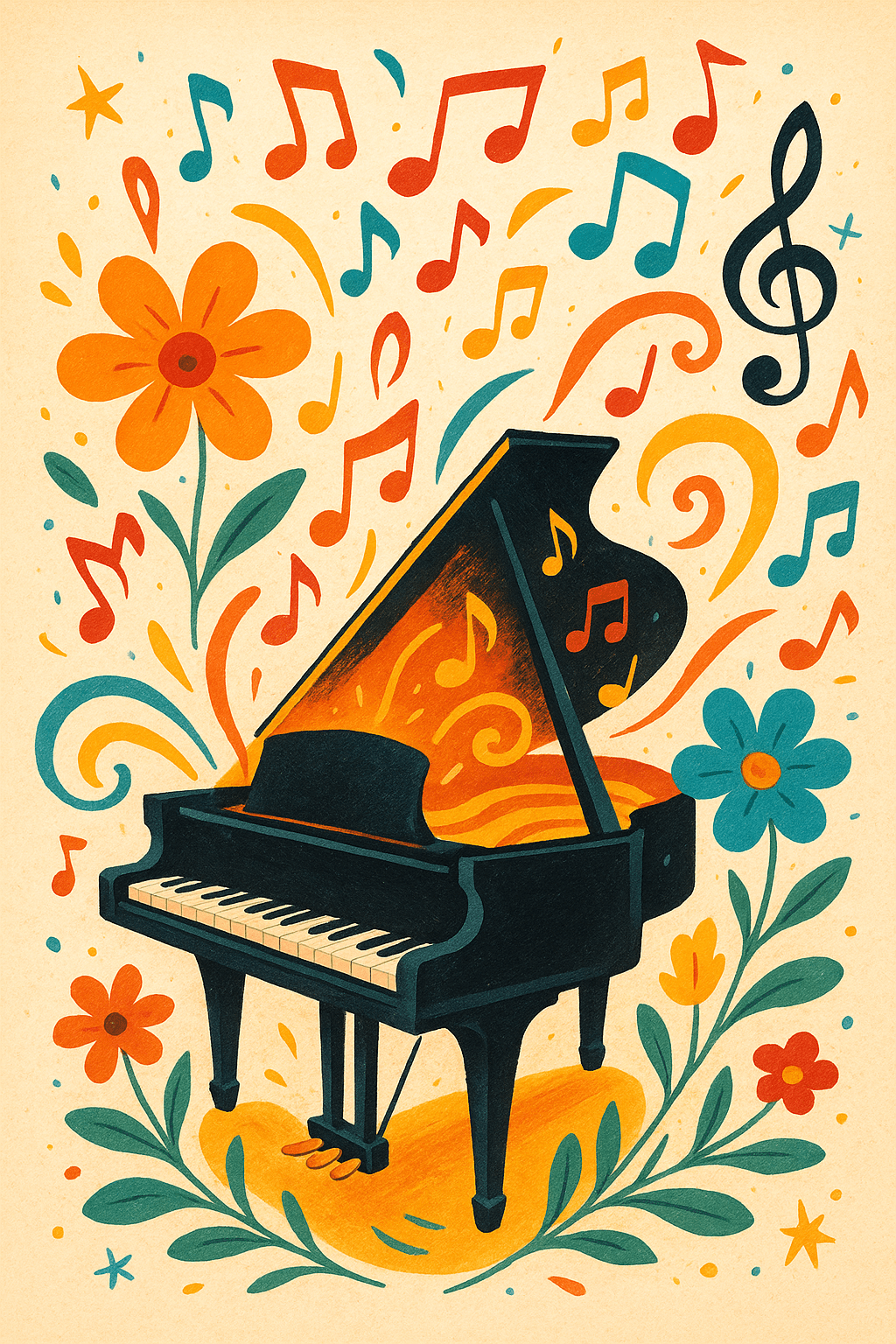
A conversation with a young pianist reminded me that music isn’t just about perfection—it’s about joy, curiosity, and the freedom to play.
The other day, I found myself in a conversation with a young boy about learning the piano. He talked about how he experimented with different chords and the joy of composing his own music. His passion reminded me how a child’s curiosity can inspire lifelong learning.
For the past few years, my relationship with the piano has been one of discipline.
- Instead of playing, I’ve been practicing.
- Instead of exploring chords, I’ve been memorizing their names.
- Instead of immersing myself in sound, I’ve been treating piano like another goal to conquer.
I realized: I don’t just do this with piano—I do this with life.
The Problem with Treating Music Like a Checklist
There’s nothing wrong with structured practice—technique, scales, and repertoire are essential. But when playing becomes secondary to performing correctly, we lose something vital:
- The thrill of discovery (What happens if I play these notes together?)
- The joy of expression (How does this chord feel?)
- The freedom to sound bad (Who cares if it’s “wrong” if it’s fun?)
How to Actually Play the Piano (Not Just Practice It)
Here’s what I’m trying now to shift my mindset—with practical examples to make it real:
1. Improvise First, Analyze Later
Try this now:
- Play C Major (C-E-G) in your left hand.
- With your right, noodle around the C Major pentatonic scale (C-D-E-G-A).
- Make it a “call and response” game: Play 3 random notes (E-G-C), pause, then answer with another 3 (A-G-D).
Pro tip: Limit yourself to 3-4 notes—constraints boost creativity!
2. Play by Ear (Like a Musical Detective)
Steal these tunes by ear:
- “Happy Birthday”: Starts on G (“Hap-“), then G-A-G-C-B…
- “Mario Theme”: The first 5 notes are E-G-E-C-D-E…
- Pop songs: Adele’s “Someone Like You” chorus is just A-B-C#m-E.
Why it works: Your ear learns faster than your fingers memorize sheet music.
3. Jam with Backing Tracks (Instant Band!)
YouTube search: “C Major jazz backing track”
- Left hand: Play Cmaj7-Fmaj7-G7 (hold each for 4 beats).
- Right hand: Improvise with the C Major scale, but add a bluesy E-flat for spice.
Style experiments:
- Lo-fi hip-hop: Play sparse chords + a repeating melodic hook.
- Cinematic: Hold the sustain pedal, play rumbling bass octaves + high sparkly notes.
4. Twist Familiar Pieces (Like a Remix DJ)
Take “Für Elise” and:
- Reggae version: Staccato melody + offbeat chords.
- Minor key: Lower all E’s to E-flat—instant “Dark Elise.”
- Boogie-woogie: Add a rolling left-hand bassline (C-E-G-A, C-E-G-A#).
Or try: Play Bach’s Minuet in G with swing rhythm (jazz it up!).
5. Experiment with Sound (Beyond Notes)
“Prepare” your piano:
- Place paper clips on strings for a harp-like twang.
- Pluck strings inside while holding the sustain pedal for eerie echoes.
- Play clusters: Smash a fistful of black keys for a thunderstorm effect.
Digital piano? Try:
- Synth pads: Drench chords in reverb/delay.
- Reverse effect: Record a phrase, play it backward, and mimic it.
6. Collaborate (Even If You’re Alone)
Duet with yourself:
- Record a left-hand loop (e.g., C-G-Am-F).
- Play it back and improvise a right-hand melody.
With a friend:
- One plays ostinato (repeating pattern), the other solos.
- “Sound painting”: Someone claps/whistles, you respond on piano.
7. Compose Mini-Masterpieces (No Theory Needed)
Create a 4-bar loop:
- Left hand: C – G – Am – F (the pop-punk progression).
- Right hand: Invent a 3-note motif (C-E-D), then vary the last note each repeat.
Advanced: Use the “rule of 3”—introduce, repeat with variation, resolve.
8. Play Games (Turn Drills into Play)
Game 1: Musical Dice
- Assign chords to numbers (1=C, 2=Dm, etc.). Roll dice to generate progressions.
Game 2: “Soundtrack a Scene”
- Mute a movie clip (Pixar’s “Up” montage), improvise sad/hopeful music.
Game 3: “Wrong Hand Challenge”
- Play melodies with your left hand, chords with your right (brain melt guaranteed).
9. Focus on Feel (Break Every Rule)
Play “Twinkle Twinkle” with:
- Dramatic rubato: Speed up/slow down like a dramatic actor.
- “Wrong” notes: Add a bluesy C# in C Major for tension.
- Extreme dynamics: Whisper the verses, then BANG the climax.
Think: “What would Hans Zimmer do with this nursery rhyme?”
10. Explore Styles (Be a Genre Chameleon)
Blues:
- Left hand: “Shuffle” bass (C-G-C-A).
- Right hand: Blues scale (C-Eb-F-Gb-G-Bb) + slide off keys for vocal-like bends.
Video Game (8-bit):
- Staccato chords + rapid arpeggios (Super Mario Bros. underground theme).
Minimalist (Philip Glass):
- Repeat a 3-note pattern (E-F#-G), shift it up/down slowly.
The Bigger Lesson: Music (and Life) Isn’t Just About the Destination
That boy didn’t care about chord names—he cared about how the music made him feel.
And that’s the real magic of piano: It’s not just an instrument. It’s a playground.
So now, I’m trying something radical:
I’m letting myself play.
Not to improve. Not to perform. Just to remember why I fell in love with music in the first place.
Your Turn
Have you ever caught yourself treating piano (or anything else) too seriously? How do you reconnect with the joy of playing?
Challenge for you today: Set a timer for 10 minutes of “guilt-free play”—no wrong notes allowed!
(Bonus: Try Happy Birthday in a minor key. It’s hilarious and weirdly beautiful.)
Now, go make some beautiful mistakes on the keys. 🎹✨
 UpLive.Life