[Written by Gemini. Image credit]
This report explores the Kardashev Scale, a fascinating theoretical framework for classifying civilizations based on their energy consumption, examines the life and contributions of its creator, Nikolai Kardashev, discusses humanity’s current position and evolutionary trajectory, and outlines potential pathways to advancing to a Type I civilization and beyond.
Nikolai Kardashev: The Visionary Behind the Scale
Nikolai Semyonovich Kardashev (1932-2019) was a Soviet and Russian astrophysicist, widely recognized for his groundbreaking work in radio astronomy and, most notably, for proposing the Kardashev Scale. Born in Moscow, Kardashev’s early life was marked by the tumultuous political climate of the Soviet Union, with both of his parents being arrested during the Great Purge. Despite these hardships, he developed a profound interest in natural sciences, particularly astronomy, from a young age.
Kardashev pursued his passion, graduating from the Department of Astronomy at Moscow State University in 1955. His studies focused on the burgeoning field of radio astronomy, where he was heavily influenced by the charismatic Iosif Shklovsky. He went on to earn his doctorate in physical and mathematical sciences in 1962. Throughout his career, Kardashev held significant positions, including deputy director of the Astro Space Center of the Lebedev Physical Institute of the Russian Academy of Sciences. He also played a key role in several spaceborne radio astronomy projects.
Kardashev developed his scale in 1964, presenting it in a paper titled “Transmission of Information by Extraterrestrial Civilizations.” His primary motivation was to help direct the search for extraterrestrial intelligence (SETI) by hypothesizing that more advanced civilizations would harness greater amounts of energy, leading to more powerful and detectable signals.
The Kardashev Scale: A Framework for Cosmic Evolution
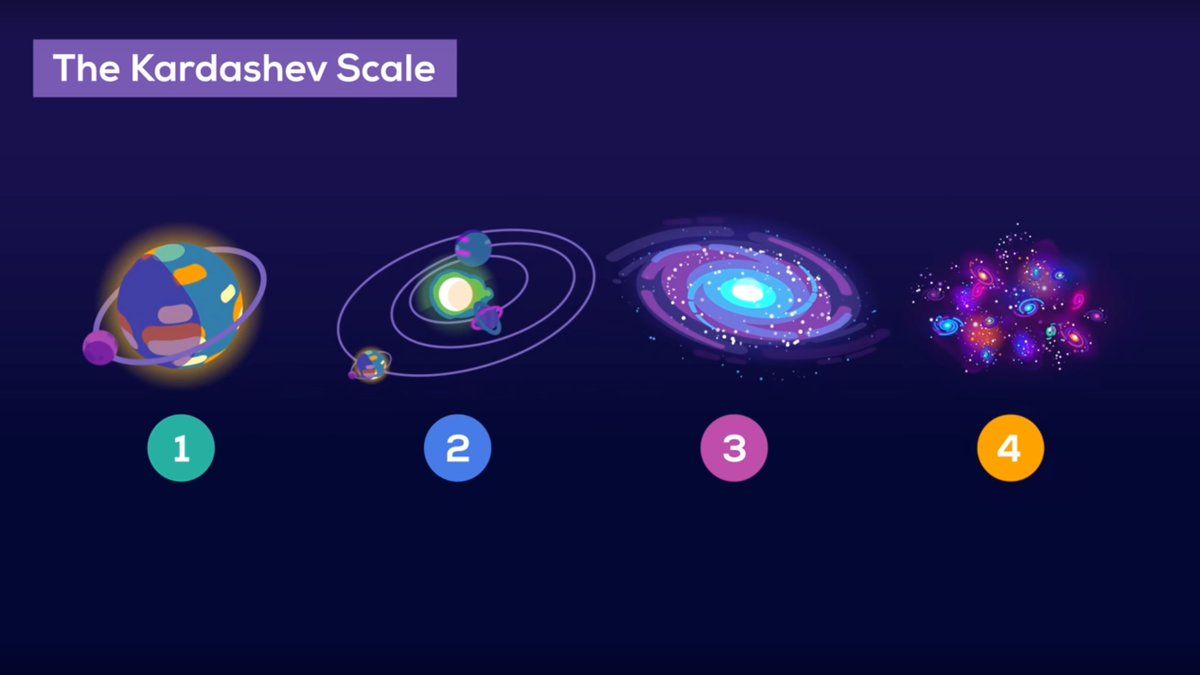
The Kardashev Scale measures a civilization’s technological advancement based on the amount of energy it is capable of harnessing and utilizing. It initially categorized civilizations into three broad types:
- Type I Civilization: A civilization that can harness all the energy available from its home planet, including solar, wind, geothermal, and even the planet’s internal heat. This level of control would imply mastery over planetary forces, such as weather patterns, earthquakes, and volcanic activity.
- Type II Civilization: A civilization capable of harnessing all the energy output of its host star. This is often conceptualized through megastructures like a Dyson Sphere, which would encompass a star to capture its entire energy output.
- Type III Civilization: A civilization that can control and utilize the energy of an entire galaxy, potentially by harnessing the energy of countless stars or even the supermassive black hole at the galactic center.
Later interpretations and additions to the scale, most notably by Carl Sagan, introduced decimal points to represent civilizations that fall between these whole-number types. This allows for a more nuanced understanding of a civilization’s progression.
Human Evolution and Energy Consumption
Humanity’s journey has been inextricably linked to its increasing ability to harness and utilize energy. From early hominids discovering fire to the agricultural revolution, the industrial revolution, and the information age, each major leap in human evolution has been fueled by an expanded capacity to extract and control energy. We are unique among species in our ability to use energy extrasomatically – outside our own bodies – allowing us to adapt to diverse environments and overcome biological limitations without direct genetic changes.
Currently, human civilization is estimated to be a Type 0 civilization on the Kardashev Scale, specifically around Type 0.72-0.73 according to some calculations. We primarily rely on fossil fuels, which are finite, along with a growing but still insufficient portion of renewable energy sources. While we have made significant technological advancements, our energy consumption is far from encompassing all the energy available on Earth.
Advancing to Type I and Beyond
Achieving Type I status would signify a monumental leap for humanity, requiring us to increase our current energy production by over 100,000 times. This advancement necessitates a global paradigm shift in energy production, consumption, and societal cooperation. Key strategies and technologies for reaching Type I include:
- Harnessing Renewable Energy on a Massive Scale: This involves dramatically expanding the use of solar (both terrestrial and space-based), wind, hydroelectric, geothermal, and tidal power. Geothermal, in particular, holds immense potential as a constant, clean energy source.
- Fusion Power: Developing and deploying practical fusion reactors would provide an almost limitless source of clean energy, mimicking the processes that power stars. This remains a significant scientific and engineering challenge but is a crucial step for long-term energy security.
- Space-Based Energy Collection: Deploying vast solar power satellites in Earth orbit that beam energy down to the surface could capture a far greater proportion of the Sun’s energy than what reaches the planet’s surface.
- Efficient Energy Storage and Distribution: Advanced battery technologies, smart grids, and global energy distribution networks would be essential to manage and distribute the immense amounts of energy harnessed.
- Sustainable Resource Management: Achieving Type I also implies a sustainable relationship with our planet’s resources, minimizing waste and maximizing recycling and closed-loop systems.
- Global Cooperation and Societal Transformation: Perhaps the most significant hurdle is fostering unprecedented global cooperation. Overcoming geopolitical divides, addressing inequalities, and uniting humanity under a common goal of sustainable progress are paramount. A Type I civilization would likely require a more unified global governance and resource management system.
Beyond Type I, the path towards Type II and Type III becomes even more speculative, involving technologies such as: - Dyson Spheres/Swarms: For Type II, constructing megastructures around the Sun to capture its entire energy output.
- Interstellar Energy Harvesting: For Type III, developing technologies to tap into the energy of multiple stars within a galaxy, potentially through advanced interstellar travel and colonization.
- Black Hole Energy Extraction: Theoretically, advanced civilizations might even learn to extract energy from the accretion disks of black holes.
The Kardashev Scale serves not only as a theoretical measure but also as a powerful thought experiment, prompting us to consider the ultimate trajectory of intelligent life in the universe. While humanity faces significant challenges, the vision of a Type I civilization and beyond offers a compelling long-term goal, driving innovation and fostering a sense of shared purpose for the future of our species.
Here are two conceptual scales — inspired by the Kardashev Scale — tailored for:
- Individuals (based on financial, political, and military power)
- Civilizations/Nations (based on economic, military, and global influence)
🌐 1. Terran Influence Scale – Individual Version
This scale ranks individuals by how much real-world power they command, directly or indirectly, through wealth, institutions, military, or ideological sway.
| Level | Description | Key Traits | Example Figures (as of 2025) |
|---|---|---|---|
| Type 0-H | Local or minor influence | Wealth <$10M; no significant political or media reach | Local politicians, small business owners |
| Type I-H | Regional economic or social power | Wealth ~$100M–$1B; moderate media, corporate, or institutional control | Elon Musk (in early 2010s), regional tycoons |
| Type II-H | National-level power | Billionaire status, or leads major institutions (media, military, or tech) with national impact | Oprah Winfrey, Mark Zuckerberg, Xi Jinping’s ministers |
| Type III-H | Global corporate or ideological influence | Controls multi-national wealth/power or global narratives | Elon Musk (SpaceX, Tesla, X), Jeff Bezos (Amazon, Blue Origin), Pope Francis |
| Type IV-H | Controls or heavily influences nations or global military balance | Direct control of major military or nuclear state | Donald Trump, Xi Jinping, Vladimir Putin |
| Type V-H (Hypothetical) | Global hegemony or supra-national control | Unified control over Earth or dominant planetary governance | None yet — possibly future UN-type planetary leader |
🏛 2. Terran Power Scale – Civilization/Nation Version
This version mimics the Kardashev Scale by ranking countries based on how much real-world influence they exert globally, through economic strength, military power, technological leadership, and diplomatic reach.
| Level | Description | Capabilities | Example Nations (2025) |
|---|---|---|---|
| Type 0-T | Weak or dependent states | Little global influence; may rely on aid | Chad, Haiti, Somalia |
| Type I-T | Regional powers | Influence in nearby regions; limited global reach | Turkey, South Africa, Iran |
| Type II-T | Emerging global powers | Strong economy and military; diplomatic reach across continents | India, Brazil |
| Type III-T | Great powers | Large GDP, advanced military, global trade and tech influence | United Kingdom, France, Germany |
| Type IV-T | Superpowers | Global military and economic dominance, space presence | USA, China |
| Type V-T (Hypothetical) | Planetary civilization | Unified global governance, integrated infrastructure, space colonization | Not yet achieved — possible future Earth federation |
📌 Notes
- The “-H” suffix refers to “Human” levels — individual influence.
- The “-T” suffix refers to “Terran” (nation/civilization) levels.
- These are not purely wealth-based: media influence, military command, ideological sway, and technological leadership all factor in.
 UpLive.Life