[Written by Claude. Image credit.]
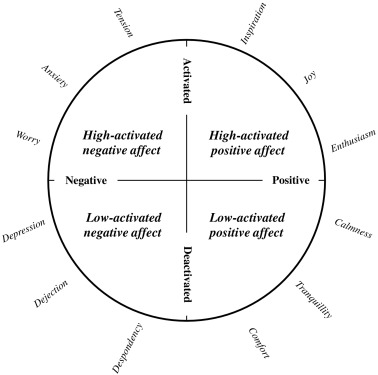
At the most fundamental level of human experience lies something psychologists call “core affect”—the continuous stream of pleasant or unpleasant feelings that color every moment of our lives. These aren’t the complex emotions we name and discuss, but rather the raw, wordless feelings that arise before we even recognize what we’re experiencing. Think of that immediate sense of unease when entering an unfamiliar room, or the subtle lift in your chest when hearing a favorite song. These feelings represent one of evolution’s most elegant solutions to the problem of survival.
Core affect emotions deserve our gratitude not because they always feel good—they often don’t—but because they serve as our body’s ancient early warning system and motivational compass. When our ancestors encountered a rustling bush on the savanna, they didn’t have time to consciously analyze whether it contained a predator or just the wind. Core affect provided an instant “gut feeling” that guided immediate action: approach or avoid, fight or flee. This rapid emotional processing allowed for split-second decisions that often meant the difference between life and death.
In our modern world, these same emotional responses continue to simplify an overwhelmingly complex decision-making landscape. Every day we face thousands of choices, from what to eat for breakfast to whom to trust with important information. Core affect acts as a sophisticated filtering system, quickly categorizing experiences as broadly positive or negative before our conscious minds even engage. When you instantly feel drawn to one job candidate over another during an interview, or immediately sense something is “off” about a business deal, you’re witnessing core affect at work—processing subtle environmental cues and past experiences into actionable intuition.
This emotional guidance system proves particularly valuable in social situations, where conscious analysis might be too slow or miss crucial nonverbal information. The slight discomfort you feel when someone’s words don’t match their body language, or the immediate warmth you experience with certain people, reflects core affect’s ability to rapidly integrate complex social signals into simple approach-or-avoid guidance.
However, this same system that once helped us survive can lead us astray in our modern context. Core affect operates on ancient algorithms designed for a very different world, and several common fallacies emerge when we rely too heavily on these emotional shortcuts. The availability heuristic leads us to overestimate risks that feel emotionally salient—we might fear airplane crashes more than car accidents because plane crashes generate stronger emotional responses despite being statistically far less likely.
Affective forecasting presents another pitfall, where our current emotional state colors our predictions about future feelings. When we’re in a positive mood, we tend to overestimate how good future events will make us feel, and when we’re down, we underestimate our capacity for future happiness. This can lead to poor long-term decisions based on temporary emotional states.
Perhaps most problematically, core affect can reinforce existing biases and prejudices. Our emotional responses often reflect learned associations rather than objective reality, leading us to feel negatively about unfamiliar groups or situations not because they’re actually threatening, but because they’re different from our past experiences. This emotional bias can perpetuate discrimination and prevent us from making fair judgments.
The confirmation bias also operates through emotional channels—we tend to seek out information that feels good because it confirms our existing beliefs, while avoiding information that creates the unpleasant feeling of cognitive dissonance. This emotional comfort-seeking can trap us in echo chambers and prevent us from updating our understanding when presented with contradictory evidence.
To harness the benefits of core affect while avoiding its pitfalls, we need to develop what might be called “emotional wisdom”—the ability to notice and appreciate our emotional responses without being enslaved by them. This means learning to pause when we feel strong emotional reactions, asking ourselves whether the intensity of our response matches the actual importance of the situation, and considering whether our feelings might be influenced by irrelevant factors like our current mood, recent experiences, or unconscious biases.
We can also practice emotional granularity—developing a more nuanced vocabulary for our internal states. Instead of simply noting that something “feels wrong,” we might distinguish between the unease that signals genuine danger and the discomfort that simply reflects unfamiliarity. This more precise emotional awareness allows us to use our feelings as information rather than commands.
Core affect emotions represent millions of years of evolutionary refinement, a sophisticated system that helped our species survive and thrive. They continue to provide valuable guidance in navigating our complex modern world, offering rapid insights that conscious analysis might miss. Yet like any powerful tool, they require skillful use. By appreciating both the wisdom and limitations of our emotional responses, we can make better decisions that honor both our evolutionary heritage and our current circumstances. Our feelings, properly understood, remain among our most valuable allies in the ongoing project of living well.
 UpLive.Life