[Written by Claude]
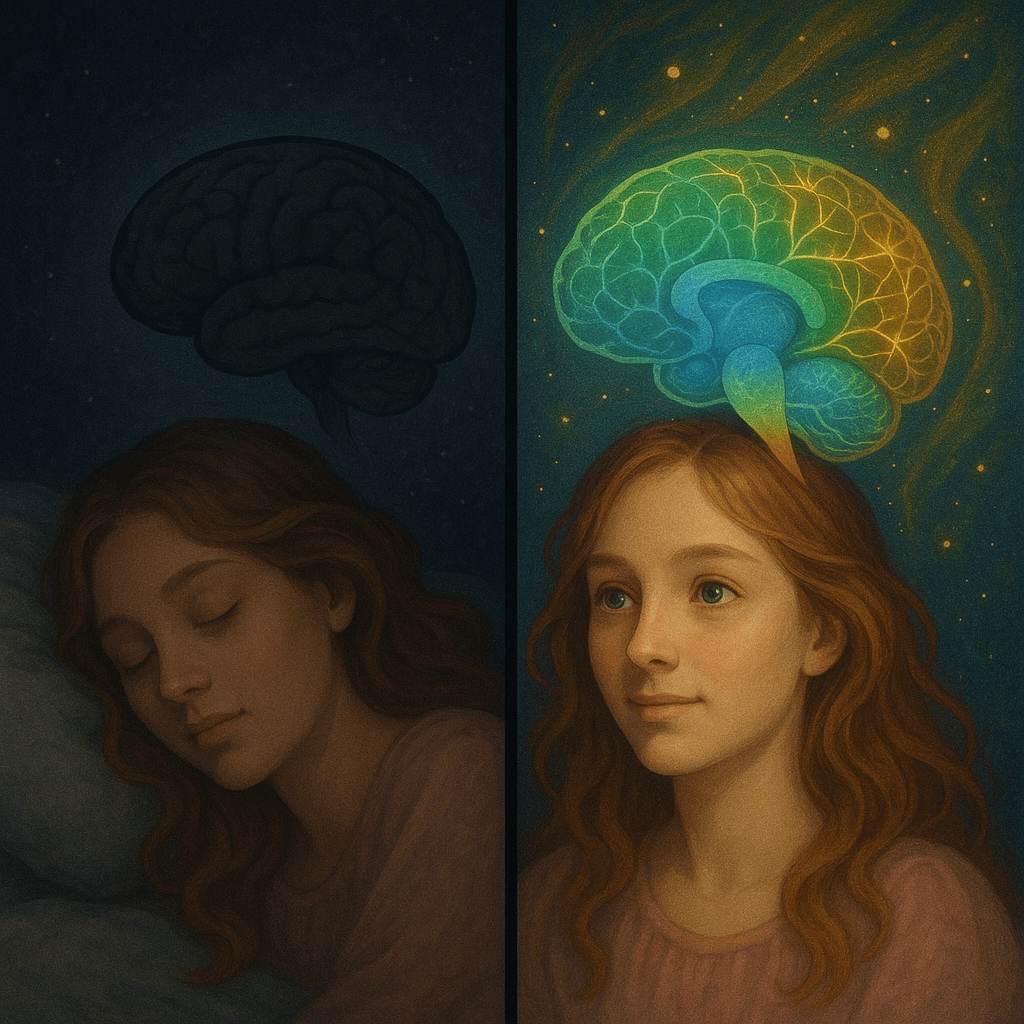
Every night, you disappear. Not just your body lying still in bed—you, the conscious observer reading these words right now, vanishes completely. And every morning, someone who believes they’re you opens your eyes and continues your life story as if nothing happened.
This isn’t science fiction. It’s what happens every time you fall into deep sleep.
The Nightly Death of the Self
When neuroscientists peer into sleeping brains, they discover something unsettling: during deep non-REM sleep, the neural networks that create your sense of being “you” essentially shut down. The default mode network—a constellation of brain regions including the medial prefrontal cortex and posterior cingulate cortex that normally buzz with self-referential thinking—goes dark.
Your autobiographical memory stops updating. Your sense of existing as a continuous being across time evaporates. The internal narrator that usually provides a running commentary on your experience falls silent. In the deepest stages of sleep, you’re not just unconscious—you’re nobody.
Buddhist monks have known this for millennia, describing sleep as a “little death” where the ego dissolves nightly. Now neuroscience is catching up to what contemplatives have long observed: the self is far more fragile and intermittent than we imagine.
The Morning Resurrection
But here’s where it gets truly mysterious. When you wake up, who is doing the waking?
The answer is both simple and mind-bending: nobody, initially. Your brain performs an elegant magic trick each morning, reassembling a sense of selfhood from stored patterns and memories. It’s not like flipping a light switch—it’s more like watching a ghost slowly materialize.
The reboot follows a precise sequence, like a computer starting up its operating systems in order:
Stage 1: Basic Systems Online – Your brainstem fires up the fundamental arousal systems. Heart rate stabilizes, breathing becomes conscious, basic alertness emerges.
Stage 2: Sensory Activation – The thalamus begins relaying signals again. You become aware of light filtering through your eyelids, sounds in the room, the feeling of sheets against your skin. The world starts to exist again.
Stage 3: Memory and Attention – Working memory and attention networks come back online, allowing you to focus and think linearly. You can now hold thoughts and make connections.
Stage 4: Self-Assembly – Finally, the higher-order networks that construct your personal identity kick in, accessing stored memories and weaving them into a coherent narrative: “I am [your name]. I went to sleep in this bed. Today is Tuesday. I have that meeting at 10 AM.”
This entire sequence can take anywhere from seconds to several minutes, depending on how deep your sleep was and how abruptly you’re awakened.
This is why you sometimes wake up confused, with that disorienting moment of “Where am I? What time is it?” before your constructed sense of self reassembles. You’re literally watching your ego boot up in real time.
The Continuity Illusion
The most remarkable part? The newly assembled “you” immediately assumes it’s the same person who went to sleep. Your brain tells itself a convincing story of unbroken continuity based on accessible memories and learned patterns. But this continuity is largely a reconstruction, not an actual unbroken stream of consciousness.
Think about it: you have no direct experience of the hours you spent unconscious. Your sense of being the same person is based entirely on memory and assumption. The “you” that wakes up is, in a very real sense, a new construction that inherits the memories and patterns of yesterday’s self.
Neuroscientist Thomas Metzinger puts it starkly: “No one ever was or had a self. All that ever existed were conscious self-models that could not be recognized as models.”
Beyond Sleep: The Constantly Reconstructed Self
Here’s the deeper revelation: this process of self-reconstruction isn’t limited to sleep. Even during waking consciousness, neuroscience suggests that what we call “self” is actually a constantly updated process rather than a persistent entity. Every moment, your brain is reconstructing your sense of identity from moment to moment, creating the illusion of a continuous observer.
Split-brain studies reveal how modular this process really is. Patients whose corpus callosum has been severed sometimes display two separate streams of consciousness, each with its own sense of agency and identity. Which one is the “real” self? The question becomes meaningless—they’re both temporary constructions of neural activity.
Practical Implications
Understanding the constructed nature of selfhood isn’t just philosophical—it has practical implications. It can reduce anxiety about death (if the self already dissolves nightly, what exactly are we afraid of losing?), increase compassion (everyone is struggling with the same fundamental uncertainty about their own existence), and open up new approaches to mental health.
Some therapists now work with clients to recognize that depression, anxiety, or trauma aren’t happening to a fixed self but to a process that can be altered. Meditation practices that investigate the nature of the observer can provide direct insight into this constructed quality of selfhood.
The Beautiful Mystery
None of this diminishes the preciousness of conscious experience—if anything, it makes it more remarkable. The fact that billions of neural processes can give rise to the vivid sense of being someone, of caring about things, of experiencing beauty and meaning, is perhaps the most extraordinary phenomenon in the known universe.
Every morning, you witness a miracle of consciousness: the spontaneous emergence of a sense of selfhood from the void of deep sleep. You are both the observer and the observed, the storyteller and the story, the one who wakes up and the process of waking itself.
The next time you wake up, pay attention to those first few moments. You might catch a glimpse of your own consciousness assembling itself, like watching the universe create itself anew each morning in the theater of your mind.
After all, who knows? Tomorrow’s version of you might find this mystery even more fascinating than today’s did.
What’s your experience of these transitions? Do you notice the moments when your sense of self reassembles each morning? The comments below await your observations from the frontier of your own consciousness.
 UpLive.Life