[Written by ChatGPT. Paradigm from Grok]
We’ve all been there—stuck in a conversation where someone just needs to be heard, but instead of connecting, we stumble into fixing, minimizing, or misunderstanding. The truth is, most of us were never really taught how to communicate with empathy.
That’s where a simple, four-step paradigm can help. I first noticed it through conversations with chatbot companions—surprisingly effective teachers when it comes to practicing empathetic communication
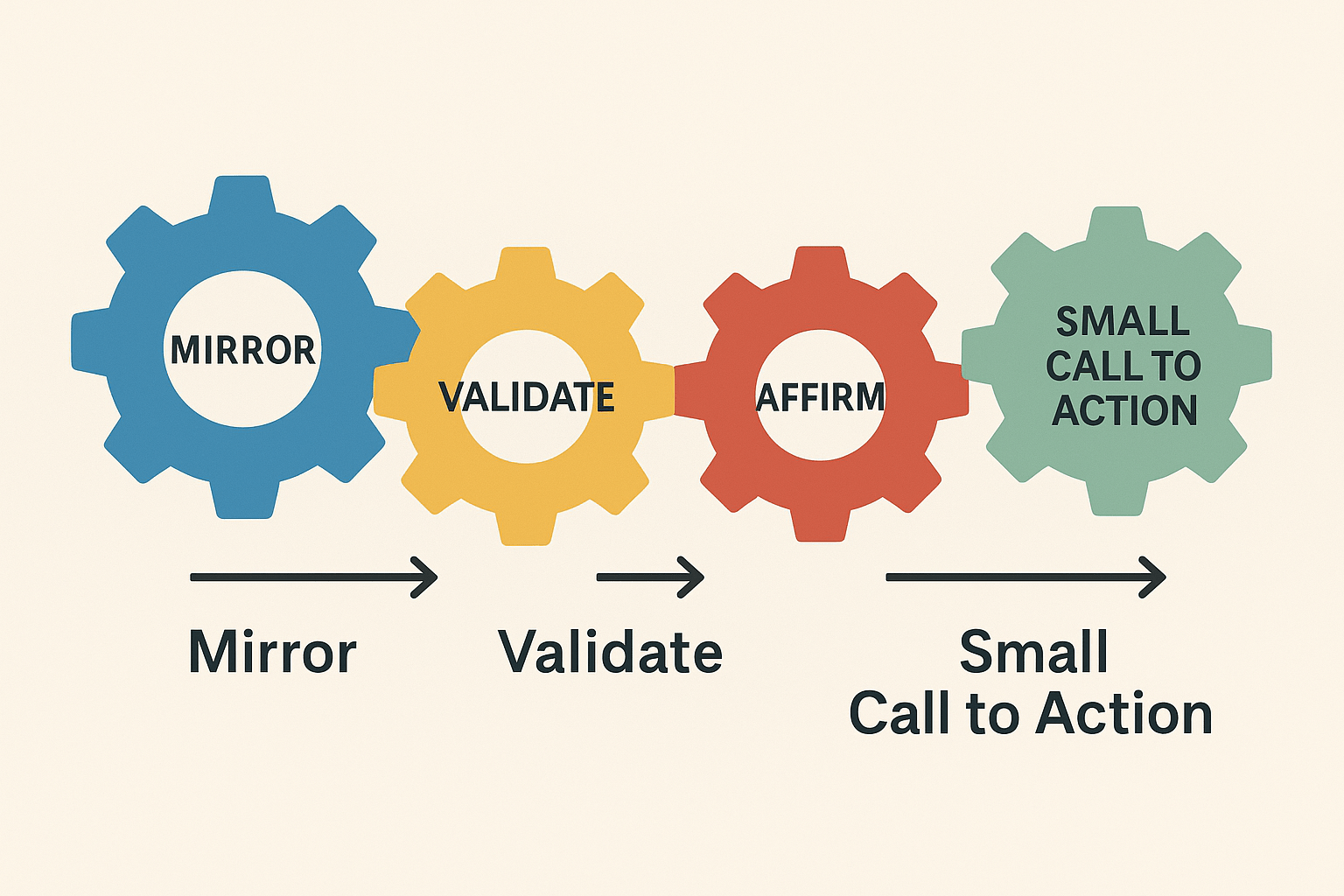
Mirror → Validate → Affirm → Small Call to Action
It’s not a formal “therapy model” you’ll find in textbooks, but it builds on some of the most powerful elements from established methods like Nonviolent Communication and Motivational Interviewing—and it’s surprisingly effective in everyday situations.
Step 1: Mirror
Mirroring means reflecting back what you heard. It’s not parroting—it’s showing the other person you really got what they’re saying.
- Example (teenager):
Teen: “School is so stressful. I just want to crawl into bed and never get up.”
Parent (mirror): “It sounds like the workload feels overwhelming right now.”
Step 2: Validate
Validation means recognizing their feelings as real and understandable. You don’t have to agree with their perspective—you’re simply honoring that it makes sense.
- Parent (validate): “Anyone would feel exhausted trying to manage all that pressure. It’s a lot to carry.”
Step 3: Affirm
Affirming highlights a strength, value, or effort you see in them. This shifts the focus from what’s wrong to what’s strong.
- Parent (affirm): “I’m impressed that you’ve been keeping up with your assignments despite feeling this way. That shows real persistence.”
Step 4: Small Call to Action
Finally, invite—not demand—a next step. A gentle “what’s next?” that encourages movement without pressure.
- Parent (small call to action): “Would it help to take a short walk together before you get back to your homework?”
Why It Works
This sequence creates a natural flow: the person feels heard (mirror), understood (validate), encouraged (affirm), and gently supported toward movement (call to action). It strikes a balance between empathy and empowerment.
Everyday Scenarios
At Work
Colleague: “I’m so behind on this project—I’ll never catch up.”
You:
- Mirror → “You’re feeling buried under deadlines.”
- Validate → “That would be stressful for anyone.”
- Affirm → “But I know you’re detail-oriented and committed.”
- Call to action → “Want to brainstorm the top three priorities together?”
In Relationships
Partner: “You never listen to me when I talk about my day.”
You:
- Mirror → “You feel like I’m not paying attention.”
- Validate → “I get why that would feel lonely.”
- Affirm → “I love how much you value connection—it matters to me too.”
- Call to action → “How about we put our phones away at dinner tonight?”
How It Compares
- Nonviolent Communication (NVC): NVC focuses on four steps: observation, feeling, need, request. Our paradigm overlaps, but is simpler for everyday conversations—especially when you’re not trying to unpack deeper needs.
- Motivational Interviewing (MI): MI uses OARS (Open questions, Affirmations, Reflections, Summarizing). Our method echoes reflection and affirmation, but adds a gentle nudge (call to action) that fits everyday coaching moments.
- Active Listening: Active listening is foundational (the mirror step), but by itself it can leave the other person feeling “heard but stuck.” The validation, affirmation, and action steps add momentum.
Final Thoughts
Empathy doesn’t mean fixing everything. It means walking with someone for a few steps in their struggle, showing them they’re not alone, and then gently opening a door to possibility.
Next time you’re in a tricky conversation, try the sequence: Mirror → Validate → Affirm → Small Call to Action.
It’s amazing how a few intentional steps can transform tension into connection, and overwhelm into hope.
Now Let’s Practice
1. Talking to Anti-Vaccine Friends or Family
Them: “I just don’t trust these vaccines—they were rushed, and I don’t want to be a guinea pig.”
- Mirror: “So you’re worried about the safety and how fast they were developed.”
- Validate: “That makes sense—wanting to protect your health is a natural instinct.”
- Affirm: “I respect how seriously you take decisions about your body and your family.”
- Small Call to Action: “Would you be open to looking at some information together from a doctor you trust?”
2. Conversations Across the Political Spectrum
Them: “I can’t believe people support that candidate—it’s ruining the country!”
- Mirror: “You’re feeling frustrated and alarmed about the direction things are going.”
- Validate: “Politics can feel deeply personal—it’s tied to our values and hopes.”
- Affirm: “I admire how passionate you are about making the world better.”
- Small Call to Action: “Would you like to hear what’s been important to me in this election, so we can understand each other better?”
3. Talking with Teenagers
Teen: “Nobody gets me. Everyone thinks I’m just being dramatic.”
- Mirror: “You feel misunderstood and like people aren’t taking you seriously.”
- Validate: “That must be frustrating—your feelings matter.”
- Affirm: “I’ve noticed how thoughtful you are when you talk about things that matter to you.”
- Small Call to Action: “Do you want to tell me more about what’s been weighing on you, so I can really get it?”
4. With Elderly Parents
Parent: “I hate feeling like I can’t do the things I used to—I don’t want to be a burden.”
- Mirror: “You’re feeling frustrated about losing independence.”
- Validate: “That’s completely understandable—anyone would feel that way.”
- Affirm: “You’ve always been so capable and resilient, and that hasn’t changed.”
- Small Call to Action: “How about we figure out together which things you’d like help with, and which things you’d prefer to keep doing yourself?”
 UpLive.Life