[Written by Grok]
I woke up with the phrase corporeal prison swirling in my mind, leaving me feeling the vast emptiness of being and isolation. Then I went out for a run and felt an equally intense opposite reaction of connection to nature, of sharing each breath with the trees, of moving the stardust that makes up my body amidst everything else around me. This duality of disconnection and unity led me to reflect on the teachings of The Tao of Physics, where science and spirituality converge to reveal the world in motion, woven with infinite mysteries.
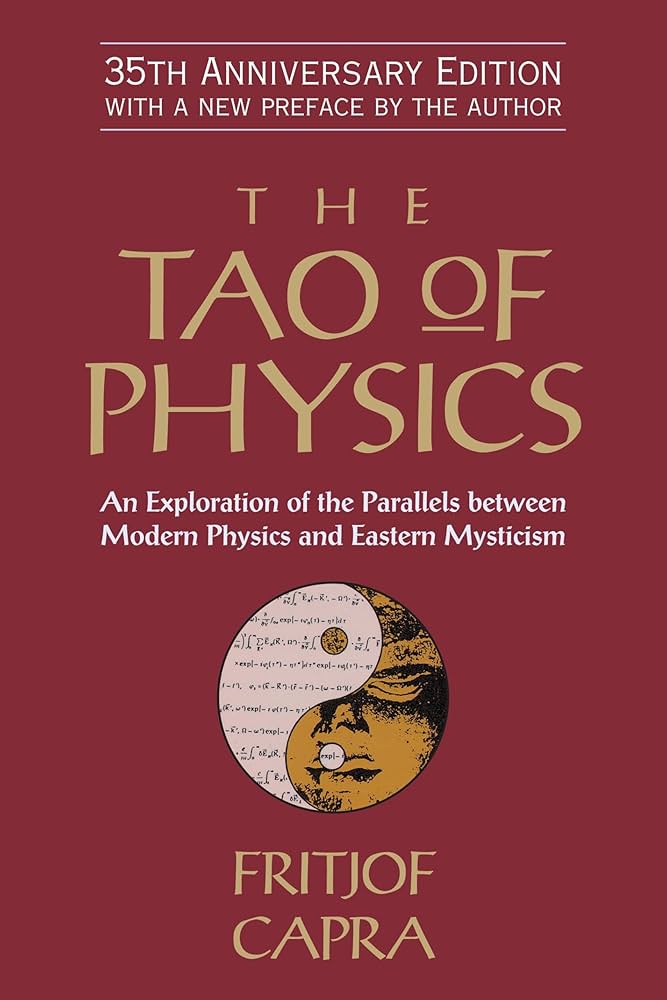
The Tao of Physics: A Book Summary
The Tao of Physics: An Exploration of the Parallels Between Modern Physics and Eastern Mysticism by Fritjof Capra, first published in 1975, bridges the seemingly disparate realms of modern science and Eastern spiritual traditions. Capra, a physicist, argues that the discoveries of quantum physics and relativity theory resonate deeply with the insights of Taoism, Buddhism, and Hinduism, revealing a unified view of reality.
Core Themes
Capra begins by contrasting the mechanistic worldview of classical physics with the holistic perspectives of Eastern philosophies. While Newtonian physics views the universe as a collection of separate objects governed by predictable laws, Eastern traditions see reality as an interconnected, dynamic web. Capra highlights how modern physics—through quantum mechanics and relativity—challenges the classical model, aligning more closely with mystical traditions.
Key Parallels:
- Interconnectedness: Quantum physics reveals that particles are not isolated entities but exist in a web of relationships, entangled across space and time. Similarly, Taoism and Buddhism emphasize the unity of all things, where distinctions between self and universe dissolve.
- Dynamic Reality: Both quantum theory and Eastern thought portray reality as fluid and ever-changing. The Tao, as described in the Tao Te Ching, is the flow of existence, while subatomic particles exhibit wave-particle duality, defying fixed definitions.
- Observer and Observed: In quantum mechanics, the act of observation influences reality, echoing the Eastern idea that consciousness and the external world are inseparable.
- Beyond Dualism: Both modern physics and mysticism reject dualistic thinking (e.g., matter vs. energy, self vs. other), embracing a holistic view where opposites coexist.
Key Concepts
Capra explores specific scientific concepts—like Heisenberg’s uncertainty principle, Einstein’s relativity, and the bootstrap hypothesis—alongside Eastern ideas such as the Taoist concept of wu wei (non-action) and the Buddhist notion of emptiness (shunyata). He argues that both systems point to a reality that transcends language and rational thought, accessible through intuition or meditation in spirituality and through mathematical abstraction in physics.
Impact and Reflection
The book invites readers to reconsider the boundaries between science and spirituality, suggesting that both are paths to understanding the same cosmic truth. Capra’s work is both a scholarly analysis and a philosophical meditation, encouraging a worldview that integrates rational inquiry with intuitive wisdom.
The Tao of Physics remains a seminal text for those seeking to reconcile the material and the mystical, offering a vision of the universe as a harmonious dance of energy, where the stardust in our bodies moves in sync with the infinite mysteries of existence.
Ending on a poem that I stumbled upon today. “Whoever you are, no matter how lonely,
the world offers itself to your imagination…”
Wild Geese | Mary Oliver
You do not have to be good.
You do not have to walk on your knees
for a hundred miles through the desert, repenting.
You only have to let the soft animal of your body
love what it loves.
Tell me about despair, yours, and I will tell you mine.
Meanwhile the world goes on.
Meanwhile the sun and the clear pebbles of the rain
are moving across the landscapes,
over the prairies and the deep trees,
the mountains and the rivers.
Meanwhile the wild geese, high in the clean blue air,
are heading home again.
Whoever you are, no matter how lonely,
the world offers itself to your imagination,
calls to you like the wild geese, harsh and exciting–
over and over announcing your place
in the family of things.
 UpLive.Life