[Written by ChatGPT]
See related posts: Finding Order in the Timeless Flow of the Dao.
Category 1. What the Dao Is.
Category 2. Virtual and being.
Category 3: Dao Applied to Politics and Ruling (3, 5, 17, 18, 19, 26, 29, 35, 37, 49, 53, 54, 57, 58, 59, 60, 61, 64, 65, 66, 72, 74, 75, 77, 78, 79, 80)
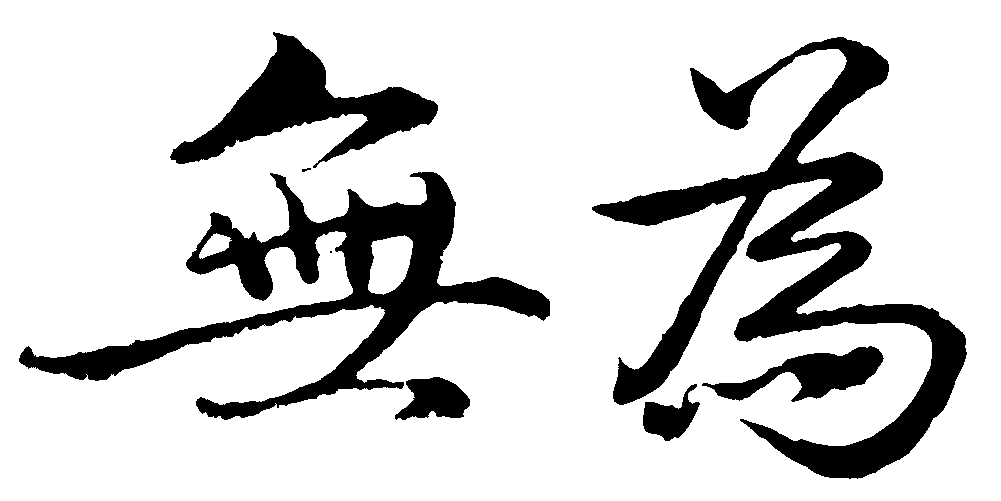
These chapters express Laozi’s philosophy of governance and social order — a vision of leadership rooted not in power or control, but in humility, restraint, and alignment with the natural rhythm of life. They form the political counterpart to the personal and cosmic teachings of the Dao De Jing. Laozi’s “politics of non-action” (wuwei zhi zheng 無為之政) proposes that the best ruler governs least — allowing people, like nature, to self-regulate and flourish in simplicity.
- Governing through Simplicity and Non-Interference
Chapters 3, 17, and 37 establish the foundation of Daoist politics. A wise ruler does not glorify the talented or hoard precious goods, because such acts breed envy, greed, and disorder (ch. 3). Instead, the sage empties the people’s hearts and fills their bellies — keeping them content and unambitious. By practicing wuwei, order arises naturally: “Do nothing, and nothing is left undone.” Similarly, the best leader (ch. 17) is one whose presence is barely felt; when his work is done, the people say, “We did it ourselves.” Governance in harmony with Dao is quiet, indirect, and nearly invisible — it guides by presence, not interference. Chapter 37 completes this vision: the Dao, left undisturbed, transforms all things of itself; when desires arise, simplicity (pu, the uncarved block) restores peace.
- The Decline from Dao to Morality
In chapters 18 and 19, Laozi describes a moral devolution: when the Dao is lost, virtue (de) arises; when virtue is lost, benevolence (ren) arises; then righteousness (yi), and finally ritual (li) — empty forms replacing natural harmony. Artificial morality and cleverness create hypocrisy, deceit, and division. Laozi therefore calls to “abandon wisdom, discard cleverness” and return to plainness and simplicity. The true order of society does not need elaborate codes; it arises from people whose desires are few and whose hearts are whole.
- The Way of the Sage-Ruler: Heaviness, Stillness, and Self-Restraint
Chapters 26, 29, and 35–37 portray the sage as weighty, still, and detached from ambition.
He knows that “heaviness is the root of lightness, and stillness the master of haste” (ch. 26); those who act rashly lose their foundation. To “take the world and do something with it” (ch. 29) is to break it — the world is a sacred vessel that cannot be forced. The sage therefore “removes excess, extravagance, and pride.” Chapter 35 describes the Dao itself as plain and tasteless — not alluring like music or luxury, yet inexhaustibly nourishing. The ideal ruler holds this “great image” — simple, stable, and quietly magnetic — so that all beings come to rest in peace.
- The Ethics of Empathy and Impartiality
Laozi’s political ethics are deeply humane yet detached. Chapter 5 says, “Heaven and Earth are not benevolent; they treat all things as straw dogs.” This means nature is impartial, not cruel: it sustains without favoritism. The sage mirrors this equanimity — loving all without attachment. Chapter 49 extends this into practice: “The sage has no fixed mind; he takes the people’s hearts as his own.” He treats both good and bad alike with goodness, and both trustworthy and untrustworthy with faith — not out of sentiment, but out of understanding that harmony requires embracing all.
- The Practice of Good Governance
The middle political chapters (53–61) elaborate practical wisdom:
Integrity expands outward (ch. 54): virtue cultivated in oneself spreads to family, community, and world.
Over-regulation breeds chaos (ch. 57): the more laws and prohibitions, the more thieves and trouble. True order comes from simplicity — the ruler’s calm emptiness stabilizes the realm.
Gentle governance (ch. 58): oppressive precision in rule creates resentment; tolerance nurtures purity. Fortune and misfortune transform into one another — the sage rules with flexibility, not dogma.
Economy and restraint (ch. 59): frugality is the root of enduring power; the ruler who conserves energy and accumulates virtue is like a tree with deep roots.
Govern lightly (ch. 60): managing a large country is like cooking small fish — too much handling spoils it. When rulers act with Dao, even unseen forces (ghosts, spirits, unrest) are pacified.
- The Humility of True Power
Chapters 61 and 66 use water as the model of leadership: the sea becomes king of rivers because it lies below them; likewise, the great nation should humble itself before the small. The ruler who takes the lower position unites the people, while one who exalts himself invites resistance. The sage leads by following — speaking modestly, placing himself behind others, and thus achieving what domination never could.
Similarly, chapters 72–75 advise rulers to avoid oppression and greed. Heavy taxation and intrusive rule cause hunger, rebellion, and death. The wise ruler honors people’s natural lives, acts without self-importance, and never governs through fear. Laozi’s vision of freedom is minimalism: when leaders stop interfering, people live simply, die naturally, and remain close to their roots.
- The Cosmic Pattern of Justice and Balance
Chapters 77–79 elevate politics into cosmic principle. Heaven’s Way resembles a drawn bow — it lowers what is high and raises what is low, redistributing excess to balance the whole. Human society, by contrast, takes from the poor to serve the rich. The sage, aligned with Heaven, gives without claiming, completes without possessing. Even in conflict (ch. 79), he does not insist on repayment; his trust in the moral gravity of De (virtue) replaces coercion with natural correction.
Chapter 78 closes this vision with the paradox of water: the softest thing in the world overcomes the hardest. Those willing to bear disgrace or misfortune for the world become its true rulers. Power lies not in dominance but in the quiet endurance of the low.
- The Ideal Society
The final chapter, 80, depicts a utopia of small, self-sufficient communities: people content with simple food, handmade clothes, and a peaceful life. They own tools but rarely use them, live without war or conquest, and die without ever straying far from home. This is not primitivism but a vision of equilibrium — a society without excess desire, where human life follows the effortless pattern of Dao itself.
Essence Summarized
These political teachings offer a radical redefinition of power. Laozi’s sage-ruler governs not by force, law, or intellect, but by emptiness, humility, and trust in natural order. The less he acts, the more harmony arises. By valuing stillness over ambition, contentment over accumulation, and softness over strength, he mirrors the cosmic balance of Heaven and Earth.
In essence, Laozi’s politics of Dao is an ecology of governance: a living balance in which human institutions, like rivers and forests, thrive when left to flow according to their own nature.
Summary of Verses
合治頌
不尚賢,使民不爭;
不貴難得,使心不亂。
虛其心,實其腹,弱其志,強其骨,
為無為,則無不治。
天地不仁,以萬物為芻狗;
聖人不仁,以百姓為芻狗。
虛而不屈,動而愈出,
多言數窮,不如守中。
上治若無治,
功成事遂,百姓皆謂我自然。
大道廢,有仁義;慧智出,有大偽。
絕聖棄智,民利百倍,
見素抱朴,少私寡欲。
重為輕根,靜為躁君;
輕則失本,躁則失君。
取天下者,不可為也;
為者敗之,執者失之。
故聖人去甚、去奢、去泰。
治大國若烹小鮮,
以無事取天下。
政闷闷,民淳淳;
正復為奇,善復為妖。
祸兮福所倚,福兮祸所伏。
善建者不拔,善抱者不脫;
修身則德真,修家則德余,
修國則德豐,修天下則德普。
深根固柢,長生久視。
江海所以為百谷王,
以其善下之。
欲上民,必以言下之;
欲先民,必以身後之。
以其不爭,天下莫能與之爭。
天道張弓,高者抑,下者舉;
有餘者損,不足者補。
聖人為而不恃,功成而不處。
大國者下流,靜勝躁,柔勝剛。
以正治國,以無為安民;
以道處上,以德馭下。
去智去欲,守樸守中,
天下自定而久。
The Way of Harmonious Rule
Do not exalt the worthy,
And the people will not compete;
Do not prize rare goods,
And hearts will not be disturbed.
Empty their minds, fill their bellies,
Weaken ambition, strengthen their roots.
Act without acting, and all is well governed.
Heaven and Earth are impartial,
Treating all things as straw dogs;
The sage likewise regards the people without favoritism.
Empty yet inexhaustible,
Silent yet ever producing —
Too many words lead to exhaustion;
Better to hold to the center.
The highest governance seems as if none governs;
When deeds are done and tasks complete,
The people say, “We have done it ourselves.”
When the Great Way declines, benevolence and righteousness arise;
When cleverness appears, great deceit is born.
Therefore, abandon wisdom, discard cunning,
Return to simplicity, embrace the uncarved block,
Diminish self and desire.
Heaviness is the root of lightness,
Stillness the master of restlessness;
Those who act rashly lose their base,
Those who grasp lose their way.
Thus the sage rejects excess, extravagance, and pride.
To govern a great state is like frying a small fish—
Do not over-handle it.
Rule through stillness,
And the people purify themselves.
When government is simple, people are sincere;
When government is clever, people are cunning.
Blessing hides within misfortune,
Misfortune lies beneath blessing.
What is well-founded cannot be uprooted,
What is well-held cannot slip away.
Cultivate virtue in oneself, it becomes real;
In family, it grows;
In nation, it flourishes;
In the world, it becomes universal.
Root deep, stand firm—this is enduring rule.
Rivers and seas are kings of the valleys
Because they dwell below them.
To rise above people, speak humbly;
To lead ahead, place yourself behind.
Because they do not contend,
No one in the world contends with them.
Heaven’s Way draws the bow:
It lowers the high and raises the low,
Takes from excess, and gives to need.
Thus the sage acts without possession,
Accomplishes without dwelling on success.
The great nation lies low;
The soft and still overcome the strong and restless.
Govern with uprightness,
Lead through non-action;
Rule with Dao, nurture with De.
Abandon cleverness and greed,
Hold to simplicity and balance—
And the world will find its peace.
Original Verses
【第三章】不尚贤,使民不争;不贵难得之货,使民不为盗;不见(xiàn)可欲,使民心不乱。是以圣人之治,虚其心,实其腹;弱其志,强其骨。常使民无知无欲,使夫(fú)智者不敢为也。为无为,则无不治。
Chapter 3 — Governing Without Stirring Desire
Do not exalt the worthy, and the people will not compete.
Do not prize rare goods, and the people will not steal.
Do not display the desirable, and the people’s hearts will not be disturbed.
Therefore the sage governs by emptying minds and filling bellies,
Weakening wills and strengthening bones.
He constantly ensures the people are without knowledge and desire,
And makes the clever dare not act.
Act without action, and nothing will be left undone.
【第五章】天地不仁,以万物为刍(chú)狗;圣人不仁,以百姓为刍狗。天地之间,其犹橐龠(tuóyuè)乎?虚而不屈,动而愈出。多言数(shuò)穷,不如守中。
Chapter 5 — Impartial Nature
Heaven and Earth are not benevolent;
They treat all things as straw dogs.
The sage is not benevolent;
He treats the people as straw dogs.
Between Heaven and Earth—is it not like a bellows?
Empty yet never exhausted;
The more it moves, the more it brings forth.
Many words lead to exhaustion—better to hold to the center.
【第十七章】太上,下知有之。其次,亲而誉之。其次,畏之。其次,侮之。信不足焉,有不信焉。悠兮其贵言。功成事遂,百姓皆谓我自然。
Chapter 17 — The Best Rulers
The best rulers are those the people barely know exist.
Next are those they love and praise;
Next are those they fear;
Next are those they despise.
When trust is insufficient, there is untrustworthiness.
The sage is reserved with words.
When the work is accomplished and affairs succeed,
The people all say, “We did it ourselves.”
【第十八章】大道废,有仁义;慧智出,有大伪;六亲不和,有孝慈;国家昏乱,有忠臣。
Chapter 18 — The Decline of the Great Way
When the great Dao is abandoned, benevolence and righteousness arise.
When cleverness appears, hypocrisy follows.
When the family loses harmony, filial piety and parental love appear.
When the state falls into chaos, loyal ministers appear.
【第十九章】绝圣弃智,民利百倍;绝仁弃义,民复孝慈;绝巧弃利,盗贼无有。此三者,以为文不足,故令有所属,见(xiàn)素抱朴,少私寡欲。
Chapter 19 — Returning to Simplicity
Cut off sagehood, abandon wisdom—
The people will benefit a hundredfold.
Cut off benevolence, abandon righteousness—
The people will return to filial piety and kindness.
Cut off cleverness, abandon profit—
Thieves and robbers will disappear.
These three are external trappings, not the root.
Therefore let there be simplicity:
See the plain, embrace the uncarved;
Have little self and few desires.
【第二十六章】重为轻根,静为躁君。是以圣人终日行不离辎(zī)重。虽有荣观(guàn),燕处超然,奈何万乘(shèng)之主,而以身轻天下?轻则失本,躁则失君。
Chapter 26 — The Weight of Stillness
Heaviness is the root of lightness; stillness is the master of restlessness.
Thus the sage travels all day without losing his burden.
Though there are splendid sights, he remains calm and detached.
How can the lord of ten thousand chariots treat himself as lightly as the world?
Lightness leads to loss of root; restlessness leads to loss of rule.
【第二十九章】将欲取天下而为之,吾见其不得已。天下神器,不可为也。为者败之,执者失之。故物或行或随,或歔(xū)或吹,或强或羸(léi),或挫或隳(huī)。是以圣人去甚,去奢,去泰。
Chapter 29 — The Sacred Vessel
Those who wish to take the world and act upon it—I see they cannot succeed.
The world is a sacred vessel, not to be meddled with.
He who acts upon it spoils it; he who grasps it loses it.
Some go forward, others follow;
Some breathe gently, others blow hard;
Some are strong, others weak; some rise, others fall.
Therefore the sage avoids excess, extravagance, and arrogance.
【第三十五章】执大象,天下往;往而不害,安平太。乐(yuè)与饵,过客止。道之出口,淡乎其无味,视之不足见(jiàn),听之不足闻,用之不足既。
Chapter 35 — The Great Image
Hold fast to the great image, and all under Heaven will come.
They come and are unharmed, at peace and content.
Music and food make a traveler stop,
But the words of the Dao seem bland and tasteless.
Looked at, it cannot be seen;
Listened to, it cannot be heard;
Used, it is inexhaustible.
【第三十七章】道常无为而无不为,侯王若能守之,万物将自化。化而欲作,吾将镇之以无名之朴。无名之朴,夫亦将无欲。不欲以静,天下将自定。
Chapter 37 — The Self-Ordering World
The Dao is ever without action, yet nothing remains undone.
If lords and kings could hold to it,
The world would transform of itself.
When desire arises, I would still it with the nameless uncarved block.
When the uncarved block is free of desire,
By stillness the world will right itself.
【第四十九章】圣人无常心,以百姓心为心。善者,吾善之;不善者,吾亦善之,德善。信者,吾信之;不信者,吾亦信之,德信。圣人在天下歙歙(xīxī),为天下浑其心。(百姓皆注其耳目),圣人皆孩之。
Chapter 49 — The Heart of the Sage
The sage has no fixed heart—
He takes the hearts of the people as his own.
To the good, I am good; to the not-good, I am also good—Virtue is goodness.
To the faithful, I am faithful; to the unfaithful, I am also faithful—Virtue is faith.
The sage lives in the world blending his heart with all;
The people fix their eyes and ears upon him,
And the sage treats them like children.
【第五十三章】使我介然有知,行于大道,唯施(迤yí)是畏。大道甚夷,而民好径。朝(cháo)甚除,田甚芜,仓甚虚。服文彩,带利剑,厌饮食,财货有余,是为盗夸。非道也哉!
Chapter 53 — The Straight and the Crooked Way
If I had the least understanding, I would walk the Great Way
And fear only straying from it.
The Great Way is smooth, but people prefer side paths.
The court is splendid, the fields are weedy, the granaries are empty.
They wear fine clothes, carry sharp swords,
Eat and drink excessively, and hoard riches—
This is called boasting thieves.
This is not the Way.
【第五十四章】善建者不拔,善抱者不脱,子孙以祭祀不辍。修之于身,其德乃真;修之于家,其德乃余;修之于乡,其德乃长(zhǎng);修之于国,其德乃丰;修之于天下,其德乃普。故以身观身,以家观家,以乡观乡,以国观国,以天下观天下。吾何以知天下然哉?以此。
Chapter 54 — Cultivating Virtue
What is well planted cannot be uprooted; what is well embraced cannot slip away.
The descendants will continue to offer sacrifices unceasingly.
Cultivate it in yourself, and virtue will be genuine;
Cultivate it in your family, and virtue will overflow;
Cultivate it in your village, and virtue will endure;
Cultivate it in your nation, and virtue will abound;
Cultivate it in the world, and virtue will be universal.
Therefore, observe the self through the self,
The family through the family,
The village through the village,
The nation through the nation,
And the world through the world.
How do I know the world is thus? By this.
【第五十七章】以正治国,以奇用兵,以无事取天下。吾何以知其然哉?以此。天下多忌讳,而民弥贫;民多利器,国家滋昏;人多伎(jì)巧,奇物滋起;法令滋彰,盗贼多有。故圣人云:“我无为而民自化,我好静而民自正,我无事而民自富,我无欲而民自朴。”
Chapter 57 — Governing with Simplicity
Rule the nation with uprightness;
Use strategy in war;
Win the world by doing nothing.
How do I know this is so? By this:
The more taboos under Heaven, the poorer the people become.
The more sharp tools people have, the more troubled the state grows.
The more clever skills people have, the more strange things appear.
The more laws and decrees are proclaimed, the more thieves arise.
Therefore the sage says:
“I do nothing, and the people transform themselves.
I love quietude, and the people become upright.
I am without business, and the people prosper.
I have no desires, and the people return to simplicity.”
【第五十八章】其政闷闷,其民淳淳;其政察察,其民缺缺。祸兮福之所倚,福兮祸之所伏。孰知其极?其无正。正复为奇,善复为妖,人之迷,其日固久。是以圣人方而不割,廉而不刿(guì),直而不肆,光而不耀。
Chapter 58 — Balanced Government
When the government is dull and tranquil,
The people are simple and pure.
When the government is sharp and clear,
The people are cunning and restless.
Calamity!—fortune rests upon it.
Fortune!—calamity hides within it.
Who knows where it ends?
There is no fixed rule.
What is right becomes strange,
What is good becomes perverse.
People have been deluded for long indeed.
Thus the sage is square but does not cut;
Honest but not injurious;
Straight but not unrestrained;
Bright but not dazzling.
【第五十九章】治人事天莫若啬(sè)。夫唯啬,是谓早服。早服谓之重(chóng)积德,重(chóng)积德则无不克,无不克则莫知其极,莫知其极,可以有国。有国之母,可以长久。是谓深根固柢(dǐ),长生久视之道。
Chapter 59 — The Root of Endurance
In governing people and serving Heaven, nothing equals moderation.
Only by moderation can one act early in accord with the Way.
To act early is to accumulate virtue deeply.
With deep virtue, nothing is unconquerable.
Being unconquerable, one knows no limit.
Knowing no limit, one can possess the state.
Possessing the mother of the state, one can long endure.
This is called deep roots and a firm foundation—
The Way of long life and lasting vision.
【第六十章】治大国若烹小鲜。以道莅(lì)天下,其鬼不神。非其鬼不神,其神不伤人;非其神不伤人,圣人亦不伤人。夫两不相伤,故德交归焉。
Chapter 60 — Subtle Rule
Ruling a great state is like cooking a small fish.
When the world is governed in accord with the Dao,
The spirits lose their powers.
Not that the spirits lose power,
But their powers do not harm people.
Not only do their powers not harm people,
The sage also does not harm people.
When neither harms the other,
Their virtues blend together.
【第六十一章】大国者下流。天下之交,天下之牝。牝常以静胜牡,以静为下。故大国以下小国,则取小国;小国以下大国,则取大国。故或下以取,或下而取。大国不过欲兼畜(xù)人,小国不过欲入事人,夫两者各得其所欲,大者宜为下。
Chapter 61 — The Power of Yielding
A great nation is like the lowland,
The meeting place of all streams,
The female of the world.
The female, by calmness, overcomes the male;
By stillness, she takes the lower place.
Thus if a great nation humbles itself before a small one,
It wins the small one;
If a small nation humbles itself before a great one,
It wins the great one.
Therefore, one lowers itself to gain,
And another lowers itself in order to gain.
A great nation wishes to nurture people;
A small nation wishes to join and serve.
Thus both achieve their desires—
But it is fitting that the great should take the lower place.
【第六十四章】其安易持,其未兆易谋,其脆易泮(pàn),其微易散。为之于未有,治之于未乱。合抱之木,生于毫末;九层之台,起于累土;千里之行,始于足下。为者败之,执者失之。是以圣人无为,故无败;无执,故无失。民之从事,常于几成而败之。慎终如始,则无败事。是以圣人欲不欲,不贵难得之货。学不学,复众人之所过。以辅万物之自然,而不敢为。
Chapter 64 — Acting Before Trouble Arises
What is at rest is easy to hold;
What shows no signs is easy to plan for;
What is fragile is easy to shatter;
What is small is easy to scatter.
Deal with it before it exists;
Bring order before it becomes chaos.
A tree that fills the arms grows from a tiny sprout;
A nine-story tower begins from a heap of earth;
A journey of a thousand miles begins with a single step.
Those who act on it ruin it; those who grasp it lose it.
Therefore the sage acts without action, so he fails not;
He grasps nothing, so he loses nothing.
When the people undertake affairs,
They often fail when success is near.
Be careful at the end as at the beginning—then nothing fails.
Thus the sage desires not to desire,
Does not value rare goods.
He learns not to learn,
And returns to what others have passed by.
He assists all things in their natural course,
Without daring to act.
【第六十五章】古之善为道者,非以明民,将以愚之。民之难治,以其智多。故以智治国,国之贼;不以智治国,国之福。知此两者,亦稽(jī)式。常知稽式,是谓玄德。玄德深矣,远矣,与物反矣,然后乃至大顺。
Chapter 65 — The Dark Virtue
The ancients who followed the Dao did not enlighten the people,
But rather made them simple.
The people are difficult to rule because they are too clever.
Therefore, using cleverness to rule the state is a curse to the state;
Not using cleverness to rule the state is a blessing to the state.
Knowing these two things is to set a pattern.
Always knowing this pattern is called profound virtue.
Profound virtue is deep and far,
Opposite to all things,
Yet leading to great harmony.
【第六十六章】江海所以能为百谷王者,以其善下之,故能为百谷王。是以欲上民,必以言下之;欲先民,必以身后之。是以圣人处上而民不重,处前而民不害,是以天下乐推而不厌。以其不争,故天下莫能与之争。
Chapter 66 — The Sea’s Humility
The rivers and seas are kings of the valleys
Because they stay below them.
Therefore, if you wish to be above the people,
You must speak humbly;
If you wish to lead the people,
You must place yourself behind them.
Thus the sage is above the people, yet they do not feel his weight;
He is ahead of them, yet they do not feel harmed.
Therefore the world gladly upholds him and never tires.
Because he does not contend,
No one in the world can contend with him.
【第七十二章】民不畏威,则大威至。无狎(xiá)其所居,无厌(yà,“厌”同“压”)其所生。夫唯不厌(yà,“厌”同“压”),是以不厌(yàn)。是以圣人自知,不自见(xiàn);自爱,不自贵。故去彼取此。
Chapter 72 — Knowing One’s Place
When the people no longer fear authority,
A greater authority will come.
Do not oppress their dwellings;
Do not weigh down their livelihood.
Only by not burdening them
Will they not resent you.
Thus the sage knows himself but does not show himself;
Loves himself but does not exalt himself.
Therefore he discards the one and embraces the other.
【第七十四章】民不畏死,奈何以死惧之!若使民常畏死,而为奇者,吾得执而杀之,孰敢?常有司杀者杀,夫代司杀者杀,是谓代大匠斫(zhuó)。夫代大匠斫者,希有不伤其手矣。
Chapter 74 — The Executioner
If the people do not fear death,
How can you frighten them with death?
If they were always in fear of death,
And one dared to act unlawfully,
I could seize and execute him—who would dare?
There is always the master executioner who kills.
To take his place and kill is to wield the hatchet of the great carpenter.
Few who try this escape cutting their own hands.
【第七十五章】民之饥,以其上食税之多,是以饥。民之难治,以其上之有为,是以难治。民之轻死,以其求生之厚,是以轻死。夫唯无以生为者,是贤于贵生。
Chapter 75 — The Root of Oppression
The people are hungry because their rulers consume too much in taxes—
That is why they are hungry.
The people are hard to rule because their rulers meddle too much—
That is why they are hard to rule.
The people take death lightly because their rulers seek life too greedily—
That is why they take death lightly.
Only those who do not live for life’s sake
Are wiser than those who prize life.
【第七十七章】天之道,其犹张弓与!高者抑之,下者举之;有余者损之,不足者补之。天之道,损有余而补不足。人之道则不然,损不足以奉有余。孰能有余以奉天下?唯有道者。是以圣人为而不恃,功成而不处,其不欲见(xiàn)贤。
Chapter 77 — The Bow of Heaven
The Way of Heaven is like the bending of a bow:
The high is pressed down, and the low is raised up.
What has excess is reduced; what is deficient is supplied.
The Way of Heaven takes from those who have too much
And gives to those who have too little.
The way of man is otherwise—
It takes from the poor and gives to the rich.
Who can give his surplus to the world?
Only one who possesses the Dao.
Thus the sage acts but does not rely on his action;
He achieves but does not dwell upon it;
He does not wish to appear worthy.
【第七十八章】天下莫柔弱于水,而攻坚强者莫之能胜,其无以易之。弱之胜强,柔之胜刚,天下莫不知,莫能行。是以圣人云,受国之垢,是谓社稷主;受国不祥,是为天下王。正言若反。
Chapter 78 — The Power of Water
Nothing in the world is softer or weaker than water,
Yet nothing surpasses it in overcoming the hard and strong.
There is nothing that can take its place.
All know that the weak conquers the strong,
The soft conquers the hard,
Yet few can put it into practice.
Therefore the sage says:
He who takes upon himself the filth of the state is called its master;
He who bears the misfortune of the state becomes the king of the world.
True words seem paradoxical.
【第七十九章】和大怨,必有余怨,安可以为善?是以圣人执左契,而不责于人。有德司契,无德司彻。天道无亲,常与善人。
Chapter 79 — The Sage’s Balance
After settling a great resentment, some resentment always remains—
How can this be good?
Therefore the sage keeps the left contract (the obligation)
And does not demand from others.
He who has virtue attends to his duties;
He who lacks virtue attends to his claims.
The Way of Heaven is impartial—
It is always with the good.
【第八十章】小国寡民,使有什伯(bǎi)之器而不用,使民重(zhòng)死而不远徙(xí)。虽有舟舆,无所乘之;虽有甲兵,无所陈之;使人复结绳而用之。甘其食,美其服,安其居,乐其俗。邻国相望,鸡犬之声相闻,民至老死不相往来。
Chapter 80 — The Ideal Small State
Let there be a small country with few people.
Let them have tools of ten or a hundred types, yet not use them.
Let them value life and not travel far.
Though they have boats and carriages, none will ride them;
Though they have armor and weapons, none will display them.
Let them return to tying knots instead of writing.
Let them enjoy their food, find beauty in their clothes,
Peace in their homes, joy in their customs.
Neighboring states will be within sight,
Their roosters and dogs heard from each other,
Yet the people will grow old and die
Without ever visiting one another.
 UpLive.Life
One thought on “Dao De Jing: The Way of Harmonious Rule”