[Written by Claude]
Rating: ★★★☆☆ (3/5)
Inspiring framework, overstated claims, useful practices—but read with scientific skepticism
What the Book Gets Right
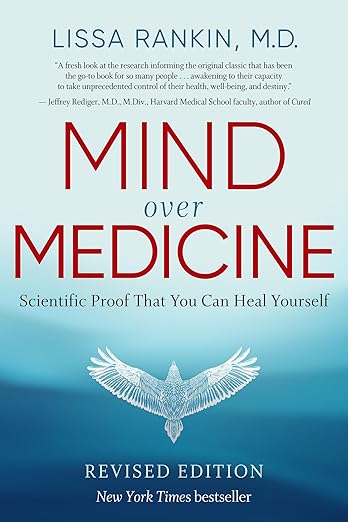
Lissa Rankin’s Mind Over Medicine: Scientific Proof That You Can Heal Yourself makes an important contribution to popular health literature: it takes mind-body medicine seriously and presents it in an accessible, emotionally resonant framework.
Her central thesis—that beliefs, emotional states, and lifestyle alignment can influence health outcomes—is supported by legitimate science. The book draws on real research in placebo effects, psychoneuroimmunology, and stress physiology, and presents it in a way that empowers rather than patronizes readers.
The Six Steps Framework
Rankin organizes her approach into six practical steps:
- Cultivate healing beliefs – Replace fear-based narratives with possibility
- Use guided visualization – Mental imagery to support healing processes
- Activate the relaxation response – Shift from sympathetic stress to parasympathetic repair
- Align life with core values – Reduce chronic stress by living authentically
- Foster healing emotions – Cultivate gratitude, joy, and compassion
- Strengthen therapeutic alliance – Build trust with healthcare providers
These are sensible, evidence-backed interventions. Research does show that:
- Placebo effects reliably improve subjective symptoms like pain, nausea, and fatigue
- Chronic stress impairs immunity, blunts vaccine responses, and slows wound healing
- Relaxation practices (meditation, breathwork) lower cortisol and support immune balance
- Positive therapeutic relationships enhance treatment adherence and outcomes
- Emotional states affect physiological markers through measurable neuroendocrine pathways
The book excels at making these abstract findings personally meaningful. Rankin, a physician herself, writes with warmth and vulnerability about her own journey from conventional medicine toward a more integrated approach.
Where the Book Oversteps
The problem isn’t that Rankin discusses mind-body healing—it’s that she sometimes overstates the evidence and ventures into territory where the science doesn’t follow.
The Title Itself Is Misleading
“Scientific Proof That You Can Heal Yourself” promises more than the research delivers.
What the science actually shows:
- Mind-body practices improve symptom burden, quality of life, and coping in illness
- They do NOT consistently alter objective disease progression (tumor size, survival rates, disease cure)
This is a crucial distinction Rankin sometimes blurs.
Cherry-Picked “Miracle” Cases
The book features numerous “spontaneous remission” stories—cancer patients who recovered against odds after making dramatic lifestyle or emotional changes.
These stories are inspiring, but they’re also anecdotal and selection-biased. For every person who experienced remission after meditation or emotional breakthrough, there are countless others who practiced the same approaches and did not recover. Rankin doesn’t adequately address this survivorship bias.
The reality: Spontaneous remissions occur in roughly 1 in 60,000 to 1 in 100,000 cancer cases, regardless of mind-body practices. When they happen, people naturally search for explanations—and may attribute recovery to whatever they were doing at the time. This doesn’t prove causation.
Overgeneralization of Placebo Research
Rankin correctly notes that placebo effects are real and measurable. But she sometimes extrapolates beyond what placebo research actually demonstrates.
Placebo effects ARE reliable for:
- Pain reduction (via endogenous opioid release)
- Nausea and fatigue
- Parkinson’s motor symptoms (via dopamine)
- Mood and anxiety
- Some digestive symptoms (IBS)
Placebo effects do NOT reliably affect:
- Tumor growth or regression
- Bacterial infections
- Survival in terminal illness
- Broken bones or structural damage
- Most objective disease markers
The book occasionally implies that belief alone can influence outcomes where the evidence is much weaker or absent.
The Risk of Implied Blame
While Rankin explicitly states she doesn’t blame patients for their illnesses, the framework carries an implicit risk: if the mind can heal, does that mean you made yourself sick?
Patients dealing with serious illness don’t need the additional burden of wondering whether they’re not healing because they haven’t “aligned with their core values” enough or cultivated sufficient “healing beliefs.”
Stress does affect immunity. But it’s one factor among many—genetics, environment, pathogens, aging, random cellular mutations—and it’s rarely the determining factor in whether someone recovers from serious disease.
What the Evidence Actually Supports
Let’s be precise about what mind-body medicine can and can’t do, based on meta-analyses and systematic reviews:
Strong Evidence (Reliable, Reproducible)
Symptom Relief:
- Pain reduction (30-60% improvement in some studies via placebo mechanisms)
- Reduced anxiety and depression in chronic illness
- Improved sleep quality
- Better quality of life metrics
Stress Physiology:
- Meditation lowers cortisol and inflammatory markers (IL-6, CRP)
- Relaxation practices improve heart rate variability (autonomic balance)
- Social connection predicts better immune function
Treatment Adherence:
- Positive therapeutic relationships improve compliance with medical regimens
- Belief in treatment enhances engagement and reduces dropout
Weak or Absent Evidence
Direct Disease Modification:
- Mindfulness-based stress reduction (MBSR) in cancer patients improves quality of life but not survival
- Group psychotherapy improves coping but does not consistently extend longevity
- No reliable evidence that visualization or positive thinking shrinks tumors or cures serious disease
Bottom Line:
Mind-body practices are adjunctive interventions—they complement conventional medicine and improve the experience of living with illness. They are not replacements for evidence-based treatment.
Who Should Read This Book?
It May Be Helpful If You:
- Are dealing with chronic illness and feel disempowered by purely biomedical approaches
- Want practical tools for managing stress, anxiety, and symptom burden
- Are interested in integrative medicine and evidence-based complementary practices
- Need inspiration and hope while navigating difficult health challenges
Approach With Caution If You:
- Are newly diagnosed with serious illness and vulnerable to false hope
- Tend toward all-or-nothing thinking about health interventions
- Are considering abandoning conventional treatment in favor of mind-body practices alone
- Have a tendency to self-blame or feel responsible for outcomes beyond your control
How to Read It Responsibly
If you choose to read Mind Over Medicine, I recommend this approach:
1. Extract the practices, question the promises
The six-step framework contains genuinely useful interventions. Practice them. But don’t expect them to cure disease—expect them to improve your quality of life, reduce symptom burden, and support your resilience.
2. Remember the hierarchy of evidence
Inspiring anecdotes < case reports < observational studies < randomized controlled trials < meta-analyses
When Rankin cites “studies,” ask: What kind? How large? Replicated?
3. Integrate, don’t replace
Use mind-body practices alongside conventional medicine, not instead of it. The most responsible application is integration—leveraging expectation and stress-reduction to complement biomedical care.
4. Reject implied blame
If you’re sick, you didn’t think yourself into it. If you don’t heal, it’s not because you failed to believe hard enough. Biology is complex, multifactorial, and often not within conscious control.
Final Verdict
Mind Over Medicine is a passionate, well-intentioned book that introduces important concepts in accessible language. Rankin’s six-step framework offers practical, evidence-backed tools that can genuinely improve quality of life for people dealing with illness.
But the book’s framing—particularly its title and emphasis on “healing yourself”—oversells what the science actually supports. Mind-body practices enhance coping and symptom management; they do not consistently cure disease.
Read it for the practices. Question the promises. And always, always keep conventional medicine in the picture.
Mind-body integration is real, valuable, and scientifically grounded. But it’s not magic, and it’s not a replacement for the hard-won tools of modern medicine.
Recommended with reservations.
Related Reading (More Balanced Perspectives)
- The Body Keeps the Score by Bessel van der Kolk (trauma and physiology, more rigorously grounded)
- Why Zebras Don’t Get Ulcers by Robert Sapolsky (stress physiology, excellent science communication)
- Altered Traits by Daniel Goleman and Richard Davidson (meditation research, evidence-focused)
- The Emperor of All Maladies by Siddhartha Mukherjee (for perspective on what actually cures cancer)
 UpLive.Life