[Written by Claude]
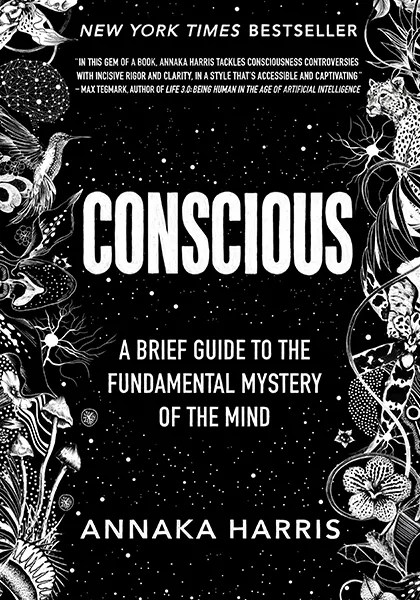
Review of Conscious: A Brief Guide to the Fundamental Mystery of the Mind by Annaka Harris
In a field long dominated by male voices, Annaka Harris brings a refreshing perspective to one of philosophy and neuroscience’s most enduring puzzles: what is consciousness, and how does it arise? Her brief yet profound book offers readers an accessible entry point into questions that have perplexed thinkers for centuries.
About the Author
Annaka Harris is an editor and consultant specializing in neuroscience and physics, with work that has appeared in the New York Times. Beyond this book, she has authored the children’s book I Wonder and collaborated on mindfulness projects. She is also married to Sam Harris, the neuroscientist, philosopher, and author known for books like The Moral Landscape and Waking Up. While both explore consciousness and meditation, Annaka brings her own distinct voice and perspective to these profound questions. Her unique position as both a science communicator and deep thinker on consciousness allows her to bridge technical concepts with elegant prose that makes complex ideas approachable.
What the Book Explores
Harris takes readers on a concise journey through the fundamental mystery of consciousness. The book grapples with deceptively simple yet profound questions: What is consciousness? Why would any collection of matter in the universe be conscious? How are we able to think about thinking itself?
Through clear explanations and thought-provoking examples, Harris examines competing theories about where consciousness resides and what gives rise to it. She explores whether consciousness could be an illusion, a universal property of all matter, or something else entirely. The book also considers timely questions about artificial intelligence and which entities might possess consciousness.
One of the book’s central explorations is panpsychism—the theory that consciousness may be inherent in all matter, perhaps embedded in the universe itself as a fundamental property. While Harris doesn’t claim to have all the answers, she presents this and other theories with remarkable clarity, allowing readers to grapple with ideas that challenge our everyday assumptions about reality.
My Perspective
While I’ll admit that panpsychism remains difficult for me to fully grasp, Harris’s poetic writing style made the journey worthwhile. She has a gift for taking abstract concepts and rendering them in language that feels almost lyrical, never sacrificing depth for accessibility. Her prose invites contemplation rather than demanding agreement.
What makes this book particularly valuable is Harris’s willingness to embrace uncertainty. She acknowledges that consciousness remains beyond our current understanding, yet she guides readers through the landscape of theories with both intellectual rigor and philosophical humility. The book doesn’t provide easy answers, but it does something perhaps more valuable: it transforms the way you think about your own mind.
In a male-dominated field, Harris’s voice offers a welcome perspective that combines scientific precision with almost meditative reflection. This is a book that respects both the reader’s intelligence and the profound mystery at its center—our own capacity to wonder about our capacity to wonder.
Verdict
Conscious is essential reading for anyone curious about the nature of mind and experience. At just over 100 pages, it accomplishes what many longer works fail to do: it makes you think differently about the most fundamental aspect of your existence. Whether or not you come away convinced by panpsychism or any particular theory, you’ll emerge with a deeper appreciation for the mystery that accompanies every moment of your conscious life.
Examples and Points in Harris’s Conscious
1. Split-Brain Studies Patients with severed connections between brain hemispheres can exhibit two seemingly independent streams of consciousness, each with its own beliefs, desires, and conflicting actions. Each patient can grasp distinct objects in each hand but only consciously recognize the item in the hand managed by the language-associated hemisphere This challenges our sense of having a unified self.
2. The “Umwelt” Concept Jakob von Uexküll’s concept of “umwelt” emphasizes the distinct perceptual reality occupied by each organism, shaped by its sensory capabilities. Harris suggests that different parts of our own bodies—even the cerebellum or individual cells—might have their own forms of consciousness.
3. The Illusion of Free Will Harris argues that genetics, past experiences, and surrounding context all shape brain decision-making outside conscious awareness. She emphasizes that we can’t decide what to think or feel any more than we can decide what to see or hear.
4. Toxoplasma Gondii Parasite The parasite modifies rats’ natural instincts, causing them to abandon their fear of cats and approach them, frequently leading to their deaths. In humans, Toxoplasma can potentially modify traits and possibly trigger mental health disorders like schizophrenia, showing how biology shapes our decisions beyond conscious control.
5. Panpsychism as the Simplest Solution Harris suggests that proposing consciousness as an intrinsic attribute of matter, rather than hypothesizing a process for its development from non-conscious elements, might offer a more straightforward explanation. She argues that even elementary entities like electrons or atoms could possess consciousness.
6. The Combination Problem Harris addresses a major challenge in panpsychism: how do individual conscious experiences combine? She proposes that consciousness may evolve in nature and complexity depending on the specific organization of matter, comparing it to how dream selves change without needing to merge.
7. Time as Neural Construction Our brain synthesizes sensory information arriving at different moments to create our experience of a unified present. Harris explores John Wheeler’s delayed-choice experiment, which suggests current observations might retrospectively impact a photon’s behavior, challenging simple notions of causality.
8. Consciousness Beyond Brains Harris suggests simple life forms like bacteria and plants, or even inanimate objects like thermostats, may exhibit conscious properties. If consciousness is linked to information processing, it might not be limited to living entities.
9. Philosophical Zombies Harris uses the thought experiment of beings that behave exactly like conscious humans but have no inner experience, raising the question: How can we know anyone else is truly conscious?
10. Advanced AI and Consciousness Harris explores whether intricate actions like offering consolation can be manifested by entities that do not require consciousness, noting that AI with advanced language skills might lead us to erroneously believe it is sentient.
 UpLive.Life