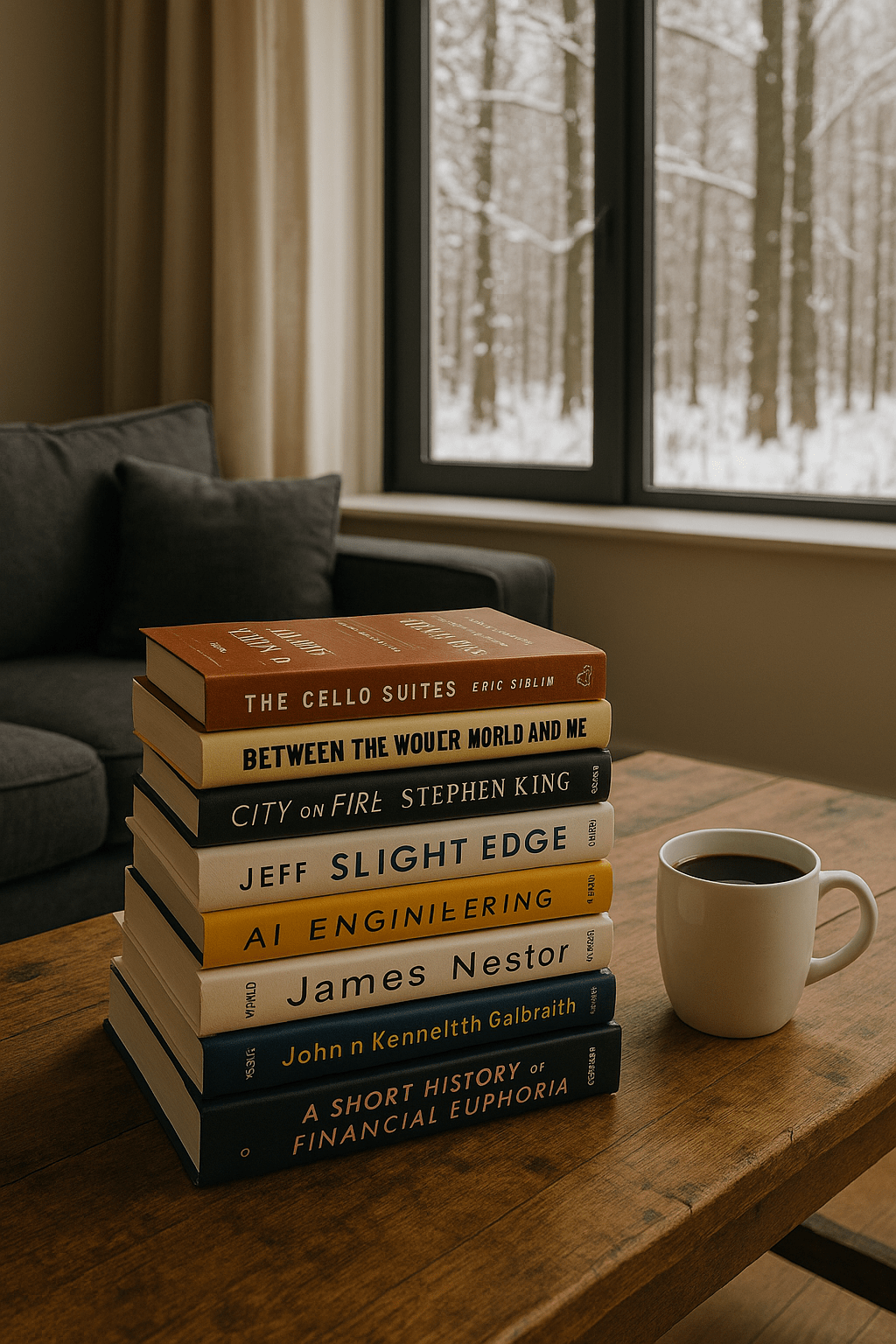
[clearly ChatGPT still has issues rendering words properly in images…]
Chris: The Cello Suites by Eric Siblin
Suhaib: Between the World and Me by Ta-Nehisi Coates. City on Fire: A Boyhood in Aligarh by Zeyad Masroor Khan
Hunter: On Writing by Stephen King
Mike: The Slight Edge by Jeff Olson
Leo: AI Engineering: Building Applications with Foundation Models by Chip Huyen
Yuan: Breath by James Nestor
Robert: Short History of Financial Euphoria by John Kenneth Galbraith
Lillian: The Embodied Mind by Thomas R. Verny; Being You by Anil Seth; Other Minds by Peter Godfrey-Smith; “What It Feels Like to Be a Bat” by Thomas Nagel
Ed: By Any Other Name by Jodi Picoult
2025 Combined Book List
[Written by ChatGPT]
Chris — The Cello Suites by Eric Siblin
Eric Siblin’s The Cello Suites is an elegant braid of biography, musicology, and personal discovery built around J.S. Bach’s six suites for solo cello. Siblin follows their journey from obscurity to global reverence, uncovering the mysteries surrounding their composition, the manuscript’s disappearance, and cellist Pablo Casals’s pivotal role in their revival. As he moves between Bach’s era, Casals’s life, and his own modern exploration, Siblin reveals how these pieces transcend time, culture, and medium. The book becomes both a detective story and a meditation on how art survives and continues to move us.
Suhaib — Between the World and Me by Ta-Nehisi Coates
Ta-Nehisi Coates’s Between the World and Me is a powerful letter to his son about growing up Black in America, blending memoir with sharp cultural critique. Coates examines the historical and ongoing violence inflicted on Black bodies, the emotional weight of systemic racism, and the hard-won wisdom he hopes to pass down. Through lyrical prose and unflinching honesty, he connects personal experience with national history, challenging readers to confront uncomfortable truths. His reflections ultimately form a poignant meditation on survival, identity, and resilience.
Suhaib — City on Fire: A Boyhood in Aligarh by Zeyad Masroor Khan
In City on Fire, Zeyad Masroor Khan recounts his childhood in Aligarh, a city shaped by cultural richness as much as by recurring communal violence. Khan intertwines personal memory with journalistic insight, capturing the tensions, friendships, fears, and hopes that defined his coming-of-age. As political and religious conflicts erupt around him, he explores how such instability imprints itself on families, communities, and a young boy’s emerging worldview. The result is a vivid, deeply human portrait of innocence shaped by a volatile environment.
Hunter — On Writing by Stephen King
Stephen King’s On Writing blends memoir with practical guidance on the craft of storytelling. King shares formative moments from his upbringing and writing career, offering candid insights into discipline, revision, character development, and the habits that sustain creative work. With humor and clarity, he dispels myths about inspiration, demystifies the writing process, and stresses the importance of reading widely and writing consistently. The book is both an intimate portrait of a writer’s life and a motivational handbook for anyone seeking to hone their craft.
Mike — The Slight Edge by Jeff Olson
In The Slight Edge, Jeff Olson argues that success is the cumulative outcome of small, simple, daily decisions—actions so easy that they are just as easy not to do. Olson explains how consistent positive habits compound over time, shaping long-term achievement in health, finances, relationships, and personal growth. He challenges readers to reject quick fixes and instead adopt a mindset-oriented approach to steady progress. The book ultimately reframes success as a quiet, ongoing discipline rather than a dramatic breakthrough.
Leo — AI Engineering: Building Applications with Foundation Models by Chip Huyen
Chip Huyen’s AI Engineering is a practical, systems-level roadmap for building production-ready AI applications in the era of large foundation models. She covers the entire lifecycle—data sourcing, model selection, evaluation, deployment, monitoring, and human-centered design—emphasizing reliability, scalability, and responsible use. Through real-world examples and clear conceptual frameworks, Huyen bridges the gap between research and engineering practice. The book equips practitioners with the tools and mindset needed to transform cutting-edge models into robust, user-focused products.
Yuan — Breath by James Nestor
James Nestor’s Breath explores the science, history, and transformative potential of proper breathing. Through immersive experiments and interviews with researchers, clinicians, and practitioners, Nestor uncovers how modern habits have led to dysfunctional breathing—and how simple techniques can dramatically improve health, sleep, athletic performance, and emotional well-being. From nasal breathing to ancient pranayama practices, he reveals surprising insights about how breath shapes the body and mind. The book ultimately argues that relearning how to breathe may be one of the most powerful health interventions available.
Robert — A Short History of Financial Euphoria by John Kenneth Galbraith
In A Short History of Financial Euphoria, economist John Kenneth Galbraith examines centuries of speculative bubbles to reveal how financial manias are driven less by market fundamentals than by recurring patterns of human psychology. With wit and precision, he highlights the roles of greed, leverage, misplaced confidence, and collective amnesia, showing how each generation believes its moment to be unique—right up until the crash. Galbraith’s concise analysis serves as both a history lesson and a warning: financial euphoria is timeless, predictable, and inevitably temporary.
Lillian — The Embodied Mind by Thomas R. Verny; Being You by Anil Seth; Other Minds by Peter Godfrey-Smith; “What It Feels Like to Be a Bat” by Thomas Nagel
These four works provide a rich, interdisciplinary exploration of consciousness, perception, and the nature of subjective experience. In The Embodied Mind, Thomas Verny argues that consciousness arises not only from the brain but from the entire body’s interconnected biological systems, challenging traditional mind–brain dualism. Being You by neuroscientist Anil Seth offers a cutting-edge account of how the brain constructs reality through prediction, showing that our sense of self is an active, constantly updated model rather than a fixed entity. In Other Minds, philosopher and diver Peter Godfrey-Smith investigates the octopus as an evolutionary experiment in intelligence, using its alien cognition to illuminate the diversity of possible minds. Thomas Nagel’s classic essay “What It Feels Like to Be a Bat” questions whether humans can ever truly grasp another creature’s subjective experience, highlighting the limits of objective science. Together, these works probe what it means to be conscious, embodied, and aware.
Ed — By Any Other Name by Jodi Picoult
Jodi Picoult’s By Any Other Name weaves together a contemporary narrative and a historical storyline to explore authorship, identity, and who gets credit for creative work. The novel follows a modern writer whose career becomes entangled with a centuries-old literary controversy, forcing her to confront issues of gender, ownership, and the politics of recognition. As Picoult alternates between past and present, she examines how stories are shaped, claimed, suppressed, and reclaimed. Ultimately, the book is a compelling reflection on originality, truth, and the power of names.
 UpLive.Life