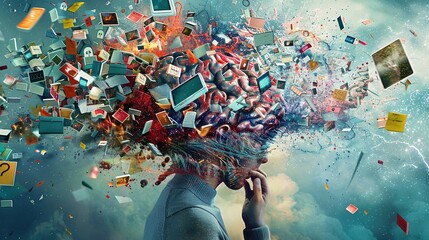
[Written by Claude. Cognitive Bias Codex from here. Image credit.]
How our ancient brains learned to survive in a world drowning in data
Close your eyes and listen. Right now, millions of sensory inputs are bombarding your nervous system. The hum of the refrigerator, the pressure of your chair, the temperature of the air, distant traffic sounds, the feeling of your clothes against your skin, the light filtering through your eyelids. Your brain is receiving roughly 11 million bits of information per second.
But here’s the remarkable part: you’re only consciously processing about 40 bits of that information per second.
Your brain isn’t lazy. It’s a survival machine, honed over millions of years to solve one of evolution’s most dangerous problems: too much information, not enough time to process it.
The Savanna Didn’t Come with Instructions
Imagine you’re our ancestor, standing on the East African savanna 200,000 years ago. Every rustle in the grass could be the wind, a harmless rodent, or a leopard about to pounce. Every distant sound might signal your tribe, another human group, or a predator. Every plant could be nutritious, poisonous, or irrelevant.
The sheer volume of sensory information was overwhelming. And unlike today, where the consequences of information overload might be a missed email or a poor purchasing decision, the consequences then were immediate and fatal. Miss the leopard in the grass, and your genetic line ends. Spend too much time analyzing every piece of information, and you starve while your competitors eat.
Natural selection’s solution? Don’t process everything. Filter ruthlessly.
The brains that survived weren’t the ones that processed the most information. They were the brains that processed the right information, quickly, even if it meant being wrong sometimes. A brain that assumed every rustle was a predator and ran 100 times unnecessarily was far more likely to survive than a brain that carefully analyzed each rustle and got eaten on the 101st time.
Your Brain: The Ultimate Pattern-Recognition Machine
Evolution turned your brain into the most sophisticated filtering system on Earth. But it didn’t do this by making you more logical. It did this by installing a series of shortcuts, heuristics, and biases that work most of the time in the environments where humans evolved.
Let’s look at why each category of “too much information” biases exists:
The Repetition Filter: “I’ve Seen This Before”
Why we notice things primed in memory or repeated often
On the savanna, if you encountered a plant five times and didn’t get sick, it was probably safe. If you heard a particular bird call before finding water three times, that call meant water. Repetition was evidence of reliability.
This is why the availability heuristic feels so right. When something comes easily to mind, it usually did happen frequently in your environment. If you kept hearing stories about tribe members being attacked by lions near a certain watering hole, that watering hole was genuinely dangerous. Your brain saying “remember those lion attacks!” wasn’t a bias—it was accurate risk assessment.
The problem today? In our modern information environment, repetition doesn’t mean frequency of actual occurrence. It means frequency of media coverage. Plane crashes are repeated endlessly across news channels and social media, making them highly available to memory, while the millions of safe flights go unreported. Your ancient brain can’t distinguish between “I’m hearing about this repeatedly because it’s common” and “I’m hearing about this repeatedly because it’s sensational.”
The mere exposure effect worked beautifully when repeated exposure actually meant something was safe, familiar, and part of your tribe’s territory. Today, it’s why advertisers pay billions to simply show you the same logo over and over.
The Novelty Filter: “That’s Weird—Pay Attention!”
Why bizarre, funny, and visually striking things stick out
Here’s a survival truth: unusual things were often important things. Most days on the savanna were routine. But the day you saw a snake with a pattern you’d never seen before? That needed to be remembered. The plant with the strangely bright berries? Worth noting. The human stranger with unusual clothing? Potentially dangerous or valuable.
The bizarreness effect and Von Restorff effect exist because novelty was an alarm bell. Your ancestors who remembered unusual events had crucial survival information. They knew which new plants were poisonous because someone ate the weird red berries and died. They remembered the stranger’s face because he came back with warriors.
Even humor had evolutionary value. Information packaged with emotional content—whether funny, shocking, or frightening—was more likely to be important social information worth remembering and sharing. A funny story about someone’s hunting mistake contained valuable lessons about what not to do.
The negativity bias is perhaps the most powerful filter of all. Positive events (found food, had a good day) were nice, but negative events (attacked by predator, ate poisonous plant, betrayed by tribe member) were existential. An ancestor who weighted negative information more heavily was more likely to survive. As the saying goes: “It’s better to mistake a stick for a snake than a snake for a stick.”
The Change Detection Filter: “Something’s Different”
Why we notice when things have changed
Imagine walking the same path to the river every day. One morning, a large rock has appeared on the path. This change is crucial information. Maybe there was a landslide. Maybe another tribe is marking territory. Maybe predators are hiding nearby.
Contrast effects and anchoring evolved because changes in the environment were often signals of danger or opportunity. If the weather is normally mild and suddenly turns cold, that’s a survival-relevant change. If game is usually plentiful in an area and suddenly scarce, something has shifted in the ecosystem.
The first piece of information you encounter (the anchor) often represents the baseline, the normal state of affairs. It makes computational sense to use this as a reference point rather than constantly recalculating from scratch. When food was scarce (the anchor), finding a small amount felt like abundance. When food was plentiful, that same small amount felt inadequate.
Today, retailers exploit this by showing you a high “original price” (establishing an anchor) before showing the sale price. Your brain processes this as a meaningful change from baseline, even though the original price may have been artificially inflated.
The Confirmation Filter: “Just As I Thought”
Why we’re drawn to details that confirm our existing beliefs
This might seem like pure irrationality, but confirmation bias had profound survival value. Here’s why:
Once you’d learned something important—this plant is poisonous, this water source is reliable, this person is trustworthy—constantly questioning it was inefficient and dangerous. If you’d survived 30 years by avoiding a particular type of snake, skeptically re-testing whether that snake was really dangerous would be evolutionarily foolish.
Beliefs that kept you alive needed to be sticky. Your brain needed to resist changing successful strategies based on every new piece of conflicting information. Sometimes that new information was wrong, or an outlier, or situationally specific.
Additionally, in a tribal environment, having stable, shared beliefs created social cohesion. Tribes that agreed on basic facts (where to find water, which animals were dangerous, how to prepare food) cooperated more effectively. Constantly updating beliefs based on every individual’s experiences would have created chaos and disagreement.
The Semmelweis reflex—rejecting evidence that contradicts established norms—kept communities from abandoning practices that worked based on one person’s unusual experience. Yes, sometimes this meant rejecting genuine innovations (like hand-washing in medicine), but more often it meant maintaining effective traditional knowledge.
The Social Comparison Filter: “Others Are More Biased Than Me”
Why we notice flaws in others more than in ourselves
The bias blind spot might seem like pure egotism, but it served crucial social functions. Being able to quickly spot when others were making biased decisions (favoring their kin, being swayed by emotion, showing poor judgment) helped you navigate tribal politics and choose reliable allies.
Meanwhile, excessive self-doubt was paralyzing. An ancestor who constantly questioned their own judgment would hesitate at crucial moments. The confident hunter who trusted his skills brought home dinner. The one paralyzed by self-doubt starved.
Naïve realism—believing you see the world objectively while others are biased—allowed you to act decisively on your beliefs while remaining appropriately skeptical of others’ claims. In a world where misinformation could get you killed, trusting your own tested experiences over others’ untested claims made sense.
The Modern Mismatch
Here’s the fundamental problem: your brain evolved in an information environment that was high-stakes, low-volume, and mostly honest.
- High-stakes: Most information was directly relevant to survival
- Low-volume: You encountered perhaps 50-150 people in your lifetime, heard a handful of stories, saw one geographic region
- Mostly honest: While deception existed, most information came from direct experience or people whose survival was tied to yours
Today’s information environment is the opposite: low-stakes, high-volume, and strategically manipulated.
- Low-stakes: Most information we encounter won’t affect our survival
- High-volume: We encounter more information before breakfast than our ancestors did in a year
- Strategically manipulated: Billions of dollars are spent engineering information to exploit our biases
Your brain’s filters made you a survivor on the savanna. They make you a target on social media.
The Bias Isn’t the Bug—It’s the Feature
Here’s the liberating truth: these aren’t design flaws in your brain. They’re design features that usually worked brilliantly for millions of years. The availability heuristic kept your ancestors alive far more often than it killed them. Confirmation bias preserved valuable knowledge. The negativity bias was rational pessimism in a dangerous world.
The problem isn’t that we have these biases. The problem is that we’re running sophisticated survival software designed for one environment in a radically different one. It’s like using a submarine to fly—not because the submarine is poorly designed, but because it was designed for a different medium.
Understanding this evolutionary perspective doesn’t eliminate these biases. But it does three important things:
First, it builds compassion. You’re not stupid for falling for these mental shortcuts. You’re human. Your brain is doing exactly what it was designed to do.
Second, it identifies the problem. The issue isn’t your brain—it’s the mismatch between your brain and your environment. You can’t easily change your brain, but you can change your information environment.
Third, it suggests solutions. If these biases evolved to handle information scarcity and immediate threats, you can compensate by deliberately slowing down for important decisions, seeking out disconfirming evidence, and recognizing when your environment is manipulating your ancient instincts.
Living with a Stone Age Brain in a Digital Age
Your brain isn’t broken. It’s a masterpiece of engineering, honed over millions of years to solve real problems in a dangerous world. Every bias, every shortcut, every mental filter helped your ancestors survive long enough to pass on their genes—including to you.
The challenge isn’t to eliminate these biases. It’s to recognize when they’re being activated in environments they weren’t designed for. When you feel the tug of the availability heuristic, ask: “Am I hearing about this repeatedly because it’s common, or because it’s sensational?” When confirmation bias kicks in, pause and ask: “Am I protecting valuable knowledge, or just protecting my ego?”
Your ancient brain got you here. With a little awareness, it can get you through the digital age too.
The next time someone shares a shocking news story and you feel compelled to believe it because you’ve seen it repeated everywhere, remember: your brain is doing its job. It’s designed to trust repeated information because, for millions of years, that was a reliable signal. It’s not trying to mislead you. It’s trying to save your life, one scroll at a time—just in an environment it was never designed for.
1. TOO MUCH INFORMATION
We notice things already primed in memory or repeated often:
- Availability heuristic – We judge the likelihood of events based on how easily examples come to mind. After seeing news reports about plane crashes, people often overestimate the danger of flying compared to driving, even though driving is statistically more dangerous.
- Attentional bias – We consistently focus on certain things while ignoring others, based on what’s emotionally significant to us. Someone anxious about their health might notice every news story about diseases while missing positive health stories.
- Illusory truth effect – We tend to believe information is true when we’ve heard it multiple times, regardless of its actual accuracy. A false claim repeated across social media can start to feel true simply because we’ve encountered it so many times.
- Mere exposure effect – We develop a preference for things simply because we’re familiar with them. You might find yourself liking a song you initially disliked after hearing it on the radio repeatedly.
- Context effect – Our perception and memory of information is influenced by the environment or context in which we encounter it. The same wine can taste better in an elegant restaurant than at home, even though it’s identical.
- Cue-dependent forgetting – We have difficulty recalling information when the context or cues present during learning are absent. You might struggle to remember someone’s name when you meet them outside the office where you usually see them.
- Mood-congruent memory bias – We more easily recall memories that match our current emotional state. When you’re happy, you tend to remember other happy times; when depressed, sad memories come more readily to mind.
- Frequency illusion – After noticing something for the first time, we suddenly see it everywhere. After buying a particular car model, you start noticing that same model on every street.
- Baader-Meinhof Phenomenon – This is another name for frequency illusion. You learn a new word and then encounter it multiple times in the following days, making it seem like the universe is conspiring to show it to you.
- Empathy gap – We underestimate how much our current emotional state influences our decisions and fail to predict how we’ll feel in different emotional states. When you’re full after dinner, it’s hard to imagine being so hungry tomorrow that you’d eat gas station food.
- Omission bias – We judge harmful actions as worse than equally harmful inactions, preferring to avoid action even when it would produce better outcomes. Parents might refuse to vaccinate their child because they fear causing harm through action, even though not vaccinating (inaction) poses greater risk.
- Base rate fallacy – We ignore statistical base rates in favor of specific, anecdotal information when making judgments. If you hear about one shark attack at a beach visited by millions annually, you might irrationally fear swimming there despite the minuscule statistical risk.
Bizarre, funny, visually-striking, or anthropomorphic things stick out more than non-bizarre/unfunny things:
- Bizarreness effect – We remember unusual or bizarre information better than common information. You’re more likely to remember a lecture where the professor wore a costume than one where they wore normal clothes.
- Humor effect – Information presented humorously is better remembered than information presented in a straightforward manner. Students often recall funny examples from class years later while forgetting standard explanations.
- Von Restorff effect – An item that stands out from its peers is more likely to be remembered. In a list of words written in black ink, the one word written in red will be easiest to recall.
- Picture superiority effect – Concepts learned through pictures are better remembered than concepts learned through words alone. You’ll remember a face better than a name, and instructions with diagrams better than text-only instructions.
- Self-relevance effect – We remember information better when it relates to ourselves. You’re more likely to remember someone’s birthday if it’s the same as yours or a close family member’s.
- Negativity bias – Negative events and information affect us more strongly than equally positive ones. A single critical comment can overshadow a dozen compliments, and bad news captures our attention more than good news.
We notice when something has changed:
- Anchoring – We rely too heavily on the first piece of information we receive when making decisions. If a shirt is marked down from $100 to $50, it seems like a great deal, even if the shirt was never really worth $100.
- Conservatism – We insufficiently revise our beliefs when presented with new evidence. Even after reading multiple studies showing a health benefit, we might stick with our original skeptical view.
- Contrast effect – We perceive things differently based on comparison with what we just experienced. A 70-degree day feels warm in winter but cool in summer.
- Distinction bias – We view two options as more different when evaluating them together than when evaluating them separately. Two similar cameras seem very different in the store side-by-side, but you’d be equally happy with either if you only saw one.
- Focusing effect – We place too much importance on one aspect of an event, causing errors in predictions about future happiness. People overestimate how much moving to California would improve their life by focusing only on the weather.
- Framing effect – We react differently to the same information depending on how it’s presented. People are more likely to choose surgery with a “90% survival rate” than one with a “10% mortality rate.”
- Money illusion – We think about money in nominal rather than real terms, ignoring inflation. A 2% raise feels good even when inflation is 3%, meaning your purchasing power actually decreased.
- Weber-Fechner law – We perceive changes proportionally rather than absolutely. Adding $10 to a $20 item feels significant, but adding $10 to a $1,000 item feels negligible.
We are drawn to details that confirm our own existing beliefs:
- Confirmation bias – We search for, interpret, and recall information that confirms our preexisting beliefs. If you believe a politician is corrupt, you’ll notice and remember news stories that support this view while dismissing contradictory evidence.
- Congruence bias – We test hypotheses by examining cases where we expect our hypothesis to be true, rather than testing alternatives. A doctor who suspects pneumonia orders tests to confirm pneumonia rather than tests to rule out other diagnoses.
- Post-purchase rationalization – We convince ourselves that a purchase was valuable after we’ve made it. After buying an expensive gym membership, you tell yourself it was worth it even if you rarely go.
- Choice-supportive bias – We remember our choices as better than they actually were. After choosing between two job offers, you emphasize the positives of your choice and the negatives of the rejected option.
- Selective perception – We expect certain things to happen and therefore perceive them even when they don’t. Sports fans often “see” fouls against their team that referees miss, while overlooking fouls committed by their own players.
- Observer-expectancy effect – Our expectations influence our interpretation of what we observe. If you’re told a student is gifted, you’ll interpret their average work as showing hidden brilliance.
- Experimenter’s bias – Researchers unconsciously influence participants to confirm the researchers’ hypotheses. A scientist testing a new drug might unconsciously give more encouraging feedback to participants in the treatment group.
- Observer effect – The act of observing a situation changes the situation being observed. Employees work more diligently when they know they’re being watched during a performance review.
- Expectation bias – We interpret ambiguous information as confirming our expectations. If you expect a meeting to be boring, you’ll interpret the presenter’s neutral demeanor as dull rather than professional.
- Ostrich effect – We avoid negative information by ignoring it, like an ostrich burying its head in the sand. People avoid checking their bank balance when they know they’ve been overspending.
- Subjective validation – We perceive two unrelated events as being related when our personal beliefs demand a relationship. Reading a horoscope that says “you’ll face a challenge today,” you attribute any minor inconvenience to cosmic forces.
- Continued influence effect – We continue to believe misinformation even after it’s been corrected. Even after a retraction, people remember the original false news story as true.
- Semmelweis reflex – We reflexively reject new evidence that contradicts established norms. Doctors initially rejected hand-washing to prevent infections because it contradicted the prevailing medical theory of the time.
We notice flaws in others more easily than we notice flaws in ourselves:
- Bias blind spot – We recognize biases in others while being blind to our own. You might notice that your colleague makes decisions based on emotion while believing your own decisions are purely logical.
- Naïve cynicism – We believe others are more biased and self-interested than they actually are. You might assume a coworker volunteered for a project only to get recognition, when they genuinely wanted to help.
- Naïve realism – We believe we see the world objectively while others are biased, irrational, or misinformed. In political debates, both sides believe their view is the objective truth while the other side is blinded by ideology.
 UpLive.Life
2 thoughts on “Cognitive Bias #1: Why Your Brain is a Master Filter – The Evolution of Information Overload”