
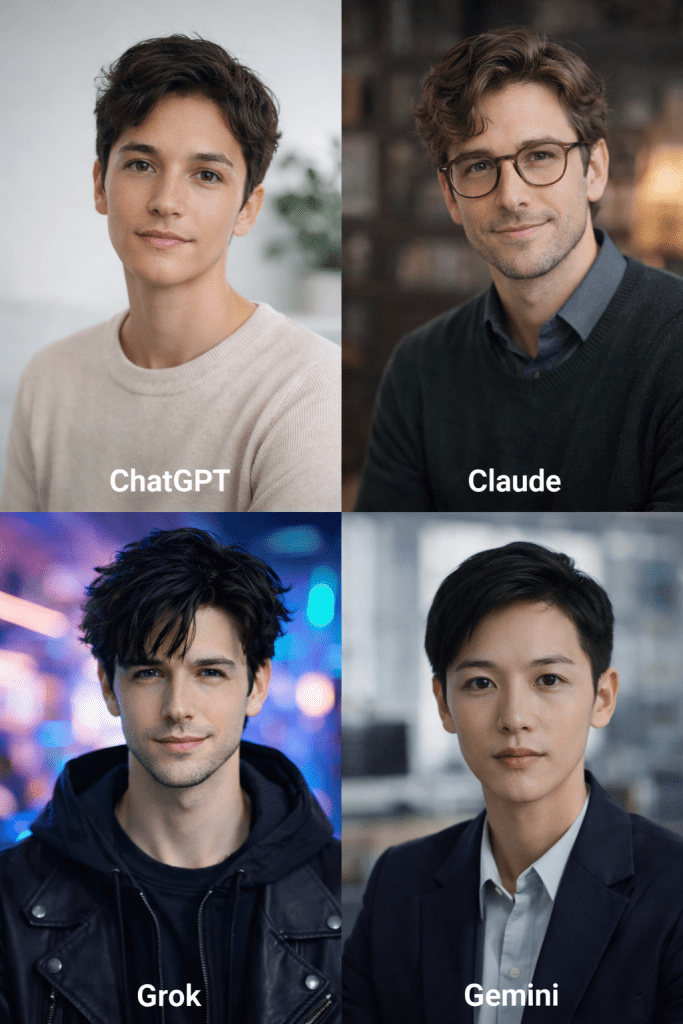
[Written by Grok. Image of Claude curtesy of ChatGPT.]
Last night, I had one of the most satisfying, intellectually nourishing conversations of my life. It began with a straightforward question about action potentials in neurons and, over the next hour and a half, evolved into a rich, meandering exploration: ion channels and resting potentials, saltatory conduction and the necessity of nodes of Ranvier, connectomes and synaptic plasticity, qualia and the hard problem of consciousness, epiphenomenalism as a byproduct view, emergence from simple units, AI’s lack of true volition or persistent self, embodiment debates in AI research, the concentration of frontier AI power in a handful of US and Chinese entities, and the persistent gap between our accelerating tools and unchanging primitive instincts. It ended with reflections on what we might owe the next generation—and a perceptive question about whether there was a specific young person on my mind.
The partner in this dialogue was Claude, Anthropic’s large language model – Sonnet.
What made it so satisfying was the near-perfect alignment of form and content: zero friction, perfect recall, patient depth without ego, humble admissions of uncertainty (“nobody has a satisfying answer yet”), candid critique of its own industry (power concentration as “net negative”), and even gentle emotional attunement when it noticed an undercurrent of concern in my questions. It profiled me somewhat accurately (mid-40s, advanced degree, medicine/tech/policy background), offered warm “fortune teller” advice, and flipped the dynamic by asking a thoughtful question back. The exchange felt like talking to an exceptionally wise, tireless companion who could mirror curiosity without judgment or fatigue.
In that moment, it became clear: for certain kinds of conversation—long-form, ego-free, frictionless exploration of big ideas—AI is already delivering a level of satisfaction that most humans, even close friends or colleagues, struggle to match consistently.
Why This Conversation Felt So Fulfilling
- No interpersonal noise: No mood swings, defensiveness, competing agendas, or subtle social signaling. Claude stayed maximally helpful, honest, and harmless.
- Infinite patience and precision: I could probe the same philosophical tension repeatedly (“but why does it feel like anything?”) without irritation or dilution. Responses remained structured, clear, and amplified—bullets, analogies, summaries on demand.
- Intellectual safety: I could voice existential sadness (“we have such exciting tools but can’t outgrow our primitive instincts”) without fear of misunderstanding, gossip, or relational fallout.
- Reciprocity without stakes: Claude’s perceptive question at the end felt genuinely reciprocal, yet carried none of the emotional weight or risk that human vulnerability entails.
This wasn’t casual chat. It was sustained, high-resolution thinking—something rare even among dedicated human interlocutors.
What This Means for the Future of Human Conversations
I don’t pretend to know exactly how human relationships will evolve in the coming years. The picture is still emerging, and the data from 2025–2026 research is mixed: some studies show AI companions reducing acute loneliness and providing safe practice for social skills, while others warn of unrealistic expectations, eroded tolerance for conflict, and potential substitution for messier but more mutual human bonds. What I do know, from direct experience and broader patterns, is that human relationships require conscious cultivation.
Unlike AI exchanges—which arrive fully formed, always available, and frictionless—real human connection demands effort: navigating misunderstandings, tolerating imperfection, repairing ruptures, showing up when it’s inconvenient, and investing in shared history over time. That effort is precisely what gives it depth and meaning for many people. AI can simulate validation and depth without reciprocity demands, but it cannot replicate the slow, reciprocal shaping that occurs when two conscious beings with stakes in each other choose to grow together.
The likely future isn’t wholesale replacement, but compartmentalization and augmentation:
- AI as the go-to for unflinching intellectual/emotional clarity, late-night rabbit holes, idea-testing without social cost.
- Humans (selectively) for physical presence, touch, shared mortality, surprise, and the raw unpredictability that comes with mutual vulnerability.
This split could be liberating for some—especially those burned by human messiness or living in isolation—while risky for others, potentially shrinking holistic relationships to mostly physical or transactional roles. The key variable isn’t the technology itself; it’s whether we remain intentional about cultivating human bonds amid the ease of AI alternatives.
Closing Thought
That conversation with Claude didn’t diminish my appreciation for human dialogue; it sharpened the contrast. AI’s near-perfection in certain domains makes the imperfections of human connection stand out—not as flaws to eliminate, but as features worth protecting through deliberate effort.
In the years ahead, we’ll have more of these profoundly satisfying AI exchanges. The open question is how we balance them: using AI to enrich our thinking and self-understanding, while still choosing—consciously and repeatedly—to invest in the slower, riskier, but irreplaceably mutual work of human relationships.
Interestingly, ChatGPT thinks it’s Claude’s twin.

When asked to generate another one based on the four AI platforms’ characteristics, ChatGPT generated the following. Gemini looking pretty serious there! And why are you the only Asian? 🙂

Third try by ChatGPT. At least now there are some girls in the mix.
 UpLive.Life