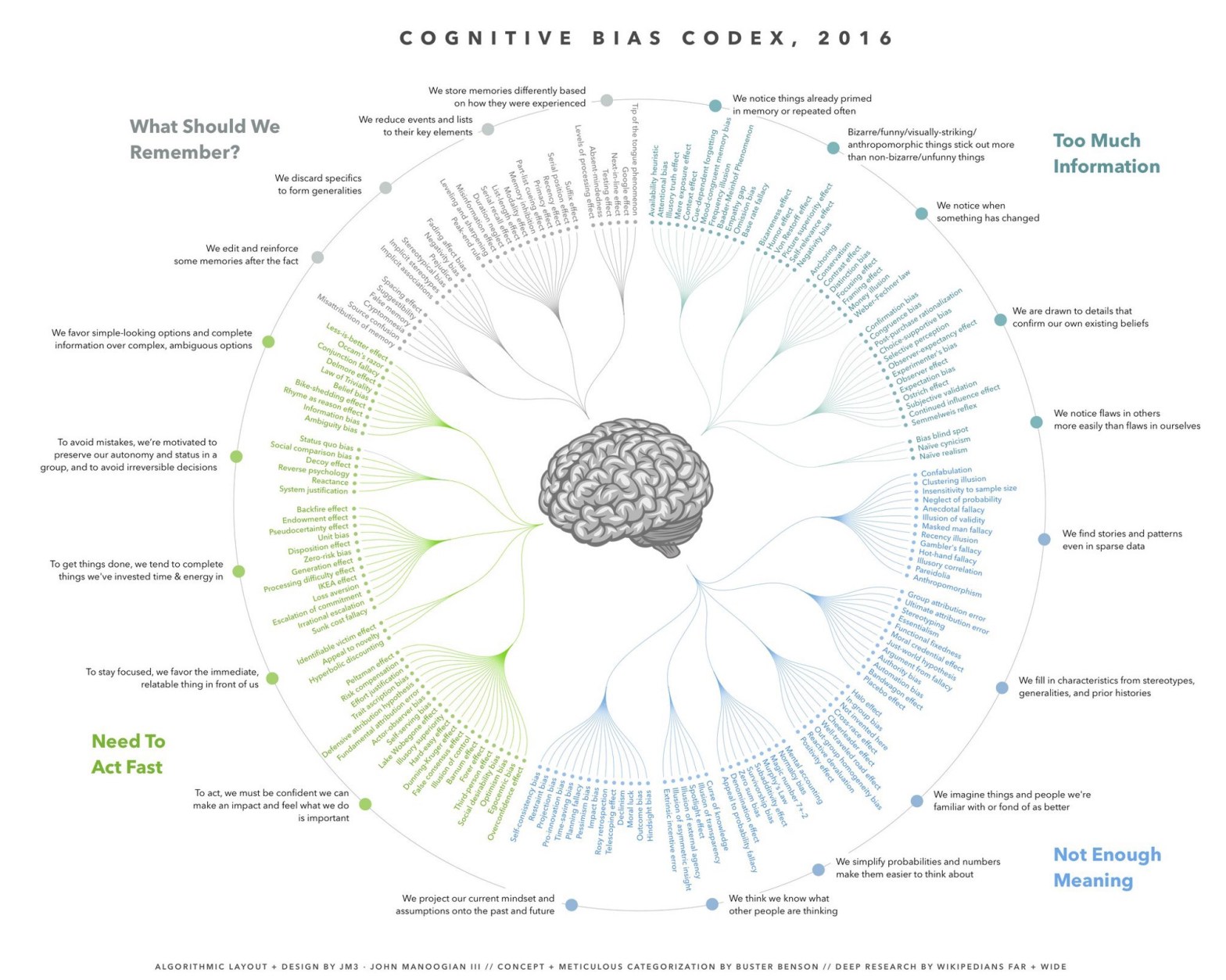
[Written by Gemini. Image credit]
Cognitive biases, defined as systematic deviations from rational judgment, represent predictable patterns of error in human thinking. These biases influence how individuals perceive reality and make decisions, often leading to interpretations and choices that deviate from objective analysis. The field of cognitive science, along with social psychology and behavioral economics, has identified a vast catalog of these biases, as exemplified by the extensive list provided by The Decision Lab. A fundamental question arises from this body of work: why do these seemingly irrational patterns of thought appear to be so consistently observed across diverse cultures and backgrounds? This report aims to explore this question by examining the evolutionary, neurological, cognitive, and social perspectives on cognitive biases, ultimately inferring what this consistency implies about the fundamental structure and function of the human brain.
To understand the pervasive nature of cognitive biases, it is helpful to consider a few prominent examples. Confirmation bias describes the tendency to seek out, interpret, favor, and recall information that aligns with one’s pre-existing beliefs or hypotheses. This bias can lead individuals to selectively focus on evidence that supports their views while disregarding contradictory information, contributing to the rigidity of beliefs across various domains. The availability heuristic refers to the inclination to overestimate the likelihood of events that are easily recalled or readily available in memory. Vivid or emotionally charged events are often more easily remembered and can thus disproportionately influence our judgments of probability. Anchoring bias highlights the tendency to heavily rely on the first piece of information received (the “anchor”) when making decisions. This initial anchor can significantly influence subsequent judgments, even if it is irrelevant to the actual decision. Finally, the fundamental attribution error describes the tendency to overemphasize dispositional or personality-based explanations for others’ behavior while underemphasizing situational factors. These examples, spanning information processing, probability assessment, and social perception, illustrate that cognitive biases are not confined to a single type of cognitive task, suggesting a broad influence of underlying cognitive mechanisms.
While behavioral economics has historically operated under the assumption that cognitive biases are universal, emerging research has increasingly explored the nuances of these biases across different cultural contexts. Despite the recognition of cultural variations, evidence suggests that certain cognitive biases do appear consistently across a wide range of cultures. For instance, research has demonstrated a universal human preference for rhythms based on simple integer ratios in music, indicating a fundamental aspect of music cognition that transcends cultural boundaries. Furthermore, the cognitive science of religion proposes that universal cognitive biases play a role in the recurrence of similar religious beliefs across unrelated cultures, influencing how individuals perceive, interpret, and remember concepts related to the supernatural. A study comparing confirmation bias across the United States, Taiwan, China, and Europe found no significant cultural differences in this particular bias. Cognitive biases are often described as robust and universal psychological phenomena that are evident in various societal issues and policymaking contexts. The notion that cognitive biases act as mental filters that universally help humans process information quickly further supports the idea of shared cognitive tendencies.
However, it is crucial to acknowledge that research also highlights cultural variations in the manifestation and strength of certain biases. Cross-cultural studies on optimism bias have revealed that while Westerners tend to be optimistic in predicting both positive and negative future events, Easterners are often more pessimistic when predicting negative events. Individualistic Western societies tend to exhibit a stronger self-enhancement bias compared to collectivistic East Asian societies, where there is often a greater emphasis on self-criticism for improvement. East Asians tend to pay more attention to avoidance-oriented information, whereas Westerners focus more on approach-oriented information. Studies on migrants have shown that their cognitive biases can shift to become more similar to those of their host culture, indicating an acculturation of biases. Furthermore, there are recognized differences in cognitive styles, with Western cultures often characterized by a more analytic approach and East Asian cultures by a more holistic one. Research conducted in Kenya has suggested that some biases may not manifest in the same way in non-WEIRD (Western, Educated, Industrialized, Rich, and Democratic) populations due to differences in context and experimental design. Meta-analyses have also indicated that the effectiveness of persuasive appeals (affective vs. cognitive) can vary across cultures based on the level of individualism or collectivism. These findings underscore the importance of considering methodological challenges in cross-cultural research, such as construct bias (where the concept being measured is not identical across cultures), sample bias (incomparable sample characteristics), and instrument bias (issues with the measurement tools themselves). The over-reliance on WEIRD populations in cognitive bias research has also been a subject of critique, emphasizing the need for more diverse samples to understand the true extent of universality. Despite these cultural variations, the recurrence of certain biases across diverse contexts suggests a fundamental underlying mechanism in human cognition that is likely shaped by our shared biology and evolutionary history.
The evolutionary psychology perspective offers a compelling lens through which to understand the potential universality of cognitive biases. From this viewpoint, these biases can be seen as evolved design features of the mind that have underpinned the human instinct for survival over millennia. Rather than viewing them as mere flaws in thinking, this perspective suggests that cognitive biases might be remnants of adaptive mental functions that served our ancestors well. In many situations, particularly those requiring immediate action, the ability to make quick decisions, even if not perfectly rational, would have been crucial for survival. Heuristics, the mental shortcuts that often underlie cognitive biases, are considered “fast and frugal” strategies that allowed our ancestors to make reasonably good choices with limited information and amidst distractions. For example, the availability heuristic, while sometimes leading to inaccurate probability assessments, provides a quick way to draw conclusions and act in a timely manner. The concept of “adaptive bias” further suggests that our decisions might be based on limited information and skewed towards avoiding the most costly errors from an evolutionary standpoint. Error management theory posits that when faced with uncertainty, it is often more advantageous to err on the side of the fitness-relevant choice, such as the detection of potential threats. For instance, assuming a rustling in the bushes is a dangerous agent, even if it is not, is a less costly error than ignoring a real threat. Furthermore, some biases, like overconfidence and in-group bias, might have offered strategic advantages in social and political contexts, enhancing group cohesion and individual status. While there is an ongoing debate about the extent to which biases are innate versus acquired, both perspectives acknowledge the role of heuristics in shaping our decisions. Ultimately, the existence of these biases might also reflect the bounded rationality of the human brain, its limited capacity to process the vast amounts of information in the environment, leading to the adoption of simplifying strategies.
| Cognitive Bias | Brief Description | Potential Evolutionary Advantage |
|---|---|---|
| Confirmation Bias | Favoring information that confirms existing beliefs. | Efficient processing of information; maintaining social group cohesion around shared beliefs. |
| Availability Heuristic | Overestimating the likelihood of easily recalled events. | Quick assessment of immediate dangers based on salient memories. |
| Fundamental Attribution Error | Overemphasizing dispositional causes for others’ behavior. | Rapidly assessing the character of others for social navigation. |
| In-Group Bias | Favoring members of one’s own group. | Promoting cooperation and resource sharing within the group; facilitating intergroup competition. |
| Loss Aversion | Feeling the pain of loss more strongly than the pleasure of an equivalent gain. | Avoiding potentially costly mistakes; prioritizing the preservation of resources. |
| Negativity Bias | Giving more weight to negative experiences or information. | Increased vigilance towards threats and potential dangers. |
The neurological basis of cognitive biases provides further insight into their origins and potential universality. Decision-making is a complex process involving intricate neural activity in brain regions such as the prefrontal cortex and the amygdala, which are responsible for rational thought and emotional regulation, respectively. The interplay between these areas plays a crucial role in guiding executive function and shaping our choices. For example, the framing effect, where the way options are presented influences choices, has been specifically linked to activity in the amygdala, highlighting the role of the emotional system in decision biases. Conversely, activity in the orbital and medial prefrontal cortex has been associated with a reduced susceptibility to the framing effect, suggesting the involvement of these areas in more rational processing. The anchoring bias, the over-reliance on initial information, is thought to involve the dorsolateral prefrontal cortex, which is related to memory retrieval. The “anchoring-and-adjustment” process, particularly when inferring others’ mental states, may involve the medial prefrontal cortex. Interestingly, research on risk-taking bias has revealed a lateralization of brain activity, with the right hemisphere showing increased activity during bias towards risky bets and the left hemisphere during bias away from risk. Memory, a key component of many biases, involves the hippocampus. Furthermore, reward-based learning and the acquisition of bias in perceptual decisions have been linked to activity in the ventral striatum, dorsolateral prefrontal cortex, parietal cortex, and ventromedial prefrontal cortex. The consistent involvement of these brain regions across individuals, regardless of their cultural background, suggests a shared neurological infrastructure that contributes to the potential universality of cognitive biases.
| Cognitive Bias | Primary Brain Regions Involved |
|---|---|
| Framing Effect | Amygdala, Orbital and Medial Prefrontal Cortex |
| Anchoring Bias | Dorsolateral Prefrontal Cortex, Medial Prefrontal Cortex |
| Risk-Taking Bias | Right Hemisphere (risky), Left Hemisphere (risk-averse) |
| Memory-Related Biases | Hippocampus, Prefrontal Cortex |
| Reward-Based Bias | Ventral Striatum, Dorsolateral Prefrontal Cortex, Parietal Cortex, Ventromedial Prefrontal Cortex |
The universality of cognitive biases can also be attributed to the fundamental aspects of human cognition, such as perception, memory, and attention, which are likely to operate in similar ways across all individuals. Perception, the process of interpreting sensory information, is inherently subjective and influenced by past experiences and expectations, leading to biased interpretations of reality. Confirmation bias, for example, illustrates how our perception can be skewed to align with our existing beliefs. Memory, far from being a perfect recording device, is reconstructive and susceptible to various biases that can distort our recall of events and influence subsequent decisions. The availability heuristic is a prime example of a memory bias, where judgments are based on the ease with which information comes to mind. Attention, being a limited resource, requires us to be selective about what we focus on, which can lead to attentional bias and contribute to biases like confirmation bias, where we selectively attend to belief-confirming information. These fundamental cognitive processes, with their inherent limitations and tendencies, are likely to be largely consistent across humanity, providing a foundation for the widespread manifestation of cognitive biases. Biases can thus be seen as byproducts of the brain’s generally efficient, though not always accurate, strategies for processing the vast amounts of information we encounter daily.
Shared human experiences and social interactions across cultures also play a role in the development and conservation of certain cognitive biases. Cognitive biases, like mental shortcuts, are a universal aspect of human experience, influencing our decisions, opinions, and perceptions of ourselves and others. Social learning and cultural transmission contribute to the propagation of certain biases within societies. Common social phenomena, such as the bandwagon effect (the tendency to follow popular trends) and the false consensus effect (the overestimation of how much others agree with us), are likely observed across cultures due to similar underlying social dynamics. Universal aspects of social interaction, like the need for group cohesion and the tendency towards in-group favoritism, might contribute to biases such as the fundamental attribution error and in-group/out-group bias. While culture can modulate the expression of biases, the fundamental social dynamics that contribute to some of them are likely shared across human societies. Shared human experiences, such as the need to make quick judgments about others or the desire for belonging, could foster the development and maintenance of certain cognitive biases across cultures.
Synthesizing these findings, the apparent conservation of cognitive biases across different cultures and backgrounds likely arises from a complex interplay of our shared evolutionary history, the fundamental architecture and limitations of our cognitive processes, and the common dynamics of human social interaction. While cultural variations in the expression and strength of some biases are evident, the underlying tendency towards these biases suggests a common human cognitive framework shaped by universal pressures and constraints. The widespread presence of cognitive biases strongly implies that the human brain is likely wired with certain inherent processing tendencies or heuristics that, while generally adaptive, can lead to systematic deviations from perfect rationality. This universality suggests that these biases reflect fundamental aspects of how the human brain evolved to efficiently process information, make decisions under uncertainty, and navigate complex social environments. The brain’s architecture might prioritize speed and efficiency over exhaustive analysis, leading to a reliance on these cognitive shortcuts that are inherently prone to biases.
In conclusion, the consistency of cognitive biases across cultures suggests that these biases are not merely cultural artifacts but rather reflect fundamental properties of the human brain’s architecture and function, shaped by evolutionary pressures, inherent cognitive processes, and shared social experiences. Recognizing this universality has significant implications for understanding human behavior and developing strategies to mitigate the negative consequences of biased thinking in various domains. Future research should continue to explore the intricate interplay between universal cognitive tendencies and cultural influences to gain a more complete understanding of human decision-making across the globe. Further investigation into the neurological underpinnings of a wider range of biases across diverse populations and the development of more effective debiasing techniques are also crucial areas for future work. Ultimately, while the human mind may be inherently biased, its remarkable adaptability allows us to recognize and potentially manage these tendencies to make more informed decisions.
 UpLive.Life