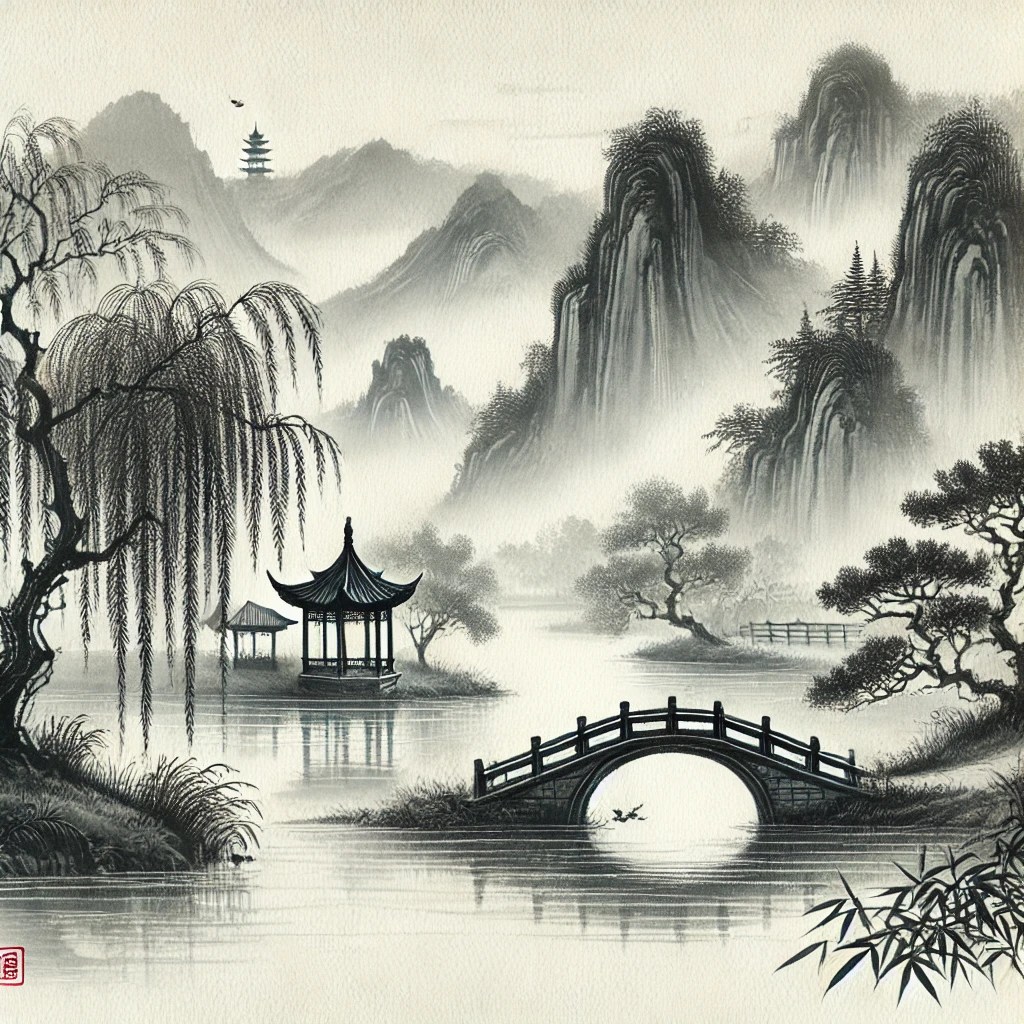
Years ago, I was gifted a truly stunning book—this translation of the Daodejing. It’s not just a translation; it’s an experience. The pages are filled with beautiful Chinese calligraphy, breathtaking photographs, and thoughtful English translations with commentary. Ever since, I’ve been itching to dive deep into the text and, if possible, try my hand at crafting my own translations.
The Daodejing is written in an incredibly concise, poetic style with no punctuation and plenty of rare characters that make it a puzzle to unravel. Interpreting it feels a bit like reading tarot cards—every nuance, every interpretation depends on the reader’s perspective. This holiday season, I hope to carve out some time to explore its layers of meaning and decipher the poetry myself. Below, I’ve laid out some context to set the stage for this journey.
[Written by ChatGPT]
About Tao Te Ching
The 道德经 (Dào Dé Jīng), also known as the Tao Te Ching or Classic of the Way and Virtue, is traditionally attributed to Laozi (老子), an ancient Chinese philosopher and the reputed founder of Taoism. Here’s a detailed breakdown of its authorship, motivations, and context:
Who Wrote It?
- Authorship: Laozi (literally, “Old Master”), whose personal name is said to be Li Er (李耳), is the figure traditionally credited with writing the Tao Te Ching. Some historians debate whether Laozi was a historical individual or a legendary figure, with some suggesting that the text could be a compilation of works by multiple authors over time.
- Historical Existence: Laozi is believed to have lived during the 6th century BCE, though some scholars argue for a later date, around the 4th century BCE.
Why Did He Write It?
- Philosophical Motivation: According to legend, Laozi was disillusioned with the moral decay and political instability of his time. As he left the Zhou Dynasty’s court to retreat into solitude, a border guard persuaded him to record his wisdom before departing. The result was the Tao Te Ching.
- Purpose: The text serves as a guide to living in harmony with the Tao (the Way), a fundamental principle representing the natural order of the universe. It emphasizes simplicity, humility, non-attachment, and the virtues of yielding and non-action (wu wei).
Motivations and Themes
- Search for Harmony: Laozi sought to provide a path to harmony both within oneself and in society. This was reflected in the emphasis on aligning with the Tao and living virtuously.
- Critique of Society: He criticized human greed, ambition, and the excessive reliance on rules and rituals, arguing that they disrupted natural harmony.
- Spiritual and Practical Guidance: The text is both spiritual and practical, offering insights into governance, personal development, and the dynamics of power.
Historical and Cultural Context
- Zhou Dynasty Decline: Laozi lived during the late Zhou Dynasty, a time of significant political fragmentation and moral decline. The disintegration of central authority led to the Spring and Autumn Period (770–476 BCE) and later the Warring States Period (475–221 BCE).
- Philosophical Competition: This era was marked by the “Hundred Schools of Thought,” a flourishing of philosophical traditions, including Confucianism, Mohism, and Legalism, each proposing solutions to societal chaos.
- Reaction to Confucianism: Taoism, as expressed in the Tao Te Ching, can be seen as a counterpoint to Confucianism. While Confucius emphasized societal roles, rituals, and moral codes, Laozi advocated for simplicity, spontaneity, and alignment with the natural order.
- Cultural Values: Early Chinese culture valued the balance of opposites (yin and yang), the interdependence of humans and nature, and the importance of humility and modesty. These values are central to the Tao Te Ching.
Legacy
The Tao Te Ching has had a profound influence on Chinese philosophy, religion, art, politics, and medicine. Its teachings extend beyond Taoism, impacting Confucianism, Buddhism, and global thought on mindfulness, leadership, and environmentalism.
Verse Structure
The number of verses in the 道德经 (Tao Te Ching) depends on how it is divided, as different editions and translations vary slightly. However, the traditional version is generally divided into 81 chapters or sections.
Structure:
- Two Parts: The text is often divided into two main sections:
- 道经 (Dào Jīng): The Book of the Way (Chapters 1–37), focusing on the philosophy of the Tao (the Way).
- 德经 (Dé Jīng): The Book of Virtue (Chapters 38–81), addressing ethical and practical applications of the Tao.
- Verses: Each chapter is written in a poetic style and contains a few concise, aphoristic verses. The exact number of verses within the chapters varies slightly across editions due to interpretation and translation.
Why Variations?
- The original text, written in classical Chinese, is highly condensed, and there is no definitive punctuation in ancient manuscripts. Translators and editors have divided the text based on their interpretations.
- Some chapters might be divided into additional verses or grouped differently in certain versions.
Conclusion:
While the Tao Te Ching traditionally consists of 81 chapters, the specific number of verses within each chapter can vary across translations and interpretations.
About Taoism
Taoism (Daoism, 道教) is a philosophical and religious tradition rooted in Chinese culture, emphasizing living in harmony with the Tao (道), which is often translated as “the Way” or “the Path.” The Tao is considered the fundamental principle underlying the natural order of the universe.
Core Aspects of Taoism
- Philosophy vs. Religion:
- As a philosophy, Taoism provides guidance on how to live a balanced and fulfilling life in accordance with the Tao. This aspect is largely associated with texts like the Tao Te Ching by Laozi and the Zhuangzi by Zhuang Zhou.
- As a religion, Taoism involves rituals, deities, meditation practices, and moral teachings. It developed formal religious structures during the Han Dynasty and later periods.
- Key Concepts:
- Tao (道): The ultimate reality and principle that governs all things. It is ineffable, eternal, and manifests in all aspects of existence.
- Wu Wei (无为): Often translated as “non-action” or “effortless action,” it refers to aligning one’s actions with the natural flow of the Tao, avoiding force or resistance.
- Qi (气): The life force or vital energy that permeates the universe and sustains life. Cultivating and balancing qi is central to Taoist practices.
- Yin and Yang (阴阳): The dynamic interplay of opposite but complementary forces, symbolizing balance and harmony in all things.
- Ethics and Values:
- Simplicity, humility, and compassion.
- Living in accordance with nature and maintaining balance.
- Avoiding excessive desires and ambitions.
Origins and Development
- Philosophical Roots:
- Taoism originated during the late Zhou Dynasty (6th–4th century BCE) amid a flourishing of Chinese philosophical traditions.
- Foundational texts like the Tao Te Ching and the Zhuangzi articulate its philosophical principles.
- Religious Taoism:
- Emerged during the Han Dynasty (202 BCE–220 CE) with formalized rituals, scriptures, and temples.
- Incorporated elements of Chinese folk religion, astrology, alchemy, and practices for longevity and immortality.
- Interaction with Other Traditions:
- Taoism coexisted and interacted with Confucianism and Buddhism, shaping Chinese culture. While Confucianism emphasized social order and ethics, and Buddhism focused on spiritual liberation, Taoism offered a path of harmony with nature and the cosmos.
Practices in Taoism
- Meditation and Breathing: Practices like Qigong and Tai Chi focus on cultivating qi and aligning the body, mind, and spirit.
- Rituals and Offerings: Religious ceremonies often involve prayers, music, and offerings to deities or ancestors.
- Fasting and Alchemy: Techniques aimed at physical and spiritual purification or immortality.
- Divination: Methods like the I Ching (Book of Changes) are used to understand the Tao’s guidance in personal and cosmic matters.
Influence and Legacy
Taoism has deeply influenced Chinese art, literature, medicine, and martial arts. Its principles of simplicity, balance, and harmony resonate in practices like Feng Shui and Traditional Chinese Medicine. Beyond China, Taoism has inspired global perspectives on spirituality, mindfulness, and ecological awareness.
Modern Taoism
Today, Taoism continues as both a spiritual tradition and a philosophical framework, with followers worldwide seeking to integrate its teachings into contemporary life.
Chinese Dynasties
Here is a chronological list of major Chinese dynasties along with their approximate time periods:
Ancient Periods
- Xia Dynasty (夏朝): ~2070–1600 BCE (Semi-legendary, earliest recorded dynasty)
- Shang Dynasty (商朝): ~1600–1046 BCE (Earliest dynasty with archaeological evidence)
- Zhou Dynasty (周朝): ~1046–256 BCE
- Western Zhou (西周): ~1046–771 BCE
- Eastern Zhou (东周): ~770–256 BCE
- Spring and Autumn Period (春秋时期): ~770–476 BCE
- Warring States Period (战国时期): ~475–221 BCE
Imperial China
- Qin Dynasty (秦朝): 221–206 BCE (First unified Chinese empire)
- Han Dynasty (汉朝): 206 BCE–220 CE
- Western Han (西汉): 206 BCE–9 CE
- Xin Dynasty (新朝): 9–23 CE (Interruption by Wang Mang)
- Eastern Han (东汉): 25–220 CE
- Three Kingdoms Period (三国时期): 220–280 CE
- Wei (魏): 220–265 CE
- Shu (蜀): 221–263 CE
- Wu (吴): 222–280 CE
- Jin Dynasty (晋朝): 266–420 CE
- Western Jin (西晋): 266–316 CE
- Eastern Jin (东晋): 317–420 CE
- Southern and Northern Dynasties (南北朝): 420–589 CE (Fragmented kingdoms)
- Sui Dynasty (隋朝): 581–618 CE (Reunification of China)
- Tang Dynasty (唐朝): 618–907 CE (Golden age of Chinese culture)
- Five Dynasties and Ten Kingdoms (五代十国): 907–960 CE (Period of disunion)
Medieval to Early Modern China
- Song Dynasty (宋朝): 960–1279 CE
- Northern Song (北宋): 960–1127 CE
- Southern Song (南宋): 1127–1279 CE
- Yuan Dynasty (元朝): 1271–1368 CE (Mongol rule under Kublai Khan)
- Ming Dynasty (明朝): 1368–1644 CE (Restoration of Han Chinese rule)
- Qing Dynasty (清朝): 1644–1912 CE (Manchu rule, last imperial dynasty)
Modern China
- Republic of China (中华民国): 1912–1949 (Ended imperial rule, established by Sun Yat-sen)
- People’s Republic of China (中华人民共和国): 1949–present
This timeline shows the rise and fall of dynasties, reflecting China’s complex and rich history over several millennia.


25 thoughts on “Exploring Taoism”