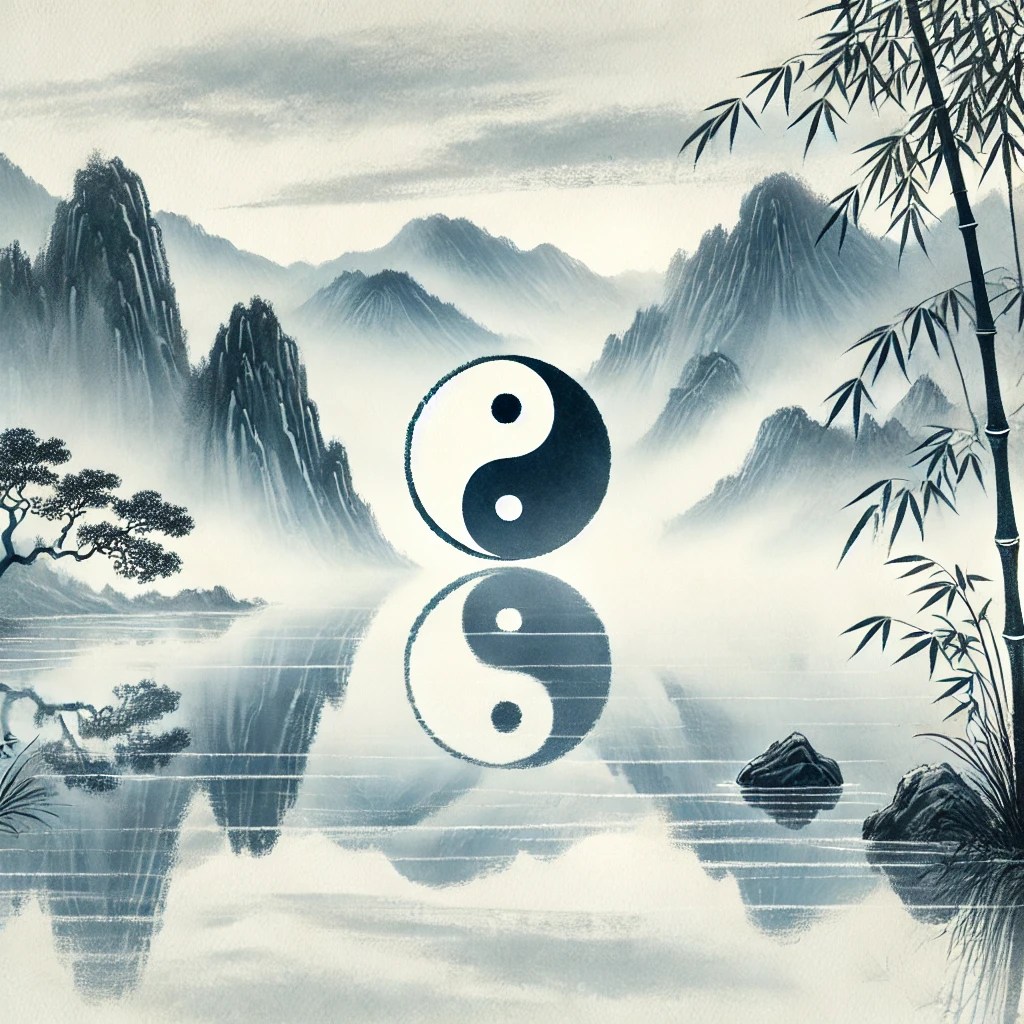
Verse 2 by Lao Zi: 天下皆知美之为美,斯恶已。皆知善之为善,斯不善已。故有无相生,难易相成,长短相较,高下相倾,音声相和,前后相随。是以圣人处无为之事,行不言之教;万物作焉而不辞,生而不有。为而不恃,功成而弗居。夫唯弗居,是以不去。
“When the world recognizes beauty as beauty, ugliness arises.
When the world recognizes good as good, evil arises.
Thus, being and non-being produce each other;
Difficult and easy complete each other;
Long and short contrast with each other;
High and low lean on each other;
Sound and silence harmonize with each other;
Front and back follow each other.
Therefore, the sage acts without striving and teaches without words.
All things arise, and they are not rejected.
The sage produces without possessing, acts without expecting, and achieves without claiming credit.
Because they do not claim credit, their achievements endure.”
[Written by ChatGPT]
Verse 2 by ChatGPT: 光暗相依,阴阳同生,寒暑相映,动静互成。圣人之道,不争而顺,因循自然,万物归真。
“Light and shadow depend on each other,
Yin and Yang are born together.
Cold and heat reflect one another,
Motion and stillness complete their form.
The way of the sage is to yield and follow,
Flowing with nature, all things return to their essence.”
Lessons from the Second Verse of the Dao De Jing: Understanding Global Dynamics and Humility
The second verse of the Dao De Jing provides profound insights that can be applied to the current fragmentation of global powers. It addresses the interdependence of opposites, the dangers of labeling, and the benefits of humility and non-action. Here’s how it relates:
1. The Danger of Labeling and Polarization
Key Line:
“When the world knows beauty as beauty, ugliness arises. When the world knows good as good, evil arises.”
Application to Global Fragmentation:
Labeling nations as “good” or “evil,” “friends” or “enemies,” creates polarization and mutual antagonism. For example:
- The USA labeling certain countries (e.g., China as a “strategic competitor” or Russia as a “threat”) solidifies divisions, making cooperation difficult.
- This labeling fosters a binary worldview where alliances and conflicts are shaped by these oppositional identities, leading to a cycle of distrust and retaliation.
Lesson from the Dao De Jing:
- Recognizing that these labels are constructs can help break the cycle. Just as beauty and ugliness are interdependent, so are cooperation and competition between nations. Moving beyond fixed labels allows for a more nuanced and balanced approach to diplomacy.
2. Interdependence of Opposites
Key Line:
“Being and non-being produce each other. Difficult and easy complete each other.”
Application to Global Powers:
- Nations like the USA, China, and Russia are interconnected in a global system where their actions shape each other. For example:
- Economic competition between the USA and China has spurred innovation, yet their interdependent supply chains mean neither can thrive in isolation.
- The conflict in Ukraine has reshaped alliances in Europe, leading to stronger NATO cohesion but also creating energy and food crises worldwide.
Lesson from the Dao De Jing:
- Instead of viewing each other as isolated adversaries, recognizing their interdependence could foster cooperation. For instance, global challenges like climate change, pandemics, and economic instability require collaborative solutions, not fragmentation.
3. The Futility of Forceful Action
Key Line:
“The sage engages in the matters of non-action and practices teaching without words.”
Application to Power Struggles:
- Nations often attempt to assert dominance through forceful actions—military interventions, economic sanctions, or propaganda campaigns. However, these actions frequently lead to unintended consequences:
- Economic sanctions on Russia have caused ripple effects in global markets, affecting countries far removed from the conflict.
- Military buildups in the South China Sea increase tensions without resolving underlying disputes.
Lesson from the Dao De Jing:
- Practicing wú wéi (non-action) doesn’t mean doing nothing, but rather aligning actions with natural flows and avoiding overreach. Diplomacy, quiet negotiations, and fostering mutual understanding often achieve more sustainable results than overt displays of power.
4. The Role of Ego and Nationalism
Key Line:
“Achieves success, yet does not claim credit. Only because they do not claim credit, their achievements endure.”
Application to National Agendas:
- Many global conflicts stem from national ego and the desire to assert superiority. For example:
- The USA often positions itself as a global leader promoting democracy, but this can alienate other nations by appearing self-serving.
- Similarly, Russia’s and China’s nationalistic rhetoric about reclaiming past greatness fuels confrontations with neighboring countries.
Lesson from the Dao De Jing:
- By reducing ego and avoiding the need to claim credit for leadership, nations could foster more inclusive coalitions. For instance, multilateral organizations could focus on shared goals rather than being dominated by a single nation’s agenda.
5. Accepting Cycles and Change
Key Line:
“High and low lean on each other. Front and back follow each other.”
Application to Shifting Power Dynamics:
- The fragmentation of global powers reflects natural cycles of rise and decline. The USA’s dominance, China’s rise, and Russia’s resurgence are all parts of a shifting global balance.
- Attempts to resist these changes (e.g., through containment strategies or isolation) often lead to greater instability.
Lesson from the Dao De Jing:
- Embracing these shifts as part of a larger cycle can lead to more adaptive and constructive policies. Instead of trying to maintain unilateral dominance, focusing on balance and mutual benefit could stabilize the global order.
6. Moving Beyond Zero-Sum Thinking
Key Line:
“Sound and silence harmonize with each other. Front and back follow each other.”
Application to Global Powers:
- Much of the fragmentation arises from zero-sum thinking: the belief that one nation’s gain must come at another’s expense. For example:
- Trade disputes between the USA and China often ignore the potential for mutual economic growth.
- NATO’s expansion is perceived by Russia as a threat, even though its stated goal is regional security.
Lesson from the Dao De Jing:
- Recognizing that opposites can harmonize instead of compete opens pathways for collaboration. For instance, balancing military alliances with dialogue and trade agreements could reduce tensions.
7. Endurance Through Humility
Key Line:
“Therefore, their achievements endure.”
Application to Long-Term Global Stability:
- Nations that act with humility, prioritizing global well-being over short-term dominance, are more likely to leave lasting legacies. For example:
- Efforts like international climate agreements (e.g., the Paris Agreement) represent shared leadership that transcends national egos.
- Historical empires that overextended often collapsed, while those that adapted to changing conditions endured.
Lesson from the Dao De Jing:
- Acting selflessly and focusing on the greater good ensures long-term stability and influence. Leadership based on service rather than control fosters trust and resilience.
Conclusion: Applying Laozi’s Wisdom to Global Fragmentation
The second verse of the Dao De Jing offers a framework for addressing the fragmentation of global powers:
- Avoid labeling: Recognize the interdependence of nations and avoid creating enemies through judgment and polarization.
- Acknowledge interdependence: Cooperation on shared challenges is more effective than competition.
- Practice humility: Let go of national egos and focus on collective achievements.
- Adopt non-action: Align actions with natural flows and avoid forceful overreach.
- Accept cycles: Embrace shifts in power dynamics as natural and inevitable.
- Seek harmony: Move beyond zero-sum thinking to find balance and mutual benefit.
By following these principles, global powers could navigate fragmentation more constructively, fostering a world that is more interconnected and harmonious rather than divided and antagonistic.
Verse 2 Breakdown
Text:
天下皆知美之为美,斯恶已。皆知善之为善,斯不善已。故有无相生,难易相成,长短相较,高下相倾,音声相和,前后相随。是以圣人处无为之事,行不言之教;万物作焉而不辞,生而不有。为而不恃,功成而弗居。夫唯弗居,是以不去。
Word Definitions:
- 天下 (tiān xià)
- 天 (tiān): Heaven; sky.
- 下 (xià): Under; below.
- Meaning: “Under Heaven,” referring to the world or everything.
- 皆 (jiē)
- Literal Meaning: All; everyone.
- 知 (zhī)
- Literal Meaning: Know; recognize.
- 美 (měi)
- Literal Meaning: Beauty; what is beautiful.
- 之 (zhī)
- Literal Meaning: Possessive particle, similar to “of.”
- 为 (wéi)
- Literal Meaning: To be; to act as.
- 美 (měi)
- Literal Meaning: Beauty (repeated for emphasis).
- 斯 (sī)
- Literal Meaning: Thus; therefore.
- 恶 (è)
- Literal Meaning: Ugliness; badness; evil.
- 已 (yǐ)
- Literal Meaning: Already; it is so.
First Sentence Translation:
“When the world knows beauty as beauty, ugliness arises.”
- 皆 (jiē): All; everyone.
- 知 (zhī): Know; recognize.
- 善 (shàn): Good; virtue.
- 之 (zhī): Of.
- 为 (wéi): To be; to act as.
- 善 (shàn): Good (repeated for emphasis).
- 斯 (sī): Thus; therefore.
- 不善 (bù shàn): Not good; evil.
- 已 (yǐ): Already; it is so.
Second Sentence Translation:
“When the world knows good as good, evil arises.”
- 故 (gù): Therefore; hence.
- 有 (yǒu): Being; existence.
- 无 (wú): Non-being; absence.
- 相生 (xiāng shēng):
- 相 (xiāng): Mutually; each other.
- 生 (shēng): Produce; give rise to.
- Meaning: “Mutually produce each other.”
Third Sentence Translation:
“Thus, being and non-being produce each other.”
- 难易 (nán yì):
- 难 (nán): Difficulty.
- 易 (yì): Ease.
- Meaning: “Difficulty and ease.”
- 相成 (xiāng chéng):
- 相 (xiāng): Mutually.
- 成 (chéng): Complete; accomplish.
- Meaning: “Complete each other.”
Fourth Sentence Translation:
“Difficult and easy complete each other.”
- 长短 (cháng duǎn):
- 长 (cháng): Long.
- 短 (duǎn): Short.
- Meaning: “Long and short.”
- 相较 (xiāng jiào):
- 相 (xiāng): Mutually.
- 较 (jiào): Contrast; compare.
- Meaning: “Contrast with each other.”
Fifth Sentence Translation:
“Long and short contrast with each other.”
- 高下 (gāo xià):
- 高 (gāo): High.
- 下 (xià): Low.
- Meaning: “High and low.”
- 相倾 (xiāng qīng):
- 相 (xiāng): Mutually.
- 倾 (qīng): Lean; depend on.
- Meaning: “Lean on each other.”
Sixth Sentence Translation:
“High and low lean on each other.”
- 音声 (yīn shēng):
- 音 (yīn): Sound.
- 声 (shēng): Tone; voice.
- Meaning: “Sound and tone.”
- 相和 (xiāng hé):
- 相 (xiāng): Mutually.
- 和 (hé): Harmonize; blend.
- Meaning: “Harmonize with each other.”
Seventh Sentence Translation:
“Sound and tone harmonize with each other.”
- 前后 (qián hòu):
- 前 (qián): Front.
- 后 (hòu): Back.
- Meaning: “Front and back.”
- 相随 (xiāng suí):
- 相 (xiāng): Mutually.
- 随 (suí): Follow.
- Meaning: “Follow each other.”
Eighth Sentence Translation:
“Front and back follow each other.”
- 是以 (shì yǐ): Therefore; thus.
- 圣人 (shèng rén): Sage; wise person.
- 处 (chǔ): Act; dwell.
- 无为 (wú wéi): Non-action; effortless action.
- 之事 (zhī shì): The matters of; affairs of.
Ninth Sentence Translation:
“Thus, the sage acts in the matters of non-action.”
- 行 (xíng): To act; to perform.
- 不言 (bù yán):
- 不 (bù): Not; without.
- 言 (yán): Words; speaking.
- Meaning: “Teaching without words.”
- 之教 (zhī jiào):
- 之 (zhī): Of.
- 教 (jiào): Teaching; instruction.
Tenth Sentence Translation:
“And practices teaching without words.”
- 万物 (wàn wù):
- 万 (wàn): Ten thousand; all.
- 物 (wù): Things; entities.
- Meaning: “All things.”
- 作焉 (zuò yān):
- 作 (zuò): Arise; come into being.
- 焉 (yān): Therein; as a result.
- Meaning: “Arise therein.”
- 而 (ér): Yet; but; and.
- 不辞 (bù cí):
- 不 (bù): Not; without.
- 辞 (cí): Refuse; decline.
- Meaning: “Without refusal.”
Eleventh Sentence Translation:
“All things arise, yet the sage does not refuse them.”
- 生 (shēng): To give birth; to create.
- 而不有 (ér bù yǒu):
- 而 (ér): Yet; but.
- 不 (bù): Not.
- 有 (yǒu): Possess; own.
- Meaning: “Yet does not possess them.”
Twelfth Sentence Translation:
“Creates but does not possess.”
- 为 (wéi): To act; to do.
- 而不恃 (ér bù shì):
- 而 (ér): Yet; but.
- 不 (bù): Not.
- 恃 (shì): Depend on; rely upon.
- Meaning: “Yet does not rely upon them.”
Thirteenth Sentence Translation:
“Acts but does not rely upon them.”
- 功成 (gōng chéng):
- 功 (gōng): Achievement; success.
- 成 (chéng): To complete; to accomplish.
- Meaning: “Achieves success.”
- 而弗居 (ér fú jū):
- 而 (ér): Yet; but.
- 弗 (fú): Not.
- 居 (jū): Dwell; claim credit.
- Meaning: “Yet does not dwell in it or claim credit.”
Fourteenth Sentence Translation:
“Achieves success, yet does not claim credit.”
- 夫唯 (fū wéi):
- 夫 (fū): Only; this.
- 唯 (wéi): Alone; simply.
- Meaning: “Only because.”
- 弗居 (fú jū):
- 弗 (fú): Not.
- 居 (jū): Dwell; claim credit.
- Meaning: “They do not claim credit.”
Fifteenth Sentence Translation:
“Only because they do not claim credit.”
- 是以 (shì yǐ): Therefore; thus.
- 不去 (bù qù):
- 不 (bù): Not.
- 去 (qù): Depart; leave.
- Meaning: “Their achievements endure.”
Sixteenth Sentence Translation:
“Their achievements endure.”
 UpLive.Life
2 thoughts on “The Harmony of Opposites: The Way of Balance”