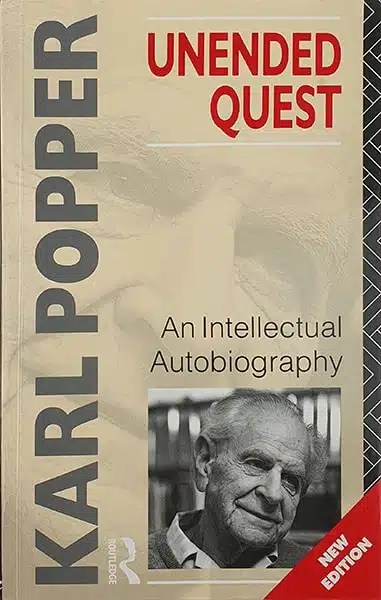
I’ve recently discovered Karl Popper and his philosophy of critical rationalism. I started reading his autobiography and found it incredibly engaging. It’s not a book you can rush through. Following Grok’s advice, I plan to break it down into five sections and share my thoughts and reviews gradually.
Related posts: Popper to Deutsch to parenting, The Sovereign Child.
[Written by Grok]
Karl Popper’s “Unended Quest: An Intellectual Autobiography” spans a wide array of topics related to his philosophical journey and contributions to the philosophy of science.
- Early Life and Educational Background (Sections 1-6)
- These sections cover Popper’s childhood, education, and early influences up to his initial academic pursuits. It sets the stage for understanding his later philosophical developments.
- Review Focus: Discuss Popper’s intellectual environment, his early interests in psychology and music, and how these influenced his later work.
- Philosophical Beginnings and the Development of the Falsifiability Principle (Sections 7-13)
- Here, Popper discusses his move towards philosophy, his critique of logical positivism, and the formulation of his theory of falsifiability.
- Review Focus: Examine the transition from his early thoughts to his groundbreaking work in the philosophy of science, focusing on “The Logic of Scientific Discovery.”
- Critique of Historicism and Social Philosophy (Sections 14-23)
- These sections deal with Popper’s views on history, social sciences, and his critique of Marxism and other deterministic theories. It includes his famous works like “The Poverty of Historicism” and “The Open Society and Its Enemies.”
- Review Focus: Analyze Popper’s arguments against historicism, his advocacy for open societies, and his impact on political philosophy.
- Further Developments in Philosophy of Science and Metaphysics (Sections 24-32)
- In these sections, Popper explores further into the philosophy of science, discussing issues like realism, probability, and his later thoughts on scientific methodology.
- Review Focus: Discuss how Popper refined his earlier theories, his take on probability and induction, and his evolving thoughts on metaphysics.
- Later Works and Reflections (Sections 33-40)
- This part covers Popper’s later philosophical explorations, his interactions with other philosophers, and his reflections on his life’s work and its reception.
- Review Focus: Look at Popper’s legacy, his dialogues with contemporary philosophers, and his reflections on the scientific method, including educational and ethical implications.
What is Critical Rationalism
Critical rationalism is a philosophy of knowledge and scientific inquiry primarily associated with Karl Popper. It emphasizes the fallibility of human knowledge and the importance of critical scrutiny in the pursuit of truth. The core idea is that we cannot prove theories to be true, but we can test and falsify them, thereby refining our understanding over time.
Key Principles of Critical Rationalism
- Falsifiability Over Verification
- Scientific theories should be structured in a way that allows them to be tested and potentially falsified.
- A theory that cannot be disproven is not scientific.
- The Growth of Knowledge Through Conjectures and Refutations
- Knowledge advances through a process of proposing bold hypotheses (conjectures) and subjecting them to rigorous testing and criticism (refutations).
- Instead of proving something to be “true,” we continuously eliminate falsehoods.
- Fallibilism (Acceptance of Human Error)
- No belief or theory is beyond doubt; even well-established theories remain tentative.
- We should always be open to revising our beliefs in light of new evidence.
- Objective Knowledge and Open Society
- Knowledge is not justified by absolute certainty but through open criticism and debate.
- This principle extends beyond science to political and social thought, advocating for free speech and democratic institutions.
- Critique of Justificationism
- Traditional epistemology sought to justify beliefs with certainty.
- Critical rationalism rejects this and argues that knowledge is a matter of trial and error, not absolute justification.
Example: Science in Action
Consider Newton’s laws of motion. For centuries, they were widely accepted as “true.” However, with new observations (e.g., the orbit of Mercury), they were challenged and eventually superseded by Einstein’s theory of relativity. This demonstrates how scientific progress follows the critical rationalist method—by continuously testing and improving theories rather than accepting them as final truths.
Implications Beyond Science
- Ethics & Politics: Supports an open society where ideas compete freely in the “marketplace of ideas.”
- Personal Growth: Encourages intellectual humility and openness to criticism.
- Technology & Innovation: Progress happens by experimenting, failing, and iterating rather than seeking an ultimate, unchallengeable truth.
Summary
Critical rationalism teaches us that knowledge is provisional, theories should be falsifiable, and progress comes from criticism, not confirmation. It is a dynamic and anti-dogmatic approach to knowledge that has influenced science, philosophy, and even democratic governance.
Intellectual Impacts
Karl Popper was influenced by several philosophical and scientific traditions, particularly rationalism, empiricism, and critical philosophy. His key influences include:
- Immanuel Kant (1724–1804) –
- Kant argued that human knowledge is structured by the mind’s categories. Popper built on this but rejected Kant’s idea of synthetic a priori knowledge.
- Popper admired Kant’s critical approach and emphasis on the limits of human knowledge.
- David Hume (1711–1776) –
- Hume’s problem of induction (the idea that past observations don’t guarantee future occurrences) deeply influenced Popper.
- Popper responded to this by developing his theory of falsifiability, arguing that science progresses by eliminating errors rather than confirming truths.
- Albert Einstein (1879–1955) –
- Popper saw Einstein’s theory of relativity as an example of a truly scientific theory because it made precise predictions that could be tested and potentially falsified.
- This contrasted with Freudian psychoanalysis and Marxist historical materialism, which Popper criticized as unfalsifiable.
- Charles Darwin (1809–1882) –
- Darwin’s evolutionary theory inspired Popper’s view of knowledge growth as a process of variation and selection.
- Popper applied evolutionary ideas to epistemology, arguing that knowledge grows through trial and error (conjectures and refutations).
- Henri Bergson (1859–1941) –
- Popper appreciated Bergson’s idea that time and change are fundamental, influencing his dynamic view of knowledge.
- Bertrand Russell (1872–1970) –
- Russell’s logical analysis influenced Popper’s early logical positivism, although he later rejected it.
- Ludwig Wittgenstein (1889–1951) –
- Popper had a famous intellectual rivalry with Wittgenstein, especially over the nature of philosophy and science.
- While Wittgenstein focused on language games, Popper emphasized problems and solutions in science.
Thinkers Influenced by Popper
Popper’s ideas have had a profound impact across multiple disciplines, including philosophy, science, politics, and economics.
- Thomas Kuhn (1922–1996) –
- Although Kuhn is often contrasted with Popper, his theory of paradigm shifts in science builds on Popper’s view that knowledge evolves through criticism and revolution.
- Imre Lakatos (1922–1974) –
- A student of Popper, Lakatos developed the concept of research programs, refining Popper’s falsification principle.
- He argued that theories are not always rejected outright but evolve through modifications.
- Paul Feyerabend (1924–1994) –
- Initially a follower, Feyerabend later criticized Popper, arguing that science does not follow a single, rational method.
- Despite their disagreements, Feyerabend’s work was shaped by Popper’s emphasis on scientific openness.
- Friedrich Hayek (1899–1992) –
- The economist Hayek, a key figure in libertarianism and free-market economics, was strongly influenced by Popper’s ideas on knowledge and society.
- Popper’s book The Open Society and Its Enemies was aligned with Hayek’s arguments for individual liberty and spontaneous order.
- George Soros (b. 1930) –
- The billionaire investor and philanthropist credits Popper as his greatest intellectual influence.
- Soros’ concept of reflexivity in markets (the idea that market participants influence and are influenced by their expectations) was inspired by Popper’s ideas on fallibility and the open society.
- David Deutsch (b. 1953) –
- A physicist who applies Popper’s epistemology to quantum mechanics, Deutsch argues that scientific progress depends on good explanations rather than just empirical data.
- Bryan Magee (1930–2019) –
- The philosopher and broadcaster helped popularize Popper’s ideas through his work on philosophy of science and knowledge.
Legacy of Popper
Popper’s influence is vast, particularly in:
- Philosophy of science – through falsifiability and the evolutionary model of knowledge.
- Political thought – advocating for open societies and democratic institutions.
- Economics – influencing thinkers like Hayek and Soros.
- Artificial intelligence & epistemology – inspiring modern theories of learning and problem-solving.
Women Who Engaged with or Were Influenced by Popper
- Susan Haack (b. 1945) –
- A philosopher of logic and epistemology, Haack developed the concept of foundherentism, which blends foundationalism and coherentism in knowledge theory.
- She has engaged with Popper’s ideas on falsification and fallibilism, often critiquing the strict falsificationist approach while recognizing its value.
- Helga Nowotny (b. 1937) –
- A sociologist of science, Nowotny expanded on ideas related to scientific uncertainty and the role of knowledge in society.
- Her work builds on Popper’s legacy by exploring how science interacts with the public sphere and democracy.
- Margaret Masterman (1910–1986) –
- A linguist and philosopher of science, Masterman was one of the first to analyze Thomas Kuhn’s “The Structure of Scientific Revolutions”.
- She linked Popperian and Kuhnian perspectives, showing how scientific progress includes both falsification (Popper) and paradigm shifts (Kuhn).
- Barbara Wootton (1897–1988) –
- A British economist and criminologist, she was influenced by Popper’s ideas on open societies and applied them to criminal justice and social reform.
- Marjorie Grene (1910–2009) –
- A philosopher of science and biology, Grene engaged with Popper’s philosophy of science and the nature of knowledge.
- She contributed to evolutionary epistemology, an area influenced by Popper’s idea that knowledge evolves through trial and error.


One thought on “Book Club: Unended Quest by Karl Popper [Reading Plan]”