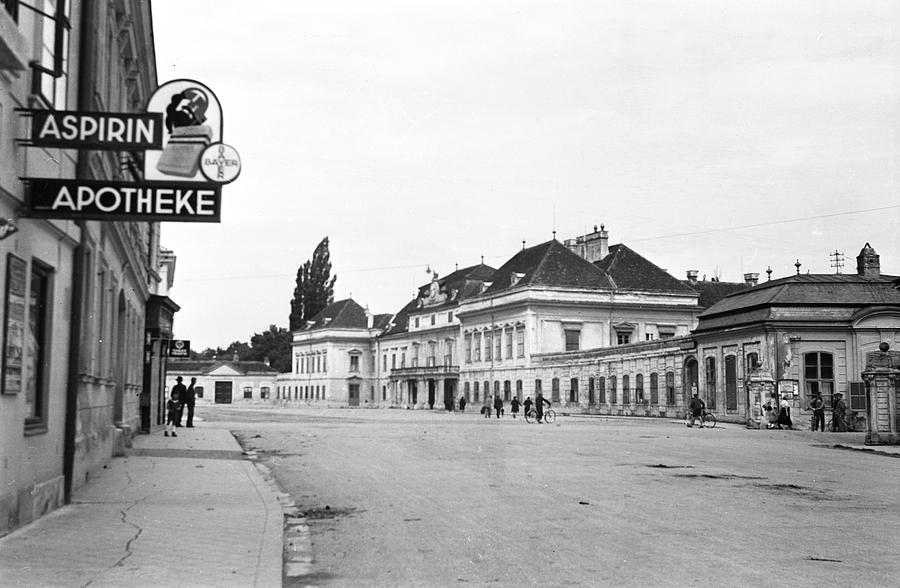
[1920s Street View in Vienna, Austria. Image credit]
I started reading Karl Popper’s Unended Quest, but quickly hit a roadblock—I realized I don’t know enough history to fully appreciate the context of his world and ideas. From the world wars to the philosophical and scientific developments of his time, I feel woefully ignorant. So, this is my first step in trying to piece together the backdrop.
[Graphic and summaries generated by ChatGPT]
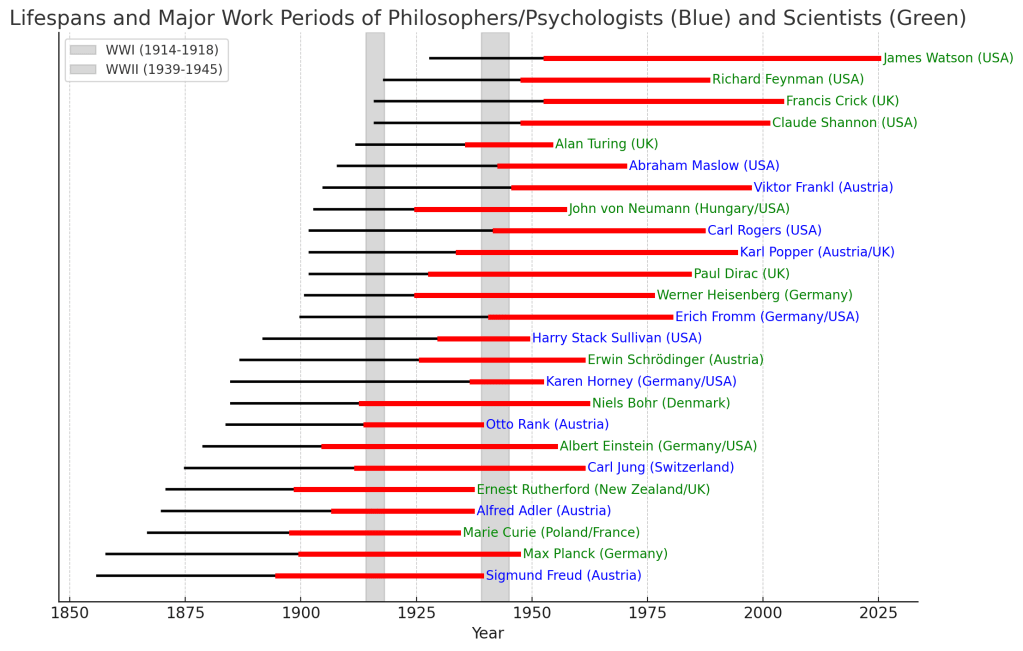
Summary of the major works of each psychologist/philosopher from the timeline
1. Sigmund Freud (Austria) (1856–1939)
- Major Works:
- The Interpretation of Dreams (1899) – Introduced psychoanalysis and dream symbolism.
- Three Essays on the Theory of Sexuality (1905) – Developed his theory of psychosexual development.
- Beyond the Pleasure Principle (1920) – Introduced the concept of the death drive (Thanatos).
- Civilization and Its Discontents (1930) – Discussed the conflict between individual desires and societal norms.
2. Alfred Adler (Austria) (1870–1937)
- Major Works:
- The Neurotic Constitution (1912) – Introduced the inferiority complex and individual psychology.
- Understanding Human Nature (1927) – Explained human motivation and personality development.
- What Life Should Mean to You (1931) – Discussed how social interest and purpose shape a meaningful life.
3. Carl Jung (Switzerland) (1875–1961)
- Major Works:
- Psychological Types (1921) – Introduced the concepts of introversion and extraversion.
- The Archetypes and the Collective Unconscious (1934) – Explored archetypes and the deep unconscious.
- Modern Man in Search of a Soul (1933) – Examined the challenges of modern psychological and spiritual development.
- Memories, Dreams, Reflections (1962) – An autobiography discussing his life and ideas.
4. Karl Popper (Austria/UK) (1902–1994)
- Major Works:
- The Logic of Scientific Discovery (1934) – Established the principle of falsifiability in science.
- The Open Society and Its Enemies (1945) – Criticized totalitarianism and defended liberal democracy.
- Conjectures and Refutations (1963) – Further developed his philosophy of science.
5. Karen Horney (Germany/USA) (1885–1952)
- Major Works:
- The Neurotic Personality of Our Time (1937) – Critiqued Freud and emphasized social and cultural influences in neurosis.
- New Ways in Psychoanalysis (1939) – Advocated for a humanistic approach to therapy.
- Our Inner Conflicts (1945) – Explained three basic neurotic strategies: moving toward, against, or away from people.
- Neurosis and Human Growth (1950) – Outlined self-realization and psychological health.
6. Erich Fromm (Germany/USA) (1900–1980)
- Major Works:
- Escape from Freedom (1941) – Explored how individuals seek authority and submission to escape anxiety.
- The Art of Loving (1956) – Defined love as a skill requiring effort and personal development.
- Man for Himself (1947) – Introduced humanistic ethics.
- To Have or To Be? (1976) – Critiqued materialism and emphasized personal growth.
7. Otto Rank (Austria) (1884–1939)
- Major Works:
- The Trauma of Birth (1924) – Proposed that birth trauma influences personality.
- Art and Artist (1932) – Examined the creative process in psychology.
- Will Therapy (1929) – Developed a humanistic approach focusing on individual will.
8. Viktor Frankl (Austria) (1905–1997)
- Major Works:
- Man’s Search for Meaning (1946) – Based on his experiences in concentration camps, advocating logotherapy (finding meaning in suffering).
- The Will to Meaning (1969) – Expanded on his theory that life’s purpose is derived from meaning, not pleasure or power.
9. Harry Stack Sullivan (USA) (1892–1949)
- Major Works:
- The Interpersonal Theory of Psychiatry (1953, posthumous) – Explained how personality develops through social interactions.
- Conceptions of Modern Psychiatry (1940) – Redefined mental disorders in interpersonal terms.
- The Fusion of Psychiatry and Social Science (1947) – Applied psychiatry to social problems.
10. Abraham Maslow (USA) (1908–1970)
- Major Works:
- A Theory of Human Motivation (1943) – Introduced the Hierarchy of Needs.
- Motivation and Personality (1954) – Further explored self-actualization.
- Toward a Psychology of Being (1962) – Discussed peak experiences and personal growth.
11. Carl Rogers (USA) (1902–1987)
- Major Works:
- Counseling and Psychotherapy (1942) – Introduced person-centered therapy.
- Client-Centered Therapy (1951) – Developed the idea of unconditional positive regard.
- On Becoming a Person (1961) – Explored personal growth and self-concept.
Key Themes Across These Thinkers:
- Freud, Adler, Jung: Focused on personality development, unconscious drives, and motivation.
- Horney, Fromm, Rank, Sullivan: Examined the role of social relationships in personality.
- Frankl, Maslow, Rogers: Explored meaning, self-actualization, and human potential.
- Popper: Focused on scientific philosophy and the nature of knowledge.
Summary of major works from each scientist
1. Albert Einstein (Germany/USA) (1879–1955)
- Annus Mirabilis Papers (1905) – Special Relativity, Photoelectric Effect, Brownian Motion.
- General Theory of Relativity (1915) – Revolutionized gravity theory.
- Unified Field Theory (1920s–1955) – Attempt to unify forces of physics.
2. Marie Curie (Poland/France) (1867–1934)
- Discovery of Radioactivity (1898) – Identified radium and polonium.
- Nobel Prize in Physics (1903) and Chemistry (1911) – First woman to win a Nobel Prize.
3. Niels Bohr (Denmark) (1885–1962)
- Bohr Model of the Atom (1913) – Explained electron orbits.
- Copenhagen Interpretation of Quantum Mechanics (1927) – Key ideas in quantum mechanics.
4. Werner Heisenberg (Germany) (1901–1976)
- Uncertainty Principle (1927) – Limits of measurement in quantum mechanics.
- Quantum Mechanics Development (1925).
5. Max Planck (Germany) (1858–1947)
- Quantum Theory (1900) – Introduced energy quanta, leading to modern physics.
6. Erwin Schrödinger (Austria) (1887–1961)
- Wave Equation (1926) – Fundamental equation of quantum mechanics.
- Schrödinger’s Cat Thought Experiment (1935) – Explored quantum superposition.
7. Paul Dirac (UK) (1902–1984)
- Dirac Equation (1928) – Predicted antimatter.
- Quantum Electrodynamics (1940s) – Key advances in particle physics.
8. Richard Feynman (USA) (1918–1988)
- Feynman Diagrams (1948) – Explained particle interactions.
- Quantum Electrodynamics (QED) – Nobel Prize in 1965.
9. Alan Turing (UK) (1912–1954)
- Turing Machine (1936) – Foundation of computer science.
- Codebreaking at Bletchley Park (WWII) – Helped crack the Enigma code.
10. John von Neumann (Hungary/USA) (1903–1957)
- Game Theory (1944) – Key in economics and strategy.
- Modern Computing (1945) – Developed the Von Neumann Architecture for computers.
11. Ernest Rutherford (New Zealand/UK) (1871–1937)
- Discovery of the Atomic Nucleus (1909) – Gold foil experiment, proving atoms have a dense nucleus.
- Nuclear Physics (1917) – First to artificially split an atom.
- Radioactivity Research (1899–1930s) – Coined the term “half-life.”
12. Claude Shannon (USA) (1916–2001)
- A Mathematical Theory of Communication (1948) – Founded information theory.
- Digital Circuit Design (1937) – Laid the foundation for modern computing.
13. Francis Crick (UK) (1916–2004) & James Watson (USA) (1928– )
- Discovery of the DNA Double Helix (1953) – Identified the structure of DNA, revolutionizing genetics.
- Central Dogma of Molecular Biology (1958) – Explained how genetic information flows.
Key Themes:
- Physics Revolution: Einstein, Bohr, Heisenberg, Schrödinger, Planck, and Dirac shaped quantum mechanics and relativity.
- Computing & AI: Turing, Shannon and von Neumann pioneered computer science and information theory.
- Mathematics & Theoretical Models: Dirac, Feynman, and von Neumann transformed physics and computation.
- Biology & Genetics: Crick, Watson.
 UpLive.Life