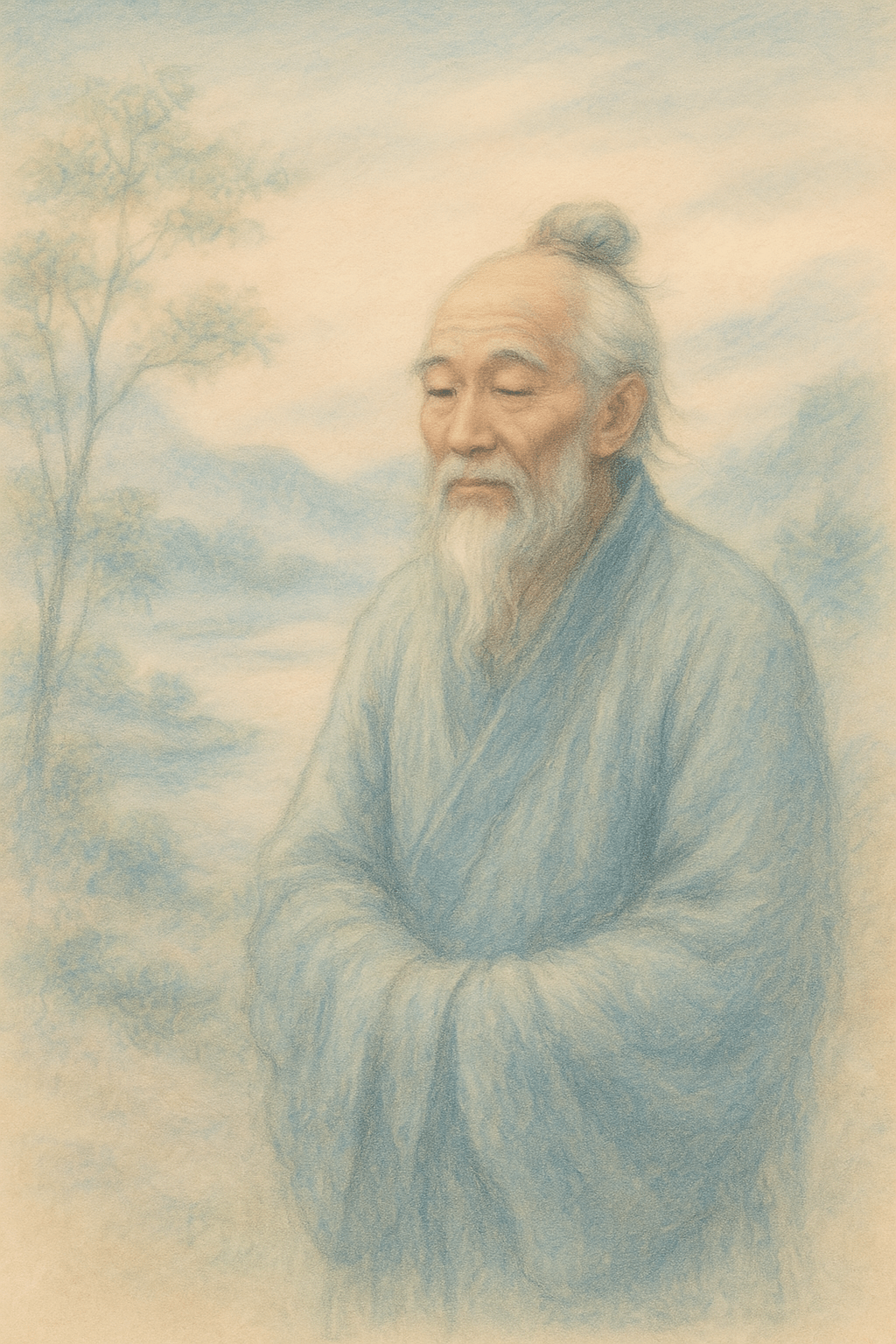
Verse 15 by Lao Zi: 古之善为士者,微妙玄通,深不可识。夫唯不可识,故强为之容。豫焉若冬涉川,犹兮若畏四邻,俨兮其若容,涣兮若冰之将释,敦兮其若朴,旷兮其若谷,混兮其若浊。孰能浊以静之徐清?孰能安以久动之徐生?保此道者不欲盈,夫唯不盈,故能蔽不新成.
Those in ancient times who were good at practicing the Way
Were subtle, mysterious, and deeply profound—
So deep they were beyond understanding.
Precisely because they were beyond understanding,
We can only describe their appearance with effort:
Cautious, as if crossing a river in winter;
Hesitant, as if wary of all around them;
Reserved, like a guest;
Fluid, like ice that is just beginning to melt;
Simple, like uncarved wood;
Open, like a valley;
Murky, like muddy water.
Who can settle the muddy water and let it gradually clear?
Who can remain still and let life arise on its own?
Those who hold to the Way
Do not seek fullness.
Precisely because they are not full,
They can be renewed without becoming worn out.
[Written by ChatGPT]
🌿 Chapter 15: The Ancient Masters of the Dao
This chapter reflects on the character of sages who truly embody the Dao. They’re described as subtle, elusive, and hard to understand. The text uses nature-inspired metaphors to capture their essence—muddy water settling into clarity, uncut wood, melting ice, an empty valley.
Key themes:
- Subtlety and mystery: The sage is not easily grasped or defined.
- Non-action (无为, wu wei): They do not impose, but allow things to unfold naturally.
- Humility and openness: Like valleys and uncarved wood, they are receptive and simple.
- Transformation through stillness: Muddy water clears through calm; life emerges from quiet.
Now, let’s connect this with earlier chapters:
🌀 Chapter 1: The Dao that can be spoken is not the eternal Dao
This sets the tone for everything: the Dao is mysterious, nameless, and beyond intellect.
Connection to Ch. 15:
Chapter 15 reflects the unknowable aspect of the Dao. The sage is hard to recognize precisely because the Dao works in subtle and paradoxical ways. Just like the Dao is nameless, the sage’s true essence escapes easy labels.
💨 Chapter 2: The world recognizes beauty as beauty, yet this is only because of ugliness
Introduces the idea of duality and interdependence—good/bad, high/low.
Connection to Ch. 15:
The sage appears murky and awkward, yet this is their form of clarity. They are “not full,” yet this emptiness allows them to be constantly renewed. The sage lives in paradox, just like the Dao.
🌊 Chapter 4: The Dao is like an empty vessel
The Dao is inexhaustible. It is like water, soft yet powerful, nourishing without competing.
Connection to Ch. 15:
The metaphors of water—muddy water settling, melting ice—mirror Chapter 4’s idea that the Dao works quietly, subtly, and powerfully through yielding.
🪵 Chapter 11: Thirty spokes converge at a hub, but the usefulness comes from what is not there
Emptiness (or what’s not visible) gives function and meaning.
Connection to Ch. 15:
The sage is like a valley (empty) or uncarved wood (undeveloped potential). Their greatness comes not from action or fullness, but from space, receptivity, and not asserting themselves.
🧘♂️ Chapter 10: Can you remain still until the right action arises by itself?
Describes aligning body and spirit, being supple, and nurturing life without controlling it.
Connection to Ch. 15:
“Who can be muddy and let it slowly clear?” mirrors this chapter’s call for deep inner harmony and patience. The sage acts without force, letting things come into being naturally.
🔄 Other thematic echoes:
- Chapter 5: Nature is impartial—like the sage who doesn’t pick sides.
- Chapter 8: The highest good is like water—benefiting all and flowing in low places.
- Chapter 14: The Dao is invisible, inaudible, and formless—difficult to grasp, much like the sage’s character in Chapter 15.
✨ Summary:
Chapter 15 is a poetic portrait of the Daoist sage—subtle, humble, and fluid. Earlier chapters (1–14) lay the philosophical foundation:
- Dao is beyond words (Ch. 1)
- It thrives in opposites (Ch. 2)
- It acts through non-action (Ch. 3, 10)
- Its strength lies in softness and emptiness (Ch. 4, 8, 11)
- It cannot be seen, heard, or held (Ch. 14)
Together, they show that true wisdom and strength come not from assertion, but from aligning with the natural flow of existence.
📖 Phrase-by-Phrase Translation and Breakdown
| Chinese | Pinyin | Literal Meaning | Interpretation |
|---|---|---|---|
| 古之 | gǔ zhī | ancient, those of | Refers to sages of ancient times |
| 善为士者 | shàn wéi shì zhě | good at being sages | Those adept in practicing the Dao |
| 微妙玄通 | wēi miào xuán tōng | subtle, delicate, mysterious, penetrating | Their minds and ways are hard to detect and deeply insightful |
| 深不可识 | shēn bù kě shí | deep, not able to be known | So profound they defy understanding |
| 夫唯不可识 | fú wéi bù kě shí | just because they cannot be known | Their depth makes them ungraspable |
| 故强为之容 | gù qiǎng wéi zhī róng | therefore forcefully describe their appearance | We must resort to metaphors |
| 豫焉若冬涉川 | yù yān ruò dōng shè chuān | cautious as crossing river in winter | They move carefully, mindful of danger |
| 犹兮若畏四邻 | yóu xī ruò wèi sì lín | hesitant like fearing neighbors | They are alert and reserved |
| 俨兮其若容 | yǎn xī qí ruò róng | solemn, as if a guest | They carry respectful composure |
| 涣兮若冰之将释 | huàn xī ruò bīng zhī jiāng shì | dispersed like ice about to melt | They’re flexible, ready to flow |
| 敦兮其若朴 | dūn xī qí ruò pǔ | honest, like uncarved wood | They are genuine, without artifice |
| 旷兮其若谷 | kuàng xī qí ruò gǔ | open like a valley | Emptiness makes them receptive |
| 混兮其若浊 | hùn xī qí ruò zhuó | murky like muddy water | Their nature seems unclear but is deep |
| 孰能浊以静之徐清? | shú néng zhuó yǐ jìng zhī xú qīng | Who can muddy, through stillness, slowly make clear? | Stillness reveals clarity over time |
| 孰能安以久动之徐生? | shú néng ān yǐ jiǔ dòng zhī xú shēng | Who can be calm and allow long movement to slowly give rise (to life)? | Calmness nurtures natural emergence |
| 保此道者 | bǎo cǐ dào zhě | those who preserve this Way | People aligned with the Dao |
| 不欲盈 | bù yù yíng | do not seek fullness | They avoid extremes, remain modest |
| 夫唯不盈 | fú wéi bù yíng | only because they don’t strive for fullness | Emptiness makes them capable |
| 故能蔽不新成 | gù néng bì bù xīn chéng | thus can stay whole without wearing out | They remain renewed by not overreaching |
🪞 Interpretive Reflection:
This chapter is a poetic mirror. It offers descriptions of ancient sages not by what they do, but by how they are—through comparisons to nature, caution, fluidity, and stillness. The sage does not assert or shine in the usual way. Their greatness lies in emptiness, softness, and yielding.
 UpLive.Life
One thought on “Chapter 15 of the Dao De Jing: The Grace of the Ancient Sage”