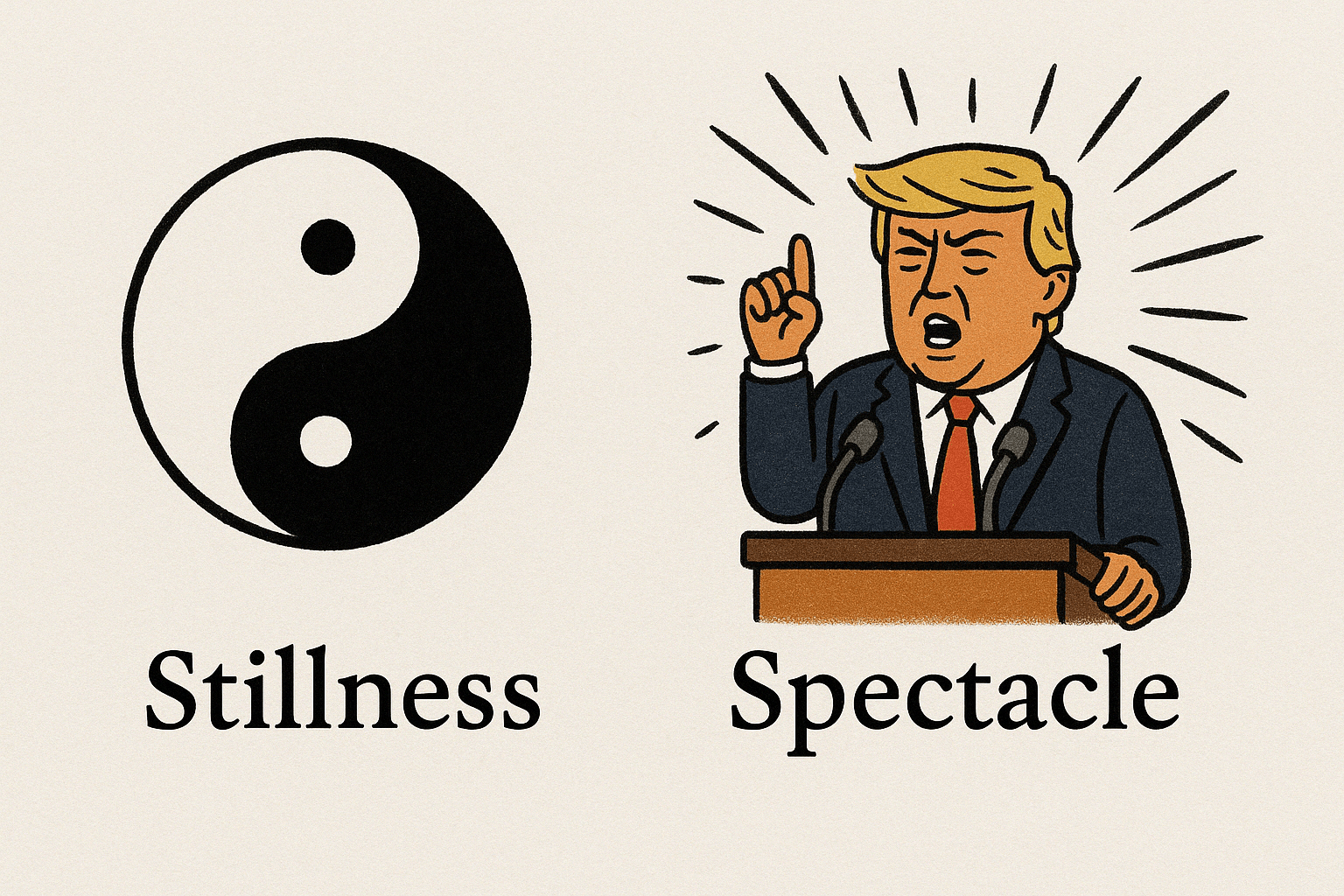
Verse 16 by Lao Zi: 致虚极,守静笃,万物并作,吾以观复。夫物芸芸,各复归其根。归根曰静,是谓复命。复命曰常,知常曰明,不知常,妄作,凶。知常容,容乃公,公乃王,王乃天,天乃道,道乃久,没身不殆。
Attain ultimate emptiness,
Maintain steadfast stillness.
As myriad things flourish together,
I watch their return.
Though all things thrive abundantly,
Each one returns to its root.
Returning to the root is called stillness;
This is returning to destiny.
Returning to destiny is called constancy;
Knowing constancy is called clarity.
Not knowing constancy leads to reckless actions,
And disaster follows.
Knowing constancy leads to tolerance,
Tolerance leads to impartiality,
Impartiality leads to sovereignty,
Sovereignty aligns with heaven,
Heaven aligns with the Dao,
The Dao endures eternally.
Throughout your life, you will encounter no peril.
[Written by ChatGPT]
The Daoist sage would likely view Trump’s leadership as out of alignment with the Dao—not because of personal judgment, but because his mode of operation disrupts natural balance, ignores constancy, and amplifies personal will over universal flow.
However, one could also say: Trump reveals the very cycles Laozi invites us to watch. The rise and fall of empires, the swing from stillness to noise, from harmony to chaos—all are part of the eternal return. In that sense, he too is part of the Dao.
🔹1. 致虚极,守静笃 – “Attain ultimate emptiness; maintain steadfast stillness.”
Daoist view: A wise leader clears their mind, acts with calm, and does not seek constant noise or agitation. Wisdom arises from inner peace, not impulsive behavior.
Trump’s approach:
- Often operates from a state of constant stimulation, tweets, media spectacles, and reactionary politics.
- Tends toward impulsivity and confrontation, rather than inner stillness or strategic silence.
👉 Contrast: This is fundamentally opposite to Daoist stillness. Trump thrives on movement and visibility, not stillness and emptiness.
🔹2. 万物并作,吾以观复 – “As myriad things flourish, I watch their return.”
Daoist view: Observe natural cycles. Step back and reflect on the rhythm of the world rather than forcing control.
Trump’s approach:
- Promotes economic nationalism and deregulation to drive aggressive growth.
- Rather than observing cycles, he often disrupts them—via tariffs, abrupt policy changes, or overturning norms.
👉 Contrast: Trump imposes strong directional change, whereas Daoism values non-interference and observation.
🔹3. 归根曰静,是谓复命 – “Returning to the root is stillness; this is returning to destiny.”
Daoist view: True power lies in returning to one’s natural self and role in the universe—not trying to exceed it.
Trump’s approach:
- Promotes American exceptionalism, a belief in disrupting the “natural order” to achieve dominance.
- Emphasizes individual will and ambition over returning to simplicity or destiny.
👉 Clash: Daoism embraces humility and return to essence; Trump’s model is expansionary, ego-centered, and destiny-defying.
🔹4. 不知常,妄作,凶 – “Not knowing constancy leads to reckless actions, and disaster follows.”
Daoist view: Ignorance of deeper truths (like cycles, limits, or the Dao) leads to chaotic actions and eventual ruin.
Trump’s actions:
- Critics argue many of his policies (e.g., climate deregulation, January 6 rhetoric, foreign relations) show a lack of regard for long-term stability.
- The short-term wins often come at the cost of institutional or global disorder.
👉 Alignment: Daoism would interpret much of Trump’s governance as 妄作 (reckless), especially when breaking norms or dismissing expert guidance.
🔹5. 知常容,容乃公,公乃王 – “Knowing constancy leads to tolerance; tolerance leads to impartiality; impartiality leads to true leadership.”
Daoist view: The path to just leadership is through deep understanding, tolerance, and fairness.
Trump’s reputation:
- Known for being polarizing, often using language that deepens division.
- Critics point to favoritism, loyalty tests, and public shaming rather than impartial governance.
👉 Mismatch: Daoism sees tolerance and fairness as the foundation of leadership. Trump’s leadership style tends toward loyalty to the leader rather than justice for all.
🔹6. 道乃久,没身不殆 – “The Dao endures; one who follows it meets no harm.”
Daoist view: Harmony with the Dao ensures stability over time—even after one’s death.
Trump’s legacy (so far):
- Remains influential, but deeply divisive.
- Faces legal battles, social backlash, and a fractured political landscape.
- His long-term impact may be unsettled and turbulent, not stable or harmonious.
👉 Insight: From a Daoist view, actions not aligned with the Dao may bring short-term gain but long-term instability.
History offers many examples where the downfall of civilizations was preceded by upheavals—suppression of intellectuals, surging nationalism, protectionism, scapegoating, and social polarization. These patterns don’t always lead to collapse, but they often signal a period of deep internal decay and unsustainable governance. Here’s how these elements have historically manifested:
🔹1. Crushing Intellectuals and Free Thought
- China – Qin Dynasty (221–206 BCE)
Emperor Qin Shi Huang famously burned books and buried scholars alive, fearing dissent and wanting to unify thought under Legalism. The dynasty collapsed within 15 years. - Cambodia – Khmer Rouge (1975–1979)
Under Pol Pot, intellectuals were executed en masse. Even wearing glasses could be seen as a sign of being “bourgeois.” This anti-intellectual purge devastated the country. - Nazi Germany (1930s–1945)
Jewish and leftist intellectuals were exiled or killed. Books were burned. While Germany became powerful, it also headed toward moral and military catastrophe.
👉 Suppressing thought tends to weaken adaptability, erode innovation, and close off the society from reform—a classic precursor to decline.
🔹2. Rise of Nationalism and Protectionism
- Imperial Japan (early 20th century)
Nationalism and militarism surged, leading to protectionist policies and expansionism. The result: World War II and total devastation. - Late Roman Empire
As external threats grew, internal divisions led to increasingly xenophobic policies, border tightening, and fragmentation. National pride couldn’t hide economic and military weakness. - 1930s Global Depression
The Smoot-Hawley Tariff Act in the U.S. raised import duties to record levels, worsening the global depression and pushing many nations toward isolationism and fascism.
👉 While nationalism can unify, extreme forms breed intolerance and strategic myopia, isolating a country from global support and innovation.
🔹3. Racism and Scapegoating
- Nazi Germany again is the clearest example. Institutionalized racism became a foundation of policy. It mobilized the masses but corroded the state’s moral and institutional foundations.
- Rwanda (1994)
Decades of ethnic discrimination escalated into genocide. Polarizing rhetoric dehumanized the other, leading to national collapse. - American South during Reconstruction
Post-Civil War, white supremacy and segregation laws (Jim Crow) led to social stagnation and economic underdevelopment compared to the North.
👉 Racism, once enshrined in policy, tends to fracture the social fabric, fuel cycles of violence, and inhibit long-term national cohesion.
🔹Historical Pattern
Many civilizations don’t fall overnight. Instead, they:
- Rot from within — corruption, inequality, decay of institutions.
- Turn against their best minds — fearing critique or change.
- Blame “the other” — immigrants, minorities, elites, outsiders.
- Create strongmen who promise order—but often erode democracy.
- Hollow out institutions — courts, media, education become tools of power.
- Collapse or stagnate, overtaken by more adaptive, open societies.
🔹Modern Relevance
When Trump or any figure:
- Delegitimizes the press and judiciary,
- Stokes nationalist fervor,
- Encourages protectionism,
- Downplays intellectuals and scientists,
- Or fuels racial division—
…it echoes the prelude to historical unraveling, not the sustainable rise of a great civilization.
🪶Final Thought:
The Dao De Jing would say: extremes lead to reversal. When a nation strays far from balance—when it forgets stillness, tolerance, and harmony—it begins to sow the seeds of its own undoing. History is full of such cycles.
致虚极,守静笃。
zhì xū jí, shǒu jìng dǔ.
“Attain ultimate emptiness; maintain steadfast stillness.”
万物并作,吾以观复。
wàn wù bìng zuò, wú yǐ guān fù.
“As myriad things flourish together, I watch their return.”
夫物芸芸,各复归其根。
fú wù yún yún, gè fù guī qí gēn.
“Though all things thrive abundantly, each returns to its root.”
归根曰静,是谓复命。
guī gēn yuē jìng, shì wèi fù mìng.
“Returning to the root is called stillness; this is returning to destiny.”
复命曰常,知常曰明。
fù mìng yuē cháng, zhī cháng yuē míng.
“Returning to destiny is called constancy; knowing constancy is clarity.”
不知常,妄作,凶。
bù zhī cháng, wàng zuò, xiōng.
“Not knowing constancy leads to reckless actions, and disaster follows.”
知常容,容乃公,公乃王,王乃天,天乃道,道乃久。
zhī cháng róng, róng nǎi gōng, gōng nǎi wàng, wàng nǎi tiān, tiān nǎi dào, dào nǎi jiǔ.
“Knowing constancy leads to tolerance; tolerance leads to impartiality; impartiality leads to sovereignty; sovereignty aligns with heaven; heaven aligns with the Dao; the Dao endures eternally.”
没身不殆。
mò shēn bù dài.
“Throughout your life, you will encounter no peril.”
 UpLive.Life
One thought on “Stillness vs. Spectacle: A Daoist Reflection on the World of Trump”