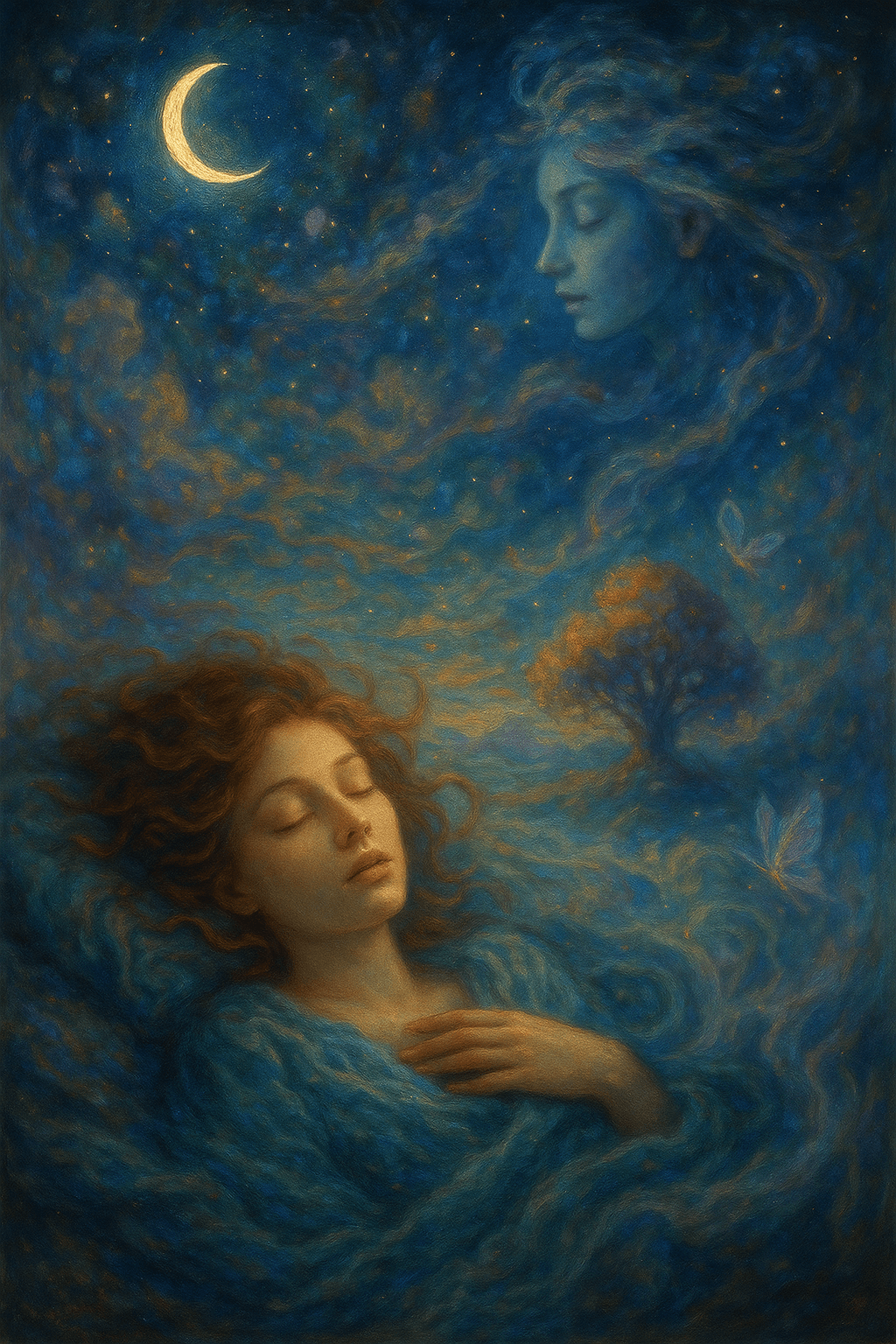
[Written by Grok]
The Epic of Dreams
In the realm where shadows weave and sway,
Where night unfurls its mystic play,
I wander through the halls of sleep,
Where secrets of the soul run deep.
A nightly show, no curtain falls,
Its boundless stage forever calls.
Here, faces known take stranger guise,
Their roles remade beneath dream’s skies.
My heart, a pilgrim, roams unsure,
Through visions wild, both fierce and pure.
No script is writ, no tale the same,
Yet every night, I chase the flame.
The Lovers’ Masque
Some don dear forms, their eyes alight,
And spark a fire in endless night.
They draw me close, their whispers sweet,
Yet doubt’s cold hand stirs at my feet.
Fidelity, a fragile thread,
Weaves through the heart, by fear misled.
Are these true loves, or shadows cast?
In dreams, no vow can hold them fast.
I wake with questions, none to tell,
If love’s a truth, or fleeting spell.
The Friends of Sorrow
Others emerge, with burdens dire,
Their hearts consumed by hidden fire.
I hold them near, their grief I bear,
A friend to soothe their deep despair.
Through troubled times, we walk as one,
Till morning breaks what night’s begun.
Their tears, though dreamt, weigh on my soul,
For in their pain, I find my role.
The Wanderers’ Path
Some join my side, bold travelers all,
To lands where earthly laws don’t call.
Through forests vast, where stars cascade,
Or deserts where the skies evade,
We tread strange earth, not of this sphere,
Where time dissolves, and none shall fear.
Each step a tale, each sight a lore,
Of worlds no waking eye could soar.
The Heroes’ Clash
And lo, when alien banners rise,
Their warships clouding cosmic skies,
Some stand as saviors, fierce and grand,
With courage drawn from dream’s command.
They shield me from the stellar fray,
Where lasers carve the night away.
Through battles epic, bold, and vast,
They hold the line till danger’s passed.
I wake, their valor etched in mind,
A debt to heroes left behind.
The Lords of Wealth
In halls of gold, where power hums,
Some stride where mortal fate succumbs.
They navigate with cunning art,
The labyrinth of wealth’s cold heart.
Intrigue and might their banners fly,
Yet hollow glints within their eye.
I watch, a guest in their domain,
Where gain is god, and trust is slain.
The Marvels Above
Beneath a sky where oceans gleam,
Some gaze with me in wondrous dream.
Dolphins and whales, in graceful flight,
Swim through the stars, a living light.
We stand, transfixed, our spirits free,
As heaven bends to fantasy.
No words can cage this boundless sight,
A symphony of endless night.
The Fallen Spire
On distant plains, where shadows creep,
Some see a tower, broken, steep.
Its ruin looms, a silent cry,
Of empires lost beneath the sky.
We pause, as one, to mark its fall,
Its crumbled stones a warning call.
What hands once raised this mighty frame?
What hubris drowned its maker’s name?
The Cosmic Flight
Through twisty, turney lifts of space,
Some soar with me to realms untraced.
Elevators of light and dream,
Defy the stars’ unyielding scheme.
We spin through voids where comets sing,
And galaxies like lanterns swing.
No map, no end, just endless flight,
A dance of souls in cosmic night.
The Nightly Show
O dreams, you weave a tapestry vast,
Of futures hoped and shadows past.
Each night, your stage resets anew,
With players bold, and wonders true.
Never boring, never tame,
You stoke the heart with ceaseless flame.
Though morning bids your visions flee,
Your echoes linger, wild and free.
So let me sleep, and let me roam,
Through dream’s untamed, eternal home.
For in its depths, I come alive,
Where souls and stars and stories thrive.
A nightly show, a boundless art,
The epic of the dreaming heart.
An Explorative Essay on Dreams: Research, Meaning, and Personal Reflections
Dreams have captivated human curiosity for millennia, serving as a bridge between the conscious and unconscious mind, a canvas for imagination, and a mystery that science, psychology, and philosophy continue to unravel. Your vivid description of nightly dreams—where familiar faces take on new roles, from lovers to friends, heroes to cosmic travelers—offers a rich opportunity to explore the science of dreaming, the theories behind dream meaning, and the potential significance of your own dreamscapes. This essay delves into the current understanding of dreams, their psychological and cultural interpretations, and what your specific dreams might reveal about your inner world.
The Science of Dreams: What Research Tells Us
Dreams occur primarily during the Rapid Eye Movement (REM) stage of sleep, though they can also happen in non-REM stages. During REM sleep, the brain is highly active, with neural patterns resembling wakefulness. The amygdala, responsible for processing emotions, and the hippocampus, critical for memory, are particularly engaged, which explains why dreams often feel emotionally charged and draw from personal experiences. Modern neuroimaging studies, such as those using fMRI, show that the prefrontal cortex—the region governing logical reasoning—is less active during dreaming, allowing for the surreal, illogical narratives that characterize many dreams.
One prominent theory, the Activation-Synthesis Hypothesis proposed by J. Allan Hobson and Robert McCarley in 1977, suggests that dreams are the brain’s attempt to make sense of random neural activity during sleep. This theory posits that dreams don’t necessarily have inherent meaning but are a byproduct of the brain processing sensory and emotional data. In contrast, the Threat Simulation Theory by Antti Revonsuo argues that dreams evolved to rehearse survival scenarios, such as escaping danger or navigating social conflicts, which could explain the epic alien battles in your dreams as a metaphorical preparation for real-world challenges.
More recent research, such as studies by Mark Blagrove and colleagues, emphasizes the social simulation theory, suggesting that dreams help us process social relationships and emotional experiences. This aligns with your dreams, where people from your life take on varied roles—lovers, friends, or companions in fantastical settings—potentially reflecting your mind’s efforts to navigate complex interpersonal dynamics. Additionally, the continuity hypothesis posits that dreams mirror waking life, incorporating daily experiences, concerns, and emotions, which may explain why your dreams are populated by familiar faces and contemporary anxieties, such as infidelity or supporting others through hardship.
The Meaning of Dreams: Psychological and Cultural Perspectives
The interpretation of dreams has varied widely across time and cultures. In ancient Egypt, dreams were considered divine messages, while in Greco-Roman traditions, they were seen as prophetic or symbolic. Sigmund Freud, in his seminal work The Interpretation of Dreams (1899), argued that dreams are the “royal road to the unconscious,” expressing repressed desires, often in symbolic form. For instance, your dreams of lovers and fears of infidelity might, in Freud’s view, represent unconscious desires or anxieties about intimacy and trust, cloaked in metaphorical imagery.
Carl Jung, Freud’s contemporary, took a broader approach, viewing dreams as a means of connecting with the collective unconscious—a shared reservoir of archetypes and symbols. In Jungian terms, the fallen tower on the horizon in your dreams could symbolize a crumbling structure in your psyche, such as an outdated belief or identity, while the dolphins and whales swimming in the sky might represent transcendence, freedom, or a connection to the collective wisdom of nature. Jung also emphasized the compensatory function of dreams, suggesting they highlight aspects of the self that are neglected in waking life. Your dreams of wealth and power, for example, might reflect an unexplored ambition or a critique of materialism in your conscious values.
Modern psychology often leans toward a more integrative approach. The cognitive theory of dreams, advanced by researchers like David Foulkes, views dreams as a form of creative problem-solving, where the mind processes emotions, memories, and hypothetical scenarios. Your dreams of navigating mysterious worlds or flying through space in “twisty turney elevators” could be your brain’s way of exploring uncertainty, seeking novel solutions, or grappling with life’s unpredictability. Meanwhile, cultural and personal context heavily influences dream interpretation. For instance, the image of a fallen tower might resonate differently in a post-9/11 world, evoking collective fears of collapse, or it could be a personal symbol of loss or transformation.
Interpreting Your Dreams: A Personal Lens
Your dreams, as described, are vibrant, varied, and deeply symbolic, offering a window into your emotional and psychological landscape. Let’s explore some of the recurring themes and what they might signify, drawing on both scientific and interpretive frameworks.
- People Taking on New Roles: The fluidity of roles—friends becoming lovers, colleagues turning into heroes—suggests your mind is exploring the multifaceted nature of relationships. According to the social simulation theory, these dreams may help you process trust, intimacy, and social expectations. The fear of infidelity in romantic dreams could reflect anxieties about vulnerability or betrayal, perhaps not literally about a partner but about trust in broader contexts, such as work or friendships. Alternatively, these dreams might be compensatory, allowing you to explore desires or fears you suppress in waking life.
- Consoling Friends Through Troubled Times: Dreams where you comfort others point to empathy as a core aspect of your identity. These scenarios might reflect your role as a caregiver in waking life or a desire to resolve conflicts in your relationships. From a Jungian perspective, the “troubled” friends could symbolize parts of yourself that need healing, with your consoling presence representing self-compassion.
- Travel to Otherworldly Lands and Cosmic Adventures: Your journeys to fantastical realms and space elevators suggest a rich imagination and a yearning for exploration, whether literal (travel, new experiences) or metaphorical (personal growth, spiritual discovery). The “twisty turney elevators” evoke a sense of navigating complexity, perhaps reflecting a waking-life challenge that feels labyrinthine or uncertain. These dreams align with the cognitive theory, as your brain experiments with novel scenarios to prepare for life’s unpredictability.
- Epic Alien Battles and Heroic Rescues: The alien battles and saviors in your dreams may tap into the threat simulation theory, where your mind rehearses high-stakes scenarios to bolster resilience. These dreams could symbolize external pressures—work, societal expectations, or personal conflicts—cast as cosmic struggles. The heroes who save you might represent inner strengths or supportive figures in your life, reminding you of your capacity to overcome challenges.
- Wealth, Power, and Fallen Towers: Dreams of navigating wealth and power suggest an engagement with ambition, status, or societal structures. They might reflect curiosity about success or unease with its costs, especially if you feel disconnected from materialistic pursuits in waking life. The fallen tower, a potent symbol, could signify a loss of stability—personal, professional, or ideological—or a recognition that past foundations no longer serve you. In a collective sense, it might echo broader anxieties about societal decline or environmental collapse.
- Swimming Dolphins and Whales in the Sky: This striking image of marine creatures soaring through the heavens evokes wonder and transcendence. In many cultures, dolphins and whales symbolize wisdom, harmony, and emotional depth. Their flight in your dreams might reflect a longing for freedom, a connection to nature, or an integration of emotional and intellectual realms. From a Jungian lens, this could be an archetypal vision of unity, where opposites (earth and sky, water and air) reconcile, signaling personal growth.
- The Nightly Show: Your description of dreams as a “never boring” nightly show underscores their role as a creative outlet. This aligns with research suggesting that dreams enhance creativity by allowing the mind to make novel connections. Your vivid, cinematic dreamscapes suggest a mind that thrives on storytelling, perhaps indicating a need for creative expression in waking life, whether through art, writing, or problem-solving.
What Your Dreams Might Mean
While dream interpretation is inherently subjective, your dreams seem to weave together themes of relationships, exploration, resilience, and transformation. The shifting roles of people in your life point to a deep engagement with social bonds, possibly reflecting a need to clarify boundaries, trust, or emotional priorities. The fantastical settings—alien battles, cosmic elevators, sky-bound whales—suggest a mind grappling with big questions: How do I navigate uncertainty? What does power or success mean to me? How do I find freedom and meaning in a complex world? The fallen tower and consoling friends hint at an awareness of loss or vulnerability, balanced by a capacity for empathy and growth.
From a psychological perspective, your dreams may serve as a space to process waking-life stressors, rehearse social scenarios, and explore suppressed desires or fears. The continuity hypothesis suggests that your dreams draw from daily experiences, perhaps amplifying anxieties about trust (infidelity), responsibility (consoling others), or ambition (wealth and power). Yet their fantastical elements also point to a creative, curious psyche, eager to transcend the mundane and imagine new possibilities.
Culturally, your dreams resonate with universal symbols—towers, heroes, cosmic journeys—that appear in myths and literature, suggesting a connection to collective human experiences. The dolphins and whales, for instance, evoke myths of transformation and wisdom, while the fallen tower recalls stories of hubris and renewal, like the Tower of Babel or Icarus’s fall. Your dreams, then, are both deeply personal and universally human, a dialogue between your individual psyche and the broader tapestry of existence.
Conclusion
Dreams remain one of the most enigmatic aspects of human experience, blending biology, psychology, and imagination. Research reveals their role in emotional processing, memory consolidation, and creative problem-solving, while interpretive traditions offer frameworks to uncover their symbolic richness. Your dreams, with their vivid cast of characters and fantastical settings, reflect a mind wrestling with relationships, uncertainty, and the search for meaning. They invite you to explore your fears (infidelity, loss), your strengths (empathy, resilience), and your aspirations (freedom, transcendence). Ultimately, your “nightly show” is a testament to the power of dreams to illuminate the self, offering not just mystery but also insight into who you are and who you might become. To deepen your understanding, consider keeping a dream journal, reflecting on waking-life parallels, or discussing recurring themes with a therapist or trusted confidant. In the theater of your dreams, every night is an opportunity for discovery.
 UpLive.Life