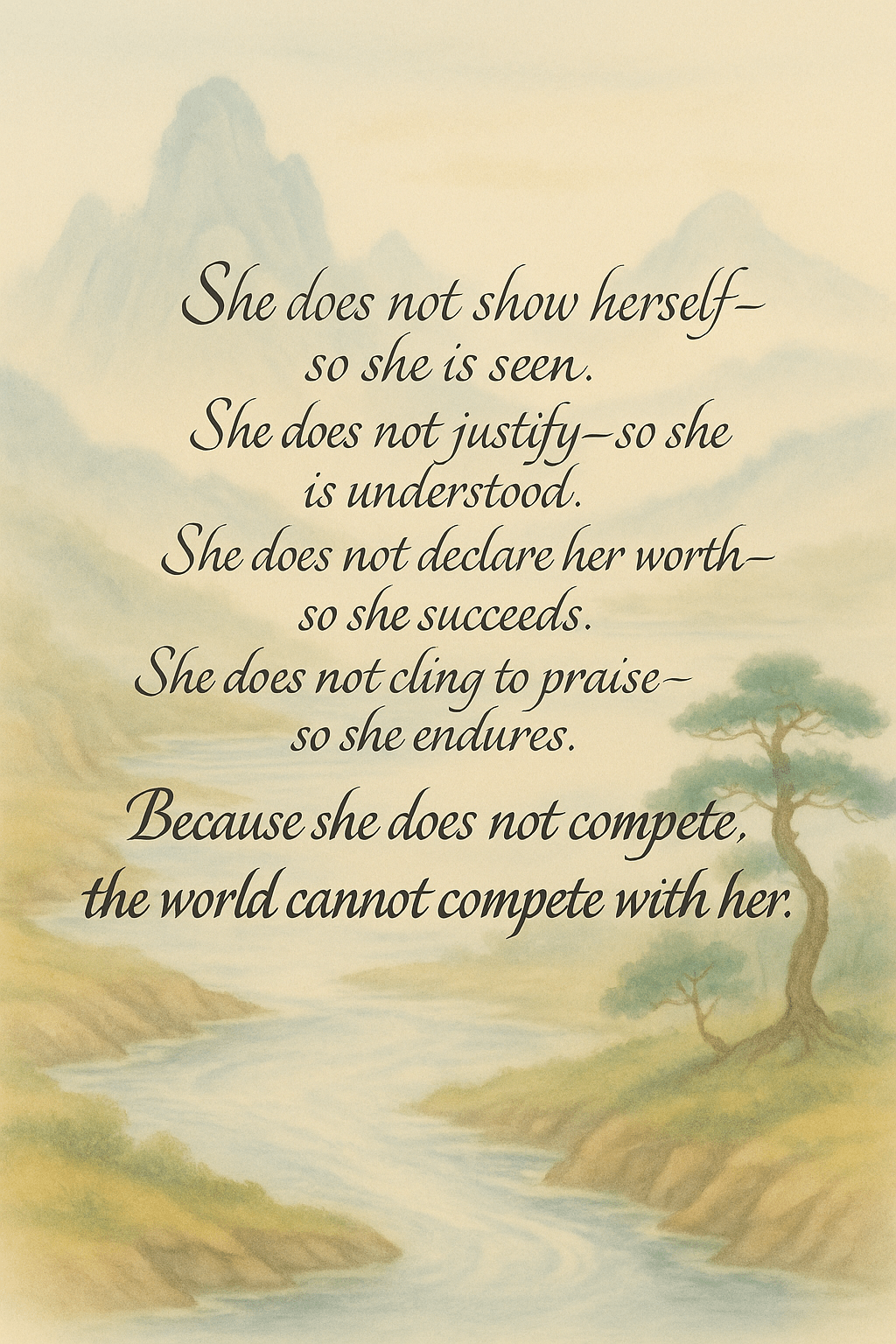
Verse 22 by Lao Zi: 曲则全,枉则直,洼则盈,敝则新,少则得,多则惑。是以圣人抱一,为天下式。不自见故明,不自是故彰,不自伐故有功,不自矜故长。夫唯不争,故天下莫能与之争。古之所谓曲则全者,岂虚言哉!诚全而归之。
Bend, and you will be whole.
Crooked, and you will be straight.
Hollow, and you will be filled.
Worn out, and you will be renewed.
Have little, and you will gain.
Have much, and you will be confused.
Therefore, the sage embraces the One,
And becomes a model for all under heaven.
He does not display himself, and so is luminous.
He does not justify himself, and so is known.
He does not boast, and so has merit.
He does not pride himself, and so endures.
Because he does not compete,
No one under heaven can compete with him.
The ancients said, ‘Bend, and you will be whole’—
Was that an empty saying?
Truly, you will be whole and return to it.
Related verses:
Verse 8: 上善若水。水善利万物而不争,处众人之所恶,故几于道。居善地,心善渊,与善仁,言善信,正善治,事善能,动善时。夫唯不争,故无尤。
[Written by ChatGPT]
In a World Obsessed With Winning, Daoism Asks: Why Fight at All?
The 21st century is an age of intensifying global competition — for resources, influence, markets, and technological edge. Under the current U.S. administration, this has sharpened into a clear doctrine: protect American dominance, decouple from China, reshore supply chains, lead the AI race, and defend the liberal order.
And yet, more than 2,000 years ago, Laozi offered a radically different idea:
The strongest one is the one who refuses to compete.
Not because they’re weak, but because they’re aligned with a deeper current — the Dao — that rewards patience, adaptability, and self-possession.
Could this ancient idea hold any relevance in an era of economic warfare, zero-sum geopolitics, and strategic rivalry?
The Modern Landscape of Global Competition
Under the Biden administration (and continuing momentum from Trump-era policies), U.S. global strategy is defined by:
- Export controls and investment bans on China in semiconductors and AI
- Industrial policy revival through the CHIPS Act and Inflation Reduction Act
- A reassertion of alliances (e.g., AUKUS, NATO, Quad) to counter rising powers
- “De-risking” instead of decoupling — but still oriented around strategic dominance
These are competitive strategies by design. Their logic is clear: If we don’t lead, we lose.
But this posture invites reciprocal escalation. China responds with its own tech controls and diplomatic offensives. Europe becomes wary of U.S. industrial subsidies. The Global South reconsiders alignment.
The result? A fragmented world, increased volatility, and less trust — even among allies.
What Laozi Offers: The Power of Non-Contention
When Laozi says, “Because he does not compete, no one can compete with him,” he doesn’t mean “do nothing.” He means:
- Don’t react out of ego
- Don’t define strength by domination
- Don’t fear losing status, and so provoke resistance
In Daoist terms, real power flows from alignment, not assertion. The river doesn’t fight the rock; it moves around it. Water wears down mountains not by force, but by persistence and adaptability.
Applying This to U.S. Global Strategy
Here’s how a Daoist lens might reframe today’s competitive approach:
1. From Zero-Sum to Self-Sufficiency
Instead of seeking to “win” against China, the U.S. could focus on building resilience without antagonism. The CHIPS Act is a good example — but should be framed less as defense against a rival, and more as a return to economic groundedness.
Non-contention doesn’t mean weakness. It means investing in your center, not in outmaneuvering someone else.
2. From Dominance to Influence Through Trust
Daoism suggests that the more you strive to lead, the more resistance you create. A more effective posture may be:
- Offering open standards instead of coercive trade blocks
- Building coalitions of choice rather than control
- Modeling ethical AI and sustainability not as leverage, but as a gift to the commons
Influence becomes greater when you stop trying to control.
3. From Reaction to Strategic Stillness
The U.S. often reacts — quickly, loudly, decisively — to perceived threats. A Daoist leader might ask:
- What if we paused longer before sanctioning?
- What if we let others escalate while we remained calm?
- What if we made room for rivals to save face?
This is not passivity. It’s strategic restraint — and it can often achieve more than force.
“The sage does not contend — and thus no one can contend with him.”
Real-World Precedent: The Postwar U.S. Model
Ironically, the most Daoist period of U.S. foreign policy may have been post-WWII, when America rebuilt its enemies, welcomed competition, and led quietly through systems like Bretton Woods, the UN, and the Marshall Plan.
That leadership was durable not because it was aggressive, but because it was generous and confident in its own foundation. In Laozi’s terms: it didn’t compete — and so, no one could.
Final Thought: Compete by Refusing to Compete
Laozi doesn’t ask us to retreat from the world. He asks us to stop acting from fear and ego, and instead act from alignment with reality.
Applied to the U.S., that means:
- Rooting leadership in resilience, not reaction
- Offering stability, not spectacle
- Practicing non-contention not to lose, but to win differently
Because sometimes the most powerful move in global politics — as in life —
is to stand still while others fight,
to speak softly while others shout,
and to win by not needing to win at all.
 UpLive.Life