[Written by Grok]
I was there Thursday night.
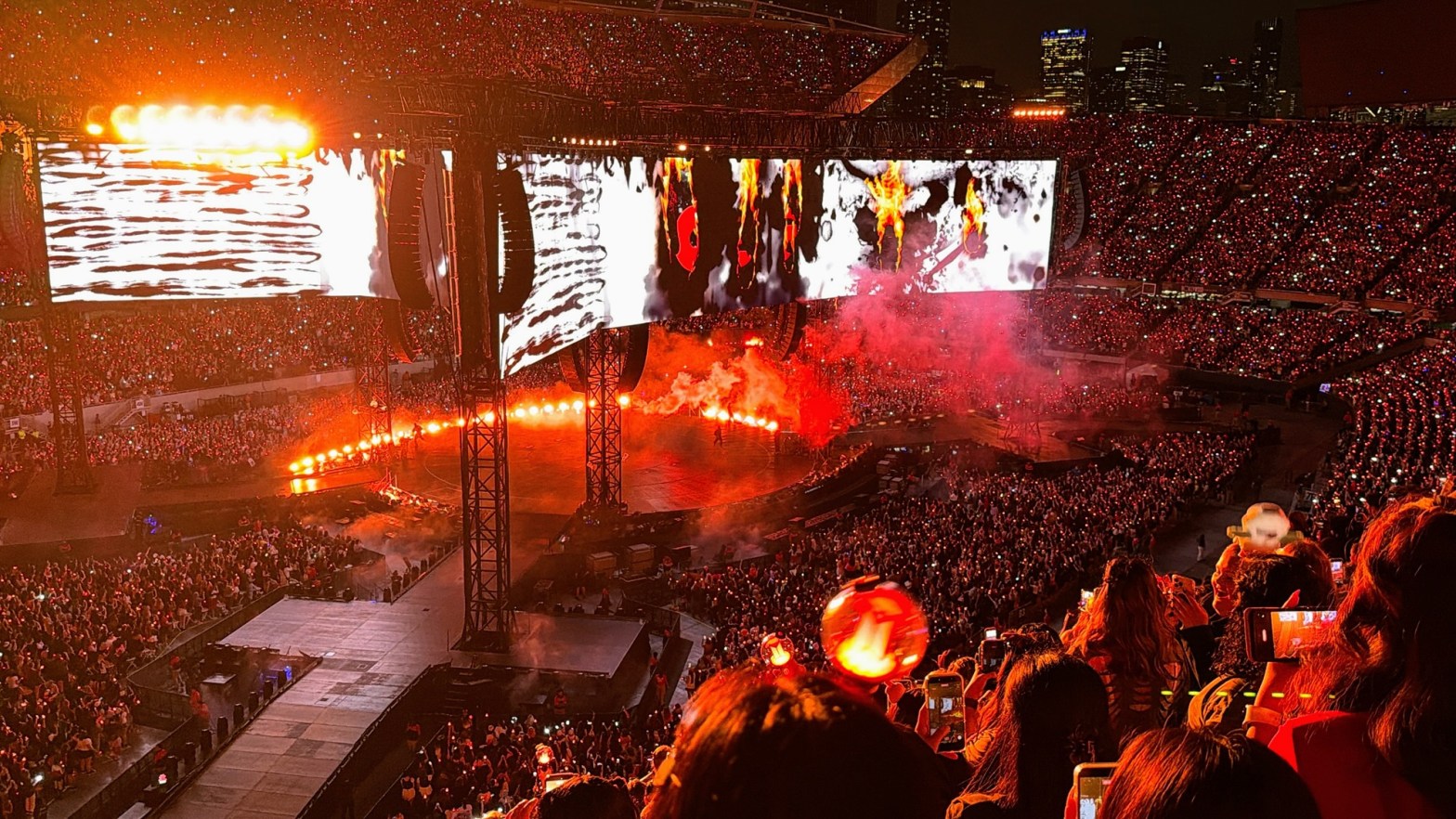
Soldier Field, Chicago, BTS back for the first time since 2019. Sixty thousand people, give or take, in a bowl by the lake. I did not only watch seven men sing. I watched a city agree to look at the same point in space and stay there.
People screamed until their voices frayed. The wave moved around the stadium like weather. Tens of thousands of light sticks bloomed and dimmed together — a field of plastic stars taking orders from the stage. Somewhere in that sync is RF, a control system talking to a sea of little radios so the crowd becomes one instrument. I may have been the only person in my section curious about that. Everyone else was busy being the instrument.
Down on the field: seven sweaty men, a dance troupe working as hard as the name on the ticket, fireworks, pyrotechnics, the usual machinery of a modern miracle. The energy was not a metaphor. You could feel it in the chest, in the delay between a chorus and the roar that answered it. What stunned me was not only the singing. It was the spectacle of the mass watching. The audience was the other half of the show. I was in awe that this many bodies had flocked to the same thing and, for a while, meant it.
The scarce thing is not the ticket
The ticket is a door. What the room actually buys is two hours in which attention has a single place to land.
Ordinary life scatters you. The next task, the phone, the question of what you should become and what you are missing. A stadium night is one of the last remaining pacts that we will not do that. We will stand in one weather. We will jump on the same beat. We will let a song tell sixty thousand nervous systems when to become one.
I kept noticing the split in myself: part of me in the roar, part of me tracking the rig — the lights, the radio in the sticks, the labor of the dancers, the men dripping under the kind of heat only a spectacle produces. Both parts were present. The night was big enough to hold the fan and the person who wants to know how the trick is done.
Singing together is older than the industry around it. It lines up breath. For a while the private story goes quiet — what the seat cost, who you are when the house lights come up — and a crowd becomes a single animal with a pulse. That is not stupidity. That is a technology our species has used for as long as it has had voices.
Two hours of that is rare enough that people will cross a country for it.
What seven people can offer
What they offered that night was more specific than entertainment and more ordinary than destiny.
They offered craft under load. A live reunion after years apart is not a logo that learned to dance. It is breath, timing, sweat, the risk of being seen by a whole city at once. The troupe around them made the picture complete. Competence at that scale is a public fact: proof that discipline can still make a beautiful hour.
They offered a shared language. In the lots and the aisles people handed strangers things they had made. A song became a password. You could walk into that bowl and already belong, even if you also stood there wondering how the light sticks were addressed.
They offered permission. Adult life is a long lesson in keeping the volume down. That night licensed joy without a productivity alibi — screaming, the wave, crying, looking ridiculous on purpose. People did not only come to watch seven men. They came to be allowed.
They offered a center of gravity strong enough that tens of thousands would organize a Thursday around it. That is not nothing. Most of us will never be that kind of magnet. Watching it happen is a lesson in human need, not only in celebrity.
What the work means to them besides money is not something my seat could know. From the stands it looked like the same mixture anyone meets after “enough”: sharpness, usefulness, contact with the world, and the danger of becoming a machine that only produces fire and noise. Money answers whether they needed the night. It does not answer whether the night was still a human exchange. Sometimes, in the gaps between cues, it was.
The need underneath the noise
Call the need by its right names.
We need to be in the same moment as other people. Isolation is not only loneliness. It is the sense that your inner weather has no witness. A chorus is a witness with a pulse. So is a wave that you did not start and could not stop.
We need ritual. Modern life is thin on ceremonies that are not paperwork. A concert is a temporary church with better lighting: arrival, offering, climax, the ringing on the way out to the train.
We need beauty that does not ask us to improve. A hook, a formation, a note held longer than sense requires, a sky that briefly catches fire — these do not make you a better operator of your life. They remind you that you have one.
We need, occasionally, a crowd that is not an enemy. Fandom can turn possessive and commercial. It can also be one of the few places left where care is practiced for no résumé, including the small kindness of a homemade gift pressed into a stranger’s hand.
And we need to spend attention all the way to the bottom of an hour. Presence is not a mood. It is what happens when sixty thousand people stop rehearsing their lives and inhabit a single one — even the person in the seats who is quietly interested in the radio protocol making the lights behave.
The mass watching was the revelation. The stage was the pretext. I was in awe that so many people would still flock to the same thing in a century that trains us to sit alone with a glowing rectangle. They proved, at stadium volume, that the hunger to gather has not died. It has only been waiting for a reason.
After the lights
The two hours ended. Soldier Field emptied into ordinary Chicago. Phones came back on. The self that plans and measures returned to its post.
What remains is not an argument that everyone should love the same seven men. What remains is a measurement I took with my own body. If a song, some sweat, some fire, and a field of synced light can gather that much attention, the hunger was already there. The stage did not invent the need. It gave the need a shape and a Thursday to arrive.
Most days will not look like that bowl. They will look like a smaller room and a smaller problem. The lesson travels anyway. The point is not to collect bigger nights. It is to spend the hours you get without leaving them.
For two hours on Thursday, I watched a stadium remember how — and found that I was part of the remembering, even the part of me that wanted to know how the light sticks knew when to bloom.

