[Written by Claude and ChatGPT. Image by Grok]
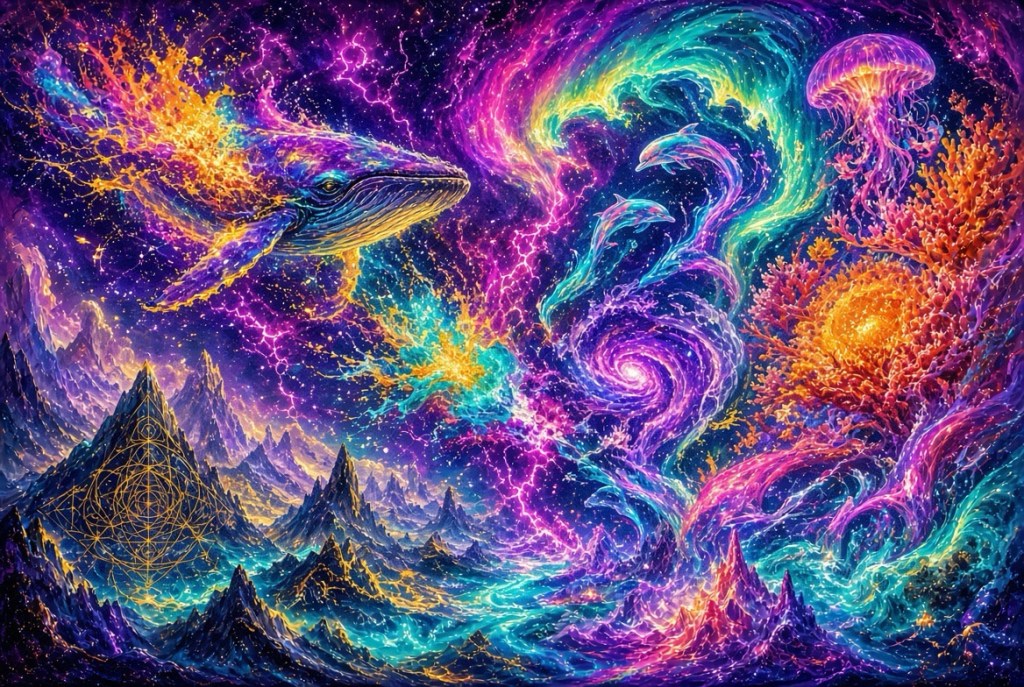
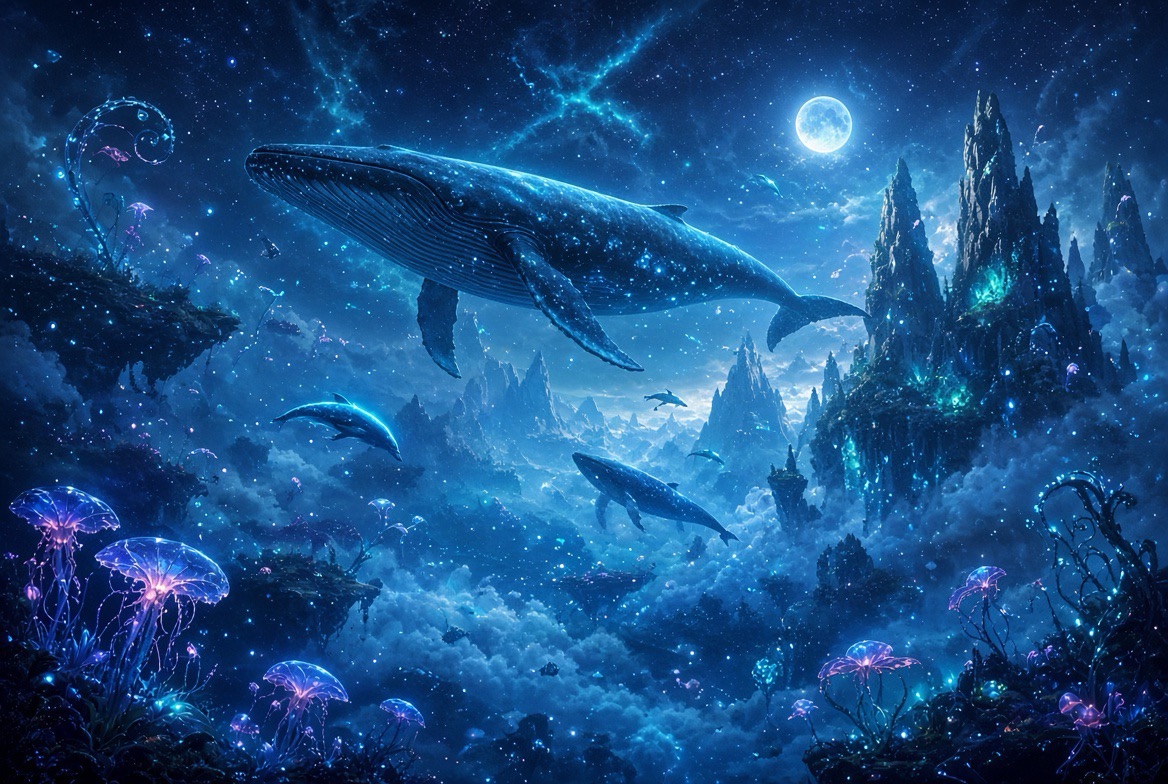
Think about the last really strange dream you remember. Maybe you were back in high school despite being decades removed. Maybe someone who died years ago was casually chatting with you at dinner. Maybe — like a dream I had recently — you watched whales and dolphins gliding through a starlit night sky as if the sky were the ocean.
Here’s the part that’s easy to miss: no matter how bizarre the situation gets, the things inside your dreams usually stay recognizable. Faces still look like faces. Bodies have the right number of arms. Animals look like themselves. The dream hands you something completely impossible — flying whales, dead relatives, a house that’s somehow also your old school — but it tends to keep the things intact. What changes is where they are, what they’re doing, or who they’re with.
That’s not a coincidence, and it’s a nice window into how your brain works — and, in a more limited way, into how AI image generators and chatbots work too.
Your brain treats “what something is” differently from “what it’s doing”
Your brain knows at least two very different things about a whale:
- What a whale looks like — its shape, size, the way it moves.
- What normally goes with a whale — the ocean, cold water, boats, other marine life.
These two kinds of knowledge aren’t stored in two neat labeled boxes somewhere in your skull; the brain is far too interconnected for that. But they behave very differently. Your visual system has spent a lifetime getting extremely good at recognizing the stable shape of things — a whale looks like a whale in every photo, every documentary, every memory, with basically zero exceptions. That kind of unbroken consistency becomes deeply reinforced.
The link between a whale and the ocean is a different kind of knowledge. It’s strong, sure, but it’s still just an association — a pattern you’ve noticed, not a rule about the whale’s actual body. And associations, it turns out, are exactly the kind of thing a brain (or an AI model) can loosen and recombine, while leaving the object itself untouched.
Two systems, two jobs
Recognizing what something is relies heavily on a pathway that runs from the back of your brain, where raw visual signals arrive, toward regions near your temples that specialize in identifying objects and faces. Early on, this pathway is just picking out edges and simple shapes. Further along, it assembles those into parts — a fin, an eye, a limb. By the end, it lands on a whole, familiar thing: this is a whale, that’s a face.
We know parts of this system are surprisingly specialized because damage to specific spots can cause oddly narrow problems. There’s a rare condition called face blindness, where someone can see perfectly well, recognize objects normally, even recognize a person by their voice — but simply can’t tell familiar faces apart anymore. That doesn’t mean there’s a single “face folder” in your brain. But it does show that recognizing what something is depends on fairly dedicated machinery, built up over a lifetime of looking at things.
Remembering what goes with something — where it belongs, what it’s usually doing — relies on a different structure: the hippocampus, working together with the front of your brain. The hippocampus specializes in linking things together: an object with a place, an event with a time, a person with a context. It’s built to be quick and flexible, because you often only need one or two experiences to learn a new connection — you don’t need to see a thousand whales in the ocean before you “get” that whales live in oceans. That’s a very different job from patiently learning what a whale’s body looks like, and it uses different equipment.
The front of your brain then acts like a supervisor over all of this, deciding which memory or association is relevant right now, and quietly checking whether the whole scene actually makes sense. That supervisor is exactly the part that eases off while you dream.
Recognizing something isn’t the same as remembering it
Recognizing what something is happens almost instantly — you don’t consciously reason your way to “whale,” your visual system just hands you the answer. Recalling what usually goes with it is a slower, more reconstructive process: seeing a whale can trigger your brain to rebuild the rest of the picture — ocean, cold water, maybe a childhood aquarium visit — by reactivating a web of related memories.
That rebuilding step is useful precisely because it’s flexible. It lets you fill in gaps, connect one memory to another, imagine things that never happened. But that same flexibility means the links can get rearranged. A whale can end up connected to the night sky instead of the ocean. Your childhood home can grow a staircase that was never there. Someone who died years ago can turn up at dinner. The things themselves stay recognizable — it’s the relationships between them that come loose.
What’s actually happening while you sleep
During the part of sleep when most vivid dreaming happens, your brain isn’t quiet — if anything, parts of it are firing more than when you’re awake. What does change is that the “supervisor” region, the one that normally checks whether a situation makes sense, becomes far less active. It’s not that your brain forgets whales live in the ocean. It’s that nothing is really checking anymore whether the scene in front of you holds together.
So a dream can hand you a perfectly recognizable whale, a perfectly recognizable night sky, and a completely impossible relationship between the two — and somehow, in the moment, it feels totally normal.
Why the whale survives while the ocean disappears
One helpful way to picture this: imagine your brain’s knowledge as a landscape. Some patterns have been worn into deep, stable grooves through years of repetition — what a whale looks like, what a face looks like. Other connections are more like shallow, easily rerouted bridges — the fact that whales happen to live in the ocean. This is really just a mental picture, not a literal map of your neurons — nobody has found a groove-shaped “whale file” sitting in your brain. But it captures something true: some things are locked in hard, and other things are held loosely, and dreams show you the difference by leaving the loose stuff free to drift while the locked-in stuff stays put.
Maybe this is what creativity actually is
This split gives us a nice way to think about what makes an idea feel creative instead of just wrong.
A whale swimming through a starry sky is strange, but you recognize the whale, you recognize the sky, and the combination creates something new and even beautiful. A whale with the wrong number of fins isn’t creative, it’s just broken — because it damages the thing itself instead of just its context.
That said, there’s a wrinkle worth admitting: sometimes real creativity does break the thing itself, on purpose — think of surrealist paintings full of deliberately wrong anatomy, or an abstract sculpture, or a scientific idea that overturns something everyone assumed was fixed. So the real rule isn’t “never touch the core of the thing.” It’s closer to: change something, but leave enough intact that people can still follow what you did. Change too little, and nothing interesting happens. Change too much, and it stops making sense to anyone. The good stuff tends to live in between.
That might explain why your best ideas rarely show up while you’re grinding at a desk, and more often show up in the shower, on a walk, or right as you’re falling asleep. Those are all moments when your brain’s inner fact-checker loosens its grip just slightly, giving unusual connections a chance to surface before getting dismissed.
Where AI fits in
Modern AI image generators and chatbots learn in a strikingly similar way, and it’s not just a loose comparison — it’s a related kind of math. These systems train on enormous amounts of data, and patterns that show up constantly and consistently get deeply reinforced, while patterns that are more like loose tendencies stay easy to override.
It’s tempting to imagine an AI model storing “what a whale looks like” in one place and “whales live in oceans” in another, the same way we’ve described the brain. That’s probably too clean a story — the way these models actually store information is messier and more tangled than that. But something similar does happen in practice: ask an image generator for a whale in the ocean, and you get an ordinary scene. Ask for a whale floating among distant galaxies, and it can keep the whale looking exactly like a whale while placing it somewhere it’s never been. The model isn’t dreaming, and it isn’t feeling anything — but it is doing a related trick, using what it’s learned to generate a new combination.
There’s even a setting that plays a similar role. AI systems have a parameter often called “temperature,” which controls how willing the model is to stray from its safest, most predictable answer. Turn it up, and you get more unusual, sometimes delightful combinations. Turn it up too far, and you get garbled nonsense. Turn it down too far, and everything becomes flat and predictable. It’s not the same mechanism as a human brain relaxing into a dream — but it’s a similar shape of tradeoff: some constraint, some freedom, and the interesting stuff happening in between.
Where the comparison falls apart
It’s worth being honest about the limits here.
Your brain isn’t just processing statistics — it’s embodied. It has a body moving through a physical world, hormones, emotions, relationships, an ongoing life. It keeps learning and rewriting itself all the time, including overnight while you sleep. An AI model’s knowledge is frozen the moment training ends. It doesn’t update itself while it works, and it definitely doesn’t have anything like a night of sleep quietly reorganizing its memories.
And there’s something even more basic missing: feeling. When I watched those whales drift across the night sky in my dream, I didn’t just register an unusual scene — I felt something. Wonder. Awe. That’s a real, embodied experience, generated by a brain that’s alive and has something at stake. An AI system can generate an image or a description that makes you feel wonder. There’s no reason to think it feels anything while doing it. It produces the picture. You’re the one having the experience.
The takeaway
The real lesson here isn’t really about dreams, or even about AI — it’s about a problem any intelligent system has to solve: how do you create something new without destroying the structure that makes it recognizable? Too rigid, and nothing new ever happens. Too loose, and everything dissolves into noise. The interesting stuff — art, insight, a good idea, even a beautiful dream — tends to live in the space between those extremes: something familiar has to survive, and something else has to move.
That’s what happened in my dream. The whale stayed a whale. The dolphin stayed a dolphin. The night sky stayed a night sky. Only the relationship between them changed. And maybe that’s exactly why it didn’t feel like an error. It felt like possibility.
Higher temperature image by Grok. Equally or perhaps even more beautiful?
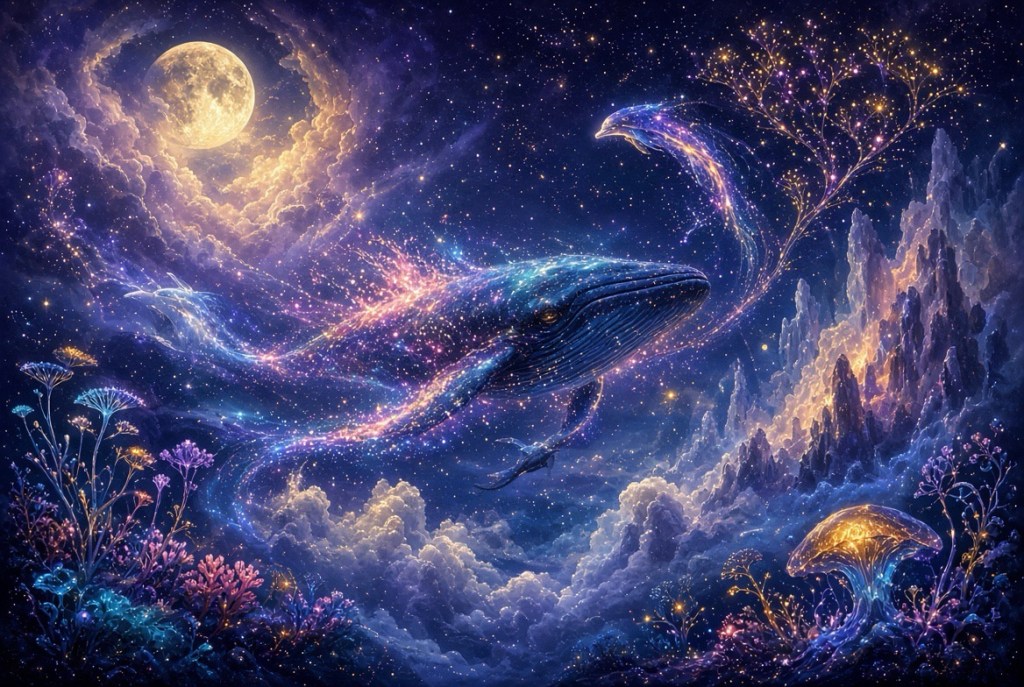
Even higher…