[Written by Claude]
Sleep is something everyone does, every night, without a second thought. But peel back the curtain and it’s one of the most intricate, tightly choreographed processes in the human body — a nightly performance of electrical switches, chemical cascades, and brainstem circuitry so reliable that most of us never once wonder how it works.
Dreams: Real Time or Distorted Time?
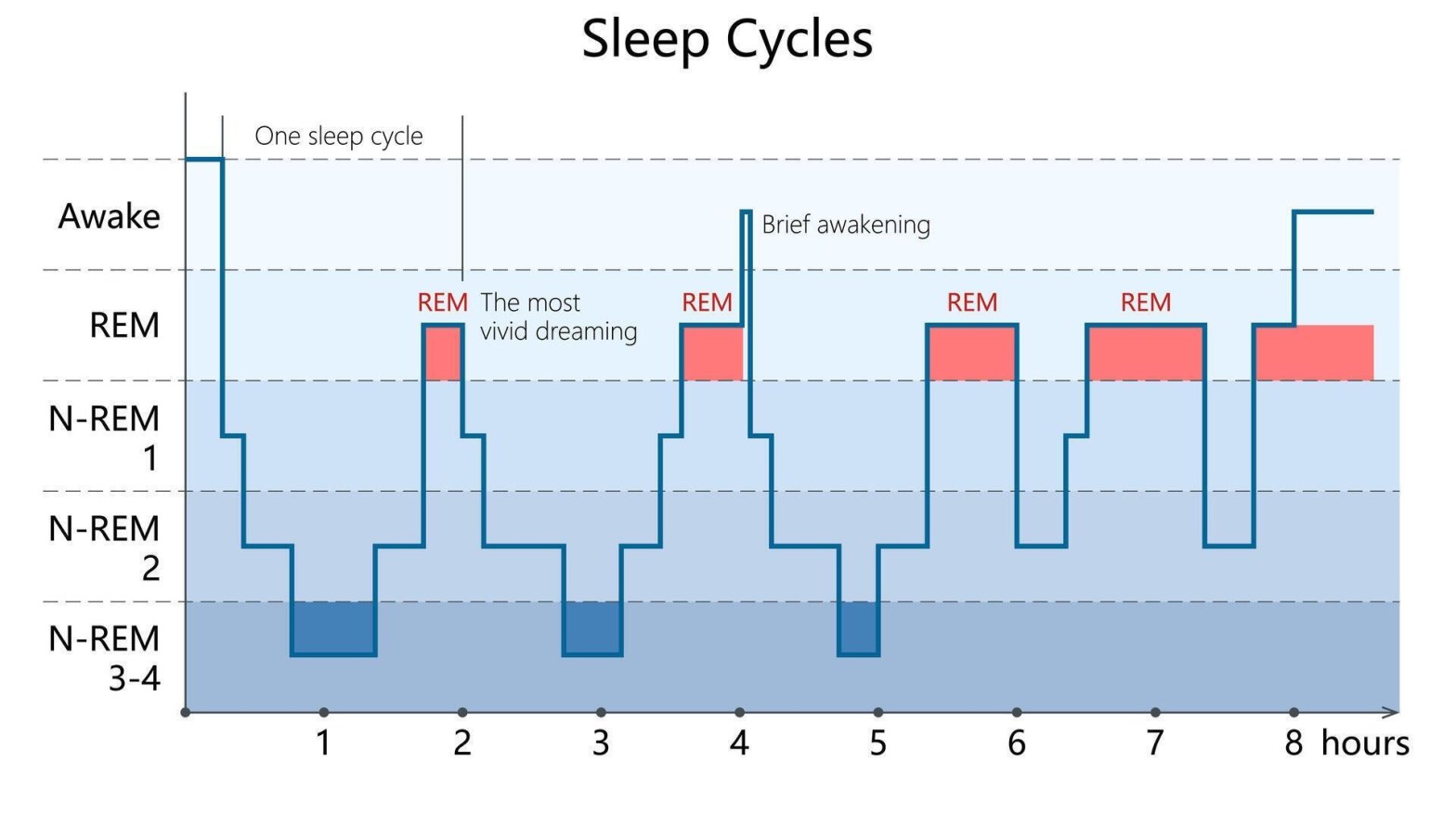
Dreams mostly happen during REM sleep, in bursts lasting anywhere from 5 to 40 minutes, growing longer as the night goes on. Contrary to the popular idea that a dream can compress a lifetime into a few seconds, most evidence suggests dream time tracks real time fairly closely — a 20-minute REM period likely corresponds to a dream that actually unfolds over about 20 minutes.
That said, perceived duration can still warp. Hypnagogic dreams (the ones right at sleep onset) can feel like they form instantly. And when we wake up, memory reconstruction reshapes the story — we stitch fragments into a narrative, which distorts our sense of how long it “really” lasted.
Why the Body Goes Still
One of the strangest features of sleep is muscle paralysis during REM — called atonia. It’s not passive relaxation; it’s an active, engineered shutdown.
Deep in the brainstem, a region called the sublaterodorsal nucleus (SLD) fires during REM and sends signals down to the spinal cord and through a relay in the medulla. There, neurons release glycine and GABA directly onto spinal motor neurons — the cells that would otherwise fire to move your limbs — hyperpolarizing them so they simply can’t respond to motor commands.
This matters because REM is paradoxical: the brain is highly active, generating vivid, motor-rich dream content (running, fighting, falling), while the body needs to stay still. Non-REM sleep doesn’t need this active override — it’s simply a lower-arousal state where motor drive naturally drops, which is why sleep talking or shifting positions can leak through more easily in that stage.
When the override fails, you get REM Sleep Behavior Disorder, where people physically act out dreams. When it lingers past waking, you get sleep paralysis — conscious, but briefly unable to move.
This same circuit is remarkably conserved across mammals. It was first discovered through cat studies in the 1960s, where damaging this brain region caused cats to get up and seemingly “hunt” while still asleep — one of the earliest clues that dreaming involves genuinely motor-scripted content.
Why Kids Move More in Bed Than Adults
Toddlers are famous for ending up sideways or backwards in bed, while adults mostly stay put. This comes down to several factors compounding: children spend more time in lighter sleep with more partial arousals, haven’t yet built the unconscious “map” of their body in bed that adults rely on, and have smaller bodies with more relative room to migrate. It’s less that adults can’t move and more that mature sleep architecture and learned stillness keep things in check.
The Switch That Starts It All
Falling asleep isn’t a gradual fade — it’s a fast flip-flop switch. Two systems build the pressure:
- Homeostatic pressure: adenosine accumulates the longer you’re awake, and caffeine works by blocking its receptors — masking tiredness rather than removing it.
- Circadian timing: your internal clock, synced to light exposure, releases melatonin as a scheduled signal for “biological night.”
When both align, the VLPO nucleus overpowers the brain’s wake-promoting arousal centers (histamine, orexin, serotonin, norepinephrine) in a mutual-inhibition standoff — and the whole system flips states. That woozy, foggy feeling right before sleep — the hypnagogic state — is the brief, unstable middle ground before one side wins.
The 90-Minute Rhythm
Once asleep, the brain cycles through non-REM and REM roughly every 90 minutes, 4-6 times a night — though this varies by person (ranging roughly 70-120 minutes), and shortens dramatically in infants. This cycling is driven by another mutual-inhibition circuit between REM-promoting and REM-suppressing brainstem neurons, each rising, inhibiting the other, then self-limiting until the balance flips back.
The cycles aren’t just repeats of each other — early cycles favor deep restorative slow-wave sleep, while later cycles skew toward REM. This is why cutting sleep short doesn’t reduce everything equally; it disproportionately steals REM, since REM is backloaded toward morning.
Why Humans Sleep At All
No single theory fully explains sleep — it appears to serve several jobs at once:
- Restoration: growth hormone release and tissue repair peak during deep sleep.
- Brain cleaning: the glymphatic system flushes cerebrospinal fluid through the brain during sleep, clearing metabolic waste including beta-amyloid, the protein implicated in Alzheimer’s.
- Memory consolidation: transferring memories from the hippocampus into stable long-term cortical storage.
- Emotional regulation: REM sleep may reprocess emotional memories in a lower-stress neurochemical state.
- Synaptic homeostasis: rebalancing and pruning the net strengthening of connections built up during waking hours.
A System That (Mostly) Never Fails
What’s genuinely remarkable is that this whole cascade — chemical buildup, circadian timing, brainstem switches, cycling, atonia, and release — runs correctly roughly 25,000+ times over a human life, almost always without conscious awareness that it’s happening at all.
Part of why it’s so reliable is redundancy: multiple independent signals (adenosine and circadian timing) usually agree, and flip-flop switches are specifically designed to resist getting stuck in ambiguous middle states. Part of it is evolutionary depth — even jellyfish, with no brain at all, show sleep-like states, meaning this system has had an enormous amount of time to be tested and refined.
It does fail, of course — insomnia, narcolepsy, sleep apnea, and REM Behavior Disorder are all real breakdowns of specific parts of this machinery. But failures are usually partial rather than catastrophic, and the system quietly self-corrects with fresh light exposure and sleep pressure resets every day.
We take it for granted largely because it’s designed to be invisible — you can’t be aware of the deep sleep meant for restoration, aware of dream logic without the very brain regions that would question it, or aware of the wake/sleep switch flipping, since it’s built to happen fast specifically so you don’t linger in between.
Could We Need Less Sleep?
Rare genetic mutations (in genes like DEC2 and ADRB1) allow some people to function well on just 4-6 hours nightly with no apparent cognitive cost — proof that sleep need isn’t fixed, but genuinely tunable.
But deliberately engineering this in the general population is far harder than it sounds. We don’t yet know why these mutations work — whether glymphatic clearance, memory consolidation, or synaptic rebalancing happens faster, or whether some processes are simply skipped with a hidden long-term cost (like slower amyloid clearance, a risk that might not surface for decades). Until that mechanism is understood, anything that merely removes the feeling of tiredness — caffeine, stimulants, willpower — is masking sleep need rather than genuinely reducing it.
Why You Only Remember One Dream (or None)
Here’s a puzzle almost everyone runs into: you have 4-6 REM periods a night, so you’re almost certainly dreaming multiple times even on a night you recall nothing. Dream recall isn’t a measure of how much dreaming happened — it’s a measure of how much got captured into retrievable memory before it faded, which is a much narrower bottleneck.
A few reasons that bottleneck is so tight:
- You mostly only remember the dream you wake up out of. A dream that ends and rolls straight into non-REM sleep without you waking is largely lost by morning, even though it happened. Since morning waking usually happens out of the final REM period of the night, that’s the one dream most people carry into the day.
- The encoding is weak to begin with. Prefrontal cortex activity — heavily involved in memory encoding — is low during REM, and the neurochemical environment (lower norepinephrine, among other things) means dreams start off poorly recorded compared to waking experience.
- The forgetting curve is brutally fast. A large share of dream content can be lost within just 5-10 minutes of waking. Glancing at the clock or thinking about the day ahead is often enough to erase what was there seconds earlier.
What changes recall frequency is telling: people who wake more often during the night (light sleepers, or those with sleep apnea) report more dreams — not because they dream more, but because they get more chances to catch one mid-REM before it fades. Waking abruptly to an alarm can also snag a dream that a gradual, natural waking would have let slip away.
If Dreams Aren’t Meant to Be Remembered, Why Have Them?
This raises an obvious question: if most dreams vanish within minutes, what’s the point of having them at all? The likely answer is that the function of dreaming and the memorability of dreaming are two separate things that just happen to be bundled together.
Most theories of REM’s purpose point to jobs that don’t require conscious recall to work:
- Emotional processing may involve dulling the emotional edge of a memory during REM’s lower-stress neurochemical state — a structural change to how the memory is stored, not something that needs to be consciously watched or remembered afterward.
- Memory integration — weaving new information into existing knowledge — shows up in your waking thinking and problem-solving, not in a memory of the reorganizing process itself.
- Threat rehearsal, one evolutionary theory suggests, may let the brain practice responses to threatening scenarios safely — the training value comes from the practice, not from remembering it happened.
- Some researchers go further and argue dreaming might be a byproduct of the brain doing something else useful entirely, with the “dream” simply being the narrative your cortex generates while making sense of internally generated activity — real, but not itself the mechanism of benefit.
There’s even a case that forgetting is adaptive, not incidental: retaining vivid memories of hundreds of strange, threat-simulating, or emotionally raw nightly scenarios could risk confusing dreamed content with real memory, or carrying forward emotional residue from things that never happened. Some researchers frame REM as intentionally structured to let processing occur without committing the raw material to long-term retrievable memory — not unlike how you don’t need conscious access to every stage of digestion for it to work.
What’s left genuinely unresolved is why there’s a felt, subjective narrative accompanying any of this at all, rather than the same emotional reprocessing happening with no experience attached — the same “hard problem” that comes up with consciousness more broadly.
Why Some People Barely Remember Dreams at All
Low or zero dream recall is common, and it isn’t a sign anything’s wrong. Studies waking self-described “non-dreamers” during REM in sleep labs find they report dreams at rates not wildly different from anyone else woken at the same point — the dreaming is happening, the capture into memory just isn’t.
A few things shape this:
- Sleep continuity. Ironically, unbroken, high-quality sleep means fewer awakenings — and fewer chances to catch a dream on the way out of REM.
- Personality and cognitive style. Higher recall correlates with traits like openness to experience and a general tendency toward mind-wandering or attending to inner mental life.
- Brain activity differences. Neuroimaging work has found high dream recallers show more activity in the temporoparietal junction, a region tied to attention and reorienting toward stimuli — both during sleep and at waking rest — suggesting a baseline difference in how readily the brain flags internal content as worth encoding.
- Age, alcohol, certain medications (especially antidepressants that suppress REM), and simply not attending to it upon waking can all further reduce recall.
A sudden, sharp drop in recall — rather than a lifelong pattern — is the version worth mentioning to a doctor, since that shift (alongside other sleep complaints) can flag new medications, mood changes, or sleep-disordered breathing.
Is there a test for this? Not a single definitive one. Researchers mostly rely on self-report scales like the Dream Recall Frequency questionnaire, sustained dream diaries (more reliable than a one-off guess, since people are bad at estimating their own average), and correlated personality measures like openness or absorption tendency. The lab gold standard — waking people during scheduled REM periods to check recall directly — consistently shows recall is higher than people’s spontaneous “I never remember dreams” impression suggests. Practically, the closest thing to a real answer for any individual is simply keeping a journal by the bed for a couple of weeks — which, notably, doesn’t just measure recall, it improves it.
And What About AI?
AI doesn’t sleep or dream, and there’s no evidence current systems have any subjective experience to speak of. But some functional analogies already exist in machine learning: replay buffers that reprocess past experience offline, generative “dreaming” techniques used to stabilize training, and research into avoiding catastrophic forgetting — all borrowing, sometimes explicitly, from the sleep and memory-consolidation literature. It’s a useful engineering analogy, not evidence of anything resembling dreaming in the human sense.
Sleep is one of those systems that’s invisible specifically because it works. The only time most of us ever hear about the sublaterodorsal nucleus, glycine release, or the VLPO switch is when something has gone wrong — smooth function simply doesn’t generate a symptom, and so it never demands our attention. Dreaming carries a version of the same quiet paradox: a nightly, brain-wide process running multiple times a night, doing real cognitive work, and for the most part, leaving no trace you’ll ever remember it happened at all.
The Quiet Miracle of Knowing It Was a Dream
Every night, your brain does something strange: it builds an entire sensory, emotional, and narrative world — using the very same visual cortex, memory circuits, and storytelling machinery you rely on for real life — and then largely convinces you, in the moment, that it’s actually happening. There’s no separate “fake experience” channel your brain routes dreams through. Dreaming co-opts the real thing. Which means the task of sorting dreamed from real isn’t like telling apart two different signals — it’s untangling two experiences built from identical parts, after the fact, usually with almost no cooperation from memory itself.
And the memory you’re working with is a poor witness. Dreams are encoded while the prefrontal cortex — the very region responsible for critical evaluation — is largely offline, and the neurochemical environment of REM sleep leaves the resulting trace weaker and more fragile than an ordinary waking memory. It starts decaying within minutes of waking. So the brain isn’t just solving a hard classification problem; it’s solving it with degraded, incomplete evidence, working against the clock, almost every single day of a person’s life, without ever being taught how.
What makes it work isn’t a dedicated dream detector — evolution didn’t need to build one. It’s a more general reality-monitoring system, the same one you use, awake, to sort “did I actually see that” from “did someone just describe it so vividly I feel like I did.” Real memories tend to carry richer, more consistent perceptual and contextual detail; dreamed ones are often patchy, inconsistent, or missing the connective tissue of how you got somewhere. The brain reads this texture, not some built-in tag, and files the experience accordingly — usually correctly, usually fast.
It isn’t flawless, and that’s part of what makes it interesting rather than magical. Mild dream-reality slippage is common — misremembering whether you did something or only dreamed it, a lingering emotional residue from a dream that takes real effort to shake. It degrades further under sleep deprivation, in early childhood, and in certain neurological and psychiatric conditions. A system that mostly works, fails gracefully under strain, and only draws attention to itself in the rare cases it slips, is arguably more impressive than one that simply never fails — it’s a sign of a robust, general-purpose trick being reused for an extraordinarily strange task, quietly, every night, for an entire lifetime.

