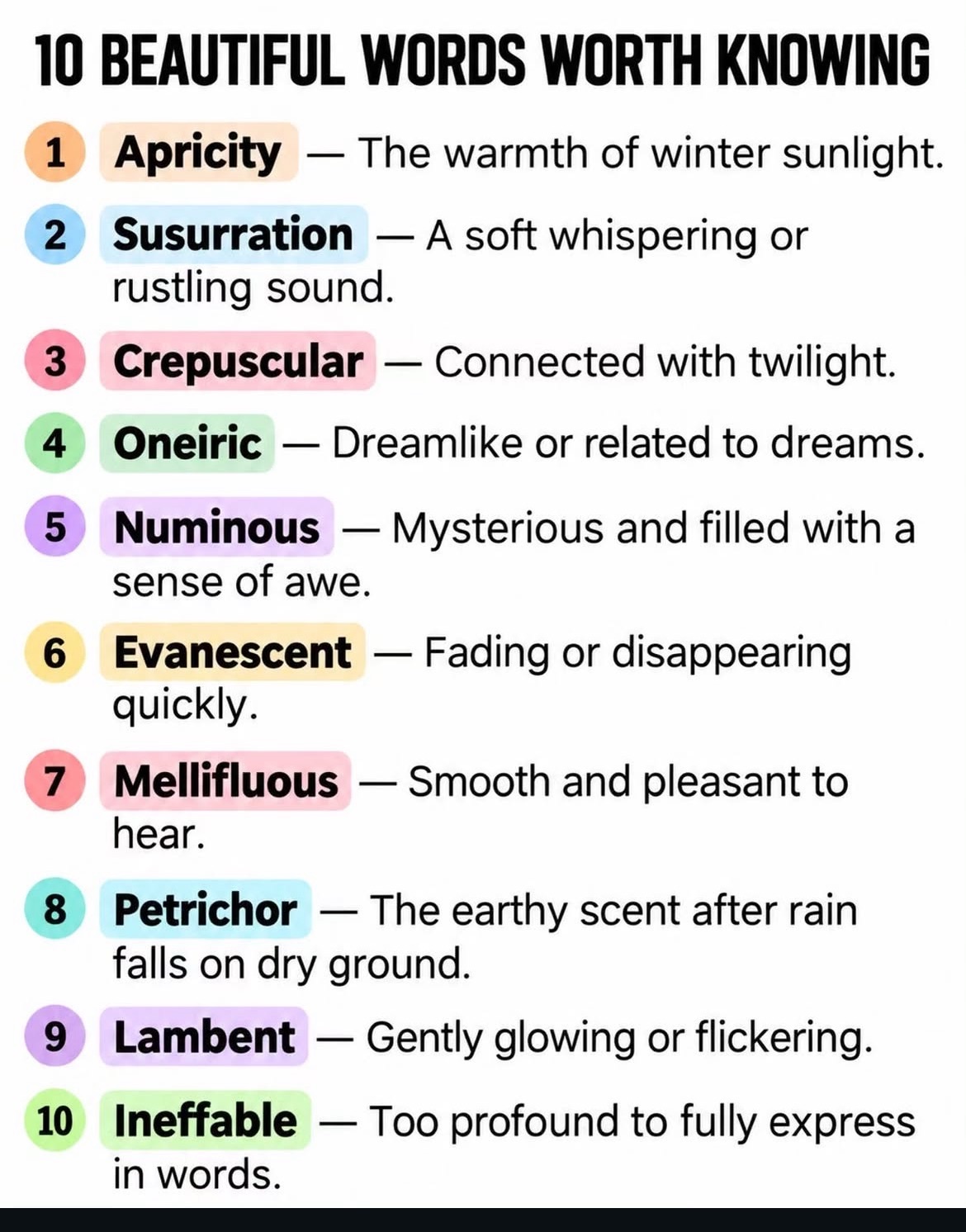
[Written by Claude]
For fourteen months, Priya Raman and Desmond Okafor had been mortal enemies every Thursday at eight.
Her team, the Quizzly Bears, sat by the window of the Salty Heron, where the apricity of the last winter sun made her glasses glow like a villain’s. His team, Les Quizerables, sat by the dartboard and lost with enormous dignity. Desmond had taken it personally for so long that it had curdled into something suspiciously like devotion.
“Capital of Burkina Faso,” the host announced, and a susurration of frantic whispers rippled through the pub. Priya wrote Ouagadougou without looking up. Desmond, across the room, mouthed it at his teammates, and she caught him spelling it wrong with his fingers.
By the crepuscular hour, the scores were tied. It had never happened before. The whole pub went quiet.
“Tiebreaker,” said the host. “Closest guess wins. How many times does the word ‘love’ appear in Shakespeare’s sonnets?”
Priya and Desmond stood at the same moment and were handed the same tiny slips of paper. A brief rain had started outside, and when someone opened the door, the petrichor drifted in, cool and mineral, cutting through the smell of fries.
“I’m going to win,” she said.
“You’re going to cheat,” he said. “You have a tell. You tap your pen.”
“I don’t have a tell.”
“You’re tapping your pen.”
She was. She stopped. He grinned, and she realized, to her horror, that she had been looking forward to this grin every Thursday for over a year.
The host’s voice was suddenly mellifluous with showmanship. “Desmond guessed 140. Priya guessed 141. The answer is…” A pause, under the lambent flicker of the Heron’s fairy lights. “…141.”
The pub exploded. Priya raised both fists. Then she saw Desmond’s face, not crushed but lit, as if losing to her were the best thing to happen to him all year.
“Congratulations,” he said. “I’d like to formally request a rematch.”
“Which of us do you mean?”
“Both of us. Not here. Somewhere with a table for two.”
Something numinous and ridiculous had settled over the room, forty strangers hushed by a feeling they hadn’t been warned about. The whole evening felt oneiric, like a dream where she’d shown up fully prepared for a test and discovered it was a date.
She knew nights like this could be evanescent, so she didn’t wait. “Saturday. But I’m picking the trivia category.”
“Terrifying. Yes.”
Later, walking home under the dripping awnings, he held her umbrella and she held his arm, and neither mentioned it. What she felt was ineffable, too bright and too silly for any answer key.
Behind them, the Heron’s sign flickered on the wet pavement. Les Quizerables, loyal to the end, were still arguing about the spelling of Ouagadougou.
Word of the Day
Hester Vane was the last employee of the Larkfield Gazette who still came to the office. The paper had been sold to a chain in another state, and the editor ran what was left of it from his lake house. But someone still had to write the weather and the obituaries, lay out the pages, and send the files to the press by nine each night, and for thirty years that someone had been Hester. She had moved to Larkfield at twenty-four for this job. Her desk sat by the window overlooking the courtyard, and every afternoon, before the day’s pages came together, she wrote a small box for page six called Word of the Day.
She had long ago stopped expecting a reply.
Monday: Apricity. The warmth of winter sunlight. In a sentence: “The best seat in town is wherever the apricity lands.”
That morning, Hester looked up from the weather and saw a man on a fourth-floor balcony across the courtyard, reading page six with a pencil. There was flour on his sleeves. He underlined something. She sat very still, like someone who has spotted a deer.
Tuesday: Susurration. A soft whispering or rustling. In a sentence: “The susurration of newsprint carries surprisingly well across a courtyard, as do the people who think no one is listening.” That evening, a chalkboard appeared on his railing, in careful block capitals: NOT ALL WHISPERS ARE MEANT FOR THE WIND.
Wednesday: Crepuscular. Of twilight. In a sentence: “Moths, deer, and certain readers are crepuscular, appearing only when it is safe.” His chalkboard: FIRST TWO, MOSTLY. NIGHT SHIFT. I SLEEP IN THE AFTERNOONS.
Thursday: Mellifluous. Smooth and pleasant to hear. In a sentence: “The author’s singing is not mellifluous. She sings in the shower like a cat falling downstairs, and would like it noted that she knows.” His chalkboard: NOTED. I WHISTLE LIKE A KETTLE.
It rained Thursday afternoon. Hester opened her window between obituaries and smelled the courtyard planters, and she wrote Friday’s entry on the spot.
Friday: Petrichor. The smell of rain on dry ground. In a sentence: “Open a window and the petrichor will find you. Courtyards are very good at this.” That evening, his window was open too. His chalkboard said: AGREED. I BAKE. HELLO.
His lamp stayed on late that night. She noticed, and then she told herself she hadn’t.
Saturday: Lambent. Gently glowing or flickering. In a sentence: “A lambent lamp in a fourth-floor window, for example. Not that anyone is checking.” On Saturday night, the lamp was on. Hester stayed up, pretending to be certain it was a coincidence.
Sunday: Oneiric. Dreamlike. In a sentence: “Writing to someone you can’t hear is oneiric. It is not clear which of us is the dream.”
That afternoon, the editor called from the lake. He had finally read page six. It was unprofessional, he said, and also readership was up forty percent, which made no difference, because the sale closed Wednesday and the last issue would run that morning.
Hester said “I see” and hung up. She sat for a long time. Then she wrote Monday’s entry.
Monday: Evanescent. Fading quickly. In a sentence: “Daily columns are evanescent, like a week, like a Wednesday.”
His chalkboard that evening said nothing at all. It was blank, and she was oddly grateful.
Tuesday: Numinous. Awe-inspiring, a little frightening. In a sentence: “A woman crossing a courtyard to knock on a stranger’s door is a numinous thing. Tomorrow’s word is yours. Fourth floor, I assume.”
That afternoon she laid out the last issue of the Gazette, thirty years of habit moving her hands. She wrote the weather. She left the box on page six empty. At six, she printed a proof of the page, put on her coat, and did something unprecedented in the history of the paper: she went across the courtyard.
The door opened before she knocked. He was taller than he looked from across the way, with gray at his temples and chalk on his sleeve now as well as flour. Behind him, taped to every wall, were clippings of page six, one for every morning.
“I moved here last February,” he said. “After the divorce. Fifty-two years old and starting over with a night-shift oven. I talked to the bread, mostly. Then I found your box.” He looked at the floor. “I assumed you’d never notice.”
“I almost didn’t,” said Hester.
She handed him the proof. The box was empty, and the file had to go to the press by nine. He took out his pencil, thought for a long moment, and wrote ineffable.
“Definition?” she asked.
“Ask me tomorrow,” he said.
“Tomorrow’s the last issue.”
“I know,” he said. “That’s why.”

