[Written by Claude. Image by ChatGPT]
I’ve been trying to read the Dao De Jing for a while now. The plan was simple: one verse at a time, start to finish, all 81 of them. It’s a short book, and it has been read for more than two thousand years, so how hard could it be?
Harder than I expected. Somewhere around chapter 15, I realized I was lost. Not because any single verse was impossible, but because the book doesn’t move in a straight line. One chapter is about the nameless source of everything, the next about how to govern a country, the next about breathing like a newborn. Ideas appear, vanish, and reappear forty chapters later in a different form. Reading in order, I kept losing the thread, and with it, my motivation.
So I’m trying again, differently. This time, with Claude’s help, I started by mapping the whole book before reading further. We sorted all 81 verses into five broad topics (the Tao itself, way of life, self-cultivation, governance, and war), then into twenty smaller subtopics, and tagged recurring themes like softness and water, emptiness, contentment, and non-action, so I can trace them across the book.
Now, instead of reading chapter 9 and then chapter 10, I read chapters 9, 12, 13, 44, and 46 together, five verses scattered across the book that all turn out to be about one thing: knowing when you have enough. Read side by side, they suddenly talk to each other.
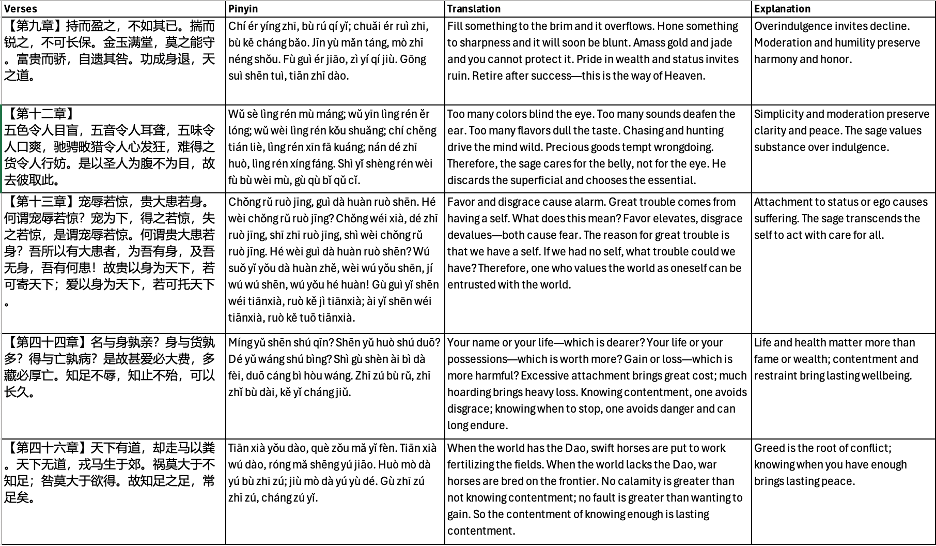
In this series, I’ll work through the Dao De Jing one theme at a time, sharing the verses, what I’m learning, and a short poem I write for each group to pull it together. First up: enough.
《知足》
持盈揣锐不长久,
金玉满堂谁可守?
五色五音乱耳目,
宠辱若惊扰心头。
名身货利孰亲疏,
得失之间病在求。
知足之足常自足,
功成身退道中游。
Chí yíng chuǎi ruì bù cháng jiǔ,
jīn yù mǎn táng shéi kě shǒu?
Wǔ sè wǔ yīn luàn ěr mù,
chǒng rǔ ruò jīng rǎo xīn tóu.
Míng shēn huò lì shú qīn shū,
dé shī zhī jiān bìng zài qiú.
Zhī zú zhī zú cháng zì zú,
gōng chéng shēn tuì dào zhōng yóu.
Enough
Filled to the brim, honed too sharp: neither lasts for long;
a hall heaped with gold and jade, who can keep it safe?
Five colors and five tones confuse the eye and ear;
praise and blame alike unsettle the heart.
Fame, self, wealth, and gain: which is near, which is far?
Between gaining and losing, the sickness lies in wanting.
The enough that knows it is enough is always enough;
the work done, step back, and wander in the Way.
At first glance, 知足 (enough) and 不知足 (not enough) look like opposites, and the Dao De Jing seems to side firmly with the first. Chapter 46 says the contentment of knowing enough is lasting contentment. Yet anyone who has built a business, learned an instrument, or written a book knows that dissatisfaction is also a teacher. Without some restlessness, nothing improves. The answer isn’t to choose one over the other, but to know where each belongs. A popular Chinese saying captures this well: 做人要知足,做事要知不足,做学问要不知足. In living, be content; in work, know your shortcomings; in learning, never be satisfied.
知足 belongs to having: possessions, status, comfort, recognition. These are the areas where wanting more rarely makes life better, because people adapt so quickly that each gain soon feels ordinary. Contentment here isn’t laziness; it’s freedom. When you no longer need a bigger house or more praise to feel secure, your energy is released for what actually matters. 不知足 belongs to becoming: craft, understanding, character, the capacity to love. These are areas without a ceiling, where reaching one level reveals the next and the pursuit itself is rewarding. Here, holy dissatisfaction is what keeps you growing.
Practicing 知足
Start by defining enough in advance. Write down what income, home, and lifestyle would support the life you want, so that when you reach it, you recognize it instead of moving the line. Then build small habits that counter adaptation: pause before a purchase and ask whether it serves the life you want or just the wish for more; notice daily what is already good, whether a meal, a walk, or a conversation, since gratitude is the most direct practice of 知足. Celebrate finished work instead of rushing to the next goal. Chapter 9’s 功成身退 suggests a ritual of completion: when something is done, mark it, enjoy it, and let it go. Finally, compare with your own life, never with others’, since envy is the quickest way to lose contentment.
Practicing 不知足
Choose one or two areas to be genuinely hungry in, rather than spreading dissatisfaction across your whole life. For example, this may be applied to writing a book or learning a new piano piece. Aim your restlessness at the work, not at yourself: “this chapter isn’t working yet” drives growth, while “I’m not a real writer” drives fear. Keep a growth edge by working slightly beyond your current ability, such as a piece of music a little too hard or a scene that scares you. Compare yourself only with who you were last month. And use the relief-versus-delight test: if pursuing something brings absorption and joy, the hunger is healthy; if it brings anxiety and only relief when you succeed, it has probably turned into fear.
Holding both
The two work best together. Contentment gives striving a stable base. When you don’t need success to feel worthy, you can take risks, fail, and keep going. Striving gives contentment depth, so that it doesn’t become complacency. Chapter 33 holds them in one breath: 知足者富,强行者有志, knowing enough is wealth, and perseverance is will. A simple question for a weekly review can keep the balance honest: where am I grasping for more than I need, and where am I settling for less than I could become? The first points to where you need 知足; the second, to where 不知足 can serve you.
Here’s a timeline of voices on 知足, knowing enough, from antiquity to now.
Ancient China
- Confucius (551–479 BCE) praised his student Yan Hui, who lived on a bowl of rice and a gourd of water in a poor alley and never lost his joy: 一箪食,一瓢饮,在陋巷,人不堪其忧,回也不改其乐 (Analects 6.11). Contentment as inner joy independent of circumstances.
- Zhuangzi (4th century BCE): 鹪鹩巢于深林,不过一枝;偃鼠饮河,不过满腹. The wren nesting in a deep forest needs only one branch; the mole drinking from a river needs only a bellyful. We need far less than what is available.
- Mencius (372–289 BCE): 养心莫善于寡欲. Nothing nourishes the heart better than having few desires.
- The Buddhist teaching of 少欲知足 (few desires, knowing contentment), especially in the Sutra of the Buddha’s Bequeathed Teaching (遗教经): one who knows contentment is at peace even sleeping on the ground, while one who doesn’t is unsatisfied even in a palace.
Ancient Greece and Rome
- Socrates (470–399 BCE), according to later accounts, walked through the market and remarked on how many things he did not need.
- Diogenes the Cynic (4th century BCE) owned almost nothing and supposedly threw away his cup after seeing a child drink from cupped hands.
- Epicurus (341–270 BCE) taught that natural desires are few and easy to satisfy, and that someone not content with little will be content with nothing. The closest Western match to chapter 46.
- Seneca (c. 4 BCE–65 CE) argued that the poor person is not the one with little, but the one who craves more.
- Epictetus and Marcus Aurelius (1st–2nd century CE) taught that wealth lies in wanting nothing outside your control.
Medieval and early modern
- Tao Yuanming (365–427) left office and returned to his fields rather than bow for a small salary. His poems turn 知足 into a life of farming, drinking, and watching the hills.
- Su Shi (1037–1101), in exile, wrote in the Former Ode on the Red Cliff (前赤壁赋) that the breeze on the river and the moon over the mountains belong to no one and are free for all to enjoy: contentment in what cannot be owned.
- Kamo no Chōmei (1155–1216) lived in a ten-foot hut and wrote Hōjōki about finding peace once he had stopped wanting a bigger house.
- Ryōkan (1758–1831), a Japanese Zen monk-poet, lived by begging and wrote of a full life with a bowl, a robe, and the moon.
- Michel de Montaigne (1533–1592) wrote about moderation and enjoying what one has rather than chasing what one lacks.
- Benjamin Franklin (1706–1790), in Poor Richard’s Almanack: content makes poor men rich; discontent makes rich men poor.
19th and 20th centuries
- Henry David Thoreau (1817–1862) wrote in Walden that a person is rich in proportion to the number of things they can afford to leave alone.
- Leo Tolstoy, in “How Much Land Does a Man Need?” (1886), tells of a peasant offered all the land he can walk around in a day. He keeps walking further out of greed and dies of exhaustion at the finish; the answer is the six feet for his grave. A perfect parable for chapters 44 and 46.
- Mahatma Gandhi (1869–1948) is widely credited with the idea that the earth provides enough for everyone’s need, but not for everyone’s greed.
- E. F. Schumacher (Small Is Beautiful, 1973) argued for an economics built around sufficiency rather than endless growth.
- Vicki Robin and Joe Dominguez (Your Money or Your Life, 1992) described a “fulfillment curve,” where more spending adds happiness up to a point called “enough” and then begins to subtract.
Today: what research says
- The hedonic treadmill (first described by Brickman and Campbell, 1971): people adapt to gains, so more wealth or possessions quickly stop feeling like more. This is the mechanism behind chapter 46’s insight.
- The Easterlin paradox: across decades, national income can rise without average happiness rising as much. Researchers still debate how strong this effect is, and how far happiness keeps rising with income.
- Barry Schwartz (The Paradox of Choice, 2004) distinguishes “maximizers,” who seek the best option, from “satisficers,” who accept a good-enough one, and finds satisficers tend to be happier: 知足 measured in a lab.
- John C. Bogle (Enough., 2008), the founder of Vanguard, wrote about how finance loses its way when it forgets the concept of enough.
- Oliver Burkeman (Four Thousand Weeks, 2021) applies the idea to time: you can never do everything, so peace comes from accepting limits.
Here’s the companion timeline: voices on productive 不知足, the hunger to keep growing, from antiquity to now.
Ancient China
- King Tang of Shang (c. 1600 BCE), via the Great Learning (大学): the inscription on his washbasin read 苟日新,日日新,又日新. If you can renew yourself one day, do it every day, and again the next. The oldest Chinese image of daily self-renewal.
- Book of Changes (易经), commentary on the first hexagram: 天行健,君子以自强不息. Heaven moves with ceaseless strength; the noble person likewise strives without rest.
- Confucius (551–479 BCE): 学而不厌,诲人不倦 (Analects 7.2), learning without tiring and teaching without weariness. He described himself as so absorbed in study that he forgot to eat and didn’t notice old age approaching (7.19).
- Qu Yuan (c. 340–278 BCE), in Li Sao (离骚): 路漫漫其修远兮,吾将上下而求索. The road is long and far; I will search high and low. Still one of the most quoted lines on the endless quest.
- Xunzi (c. 310–235 BCE), Encouraging Learning (劝学): 学不可以已, learning must never stop, and 锲而不舍,金石可镂, keep carving without giving up, and even metal and stone can be engraved.
Ancient Greece and Rome
- Socrates (470–399 BCE) said at his trial that the unexamined life is not worth living. Philosophy as a lifelong refusal to settle into easy answers.
- Aristotle (384–322 BCE) taught that excellence is built through practice and that a good life is an activity, not a possession. Flourishing is something you keep doing, not something you reach.
- Seneca (c. 4 BCE–65 CE) wrote that we learn by teaching, and urged daily self-examination to keep improving.
Medieval and early modern
- Augustine (354–430) described the human heart as restless until it rests in God, a spiritual 不知足 that finds its resolution only in the infinite.
- Han Yu (768–824), Explaining Advancement in Learning (进学解): 业精于勤,荒于嬉. Skill is perfected through diligence and ruined by idleness.
- Zhu Xi (1130–1200), in his poem on reading: 问渠那得清如许?为有源头活水来. Why is the pond so clear? Because fresh water keeps flowing in from its source. Constant learning keeps the mind clear.
- Wang Yangming (1472–1529) taught 知行合一, unity of knowing and doing, and 事上磨练, being polished through real-world tasks. Growth comes from practice, not just study.
- Michelangelo (1475–1564) is said to have written ancora imparo, “I am still learning,” in his late eighties. The attribution is uncertain, but the image has endured.
18th and 19th centuries
- Goethe’s Faust (1808, 1832) is the great literary study of 不知足. Faust bargains that if he ever asks a moment to stay because it’s so beautiful, he will lose his soul. His endless striving is both his flaw and, in the end, what redeems him.
- Tennyson’s “Ulysses” (1842) imagines the aging hero refusing to rest at home, choosing to strive, seek, and find, and not to yield.
- Ralph Waldo Emerson (1803–1882) wrote about self-reliance and continual growth, arguing that a person should never be bound by who they were yesterday.
- Friedrich Nietzsche (1844–1900) put self-overcoming at the center of life in Thus Spoke Zarathustra: the self is something to be surpassed again and again.
20th century
- Abraham Maslow (1908–1970) described self-actualization as the drive to become everything one is capable of becoming, a growth need that never fully closes.
- Martha Graham (1894–1991), the dancer and choreographer, described artists as living with a “divine dissatisfaction,” a restlessness that keeps them creating.
- Kaizen (post-war Japan), popularized in the West by Masaaki Imai’s 1986 book: continuous improvement in small daily steps, in manufacturing and in life. A modern version of King Tang’s washbasin.
- Mihaly Csikszentmihalyi (1934–2021) found that “flow” occurs when a challenge slightly exceeds your current skill, so healthy growth requires a constant edge.
- K. Anders Ericsson (1947–2020) showed that expert performance comes from deliberate practice: focused work on weaknesses, just beyond your comfort zone.
21st century
- Carol Dweck (Mindset, 2006): a growth mindset treats ability as something developed, so setbacks become information rather than verdicts.
- Steve Jobs closed his 2005 Stanford commencement speech with “Stay hungry, stay foolish,” borrowed from the Whole Earth Catalog.
- Angela Duckworth (Grit, 2016): long-term passion and perseverance predict achievement more than talent does. Xunzi’s carving, measured.
- James Clear (Atomic Habits, 2018): small improvements compounded over time, kaizen for personal life.
The cautions
Even the champions of 不知足 knew its dangers. Faust’s striving nearly destroys him. Psychologist Tal Ben-Shahar named the “arrival fallacy”: the belief that reaching a goal will bring lasting happiness, followed by disappointment when it doesn’t. Research on burnout and on “maximizers” shows that dissatisfaction aimed at the self rather than the work turns into anxiety. Healthy 不知足 is Zhu Xi’s flowing spring, a constant fresh source, not Tolstoy’s peasant walking until he drops.
Put side by side, the two timelines tell one story. The 知足 voices teach how to rest, and the 不知足 voices teach how to grow. The wisest in both traditions knew they need each other.

