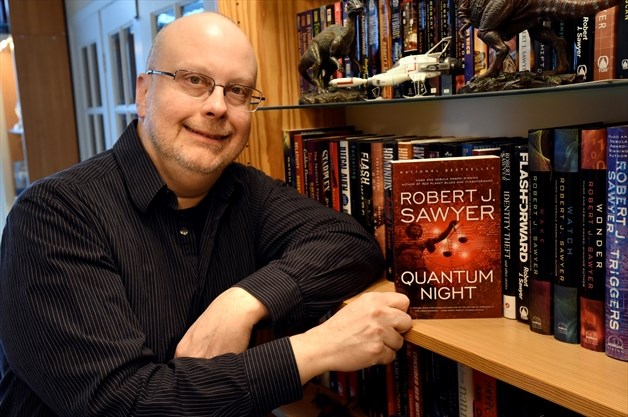
I was at a sci-fi convention today, and I met Robert J. Sawyer.
If you don’t know the name, Rob is one of Canada’s best-known science fiction writers. He’s won both the Hugo and Nebula awards, two of the genre’s highest honors, and he’s the author of Hominids, Calculating God, and Flashforward, which was adapted into a TV series. He’s been writing thoughtful, idea-driven SF for decades.
We got to talk, and then he gave me a book: a collection of his short articles on writing. One of the articles was about how to open a science fiction novel.
Years of thinking about my own sci-fi idea is long enough. Time to start writing.
[Written by Claude]
Eight Ways to Open a Science Fiction Novel (and How Well Each One Works)
A field guide to sci-fi openings, with examples from the shelf and an honest look at what each approach gets you, and what it costs.
The first page of a science fiction novel has an unusual double job. Like any novel, it has to make a stranger care. Unlike most novels, it also has to start teaching the reader the rules of a world that doesn’t exist, without sounding like a manual.
Robert J. Sawyer’s essay “Great Beginnings” (1995) boils the options down to four broad moves: evocative description, an intriguing character, material that isn’t the main narrative (a news clipping, a journal entry), and starting in the middle of action. (I’m working from a summary of the essay rather than its text, so treat that framing as secondhand.) Those four cover a lot of ground, but looking at published novels, a few more patterns show up. Below are eight, each with concrete examples and a verdict on how reliably it works.
A quick note on method: I paraphrase opening lines rather than quote them, so pull the books off your shelf and read the real first pages alongside this article. That is the best way to feel the difference between these techniques.
1. The evocative image
What it is: The book opens on setting and atmosphere, and a single striking image carries the tone of the entire novel.
Examples:
- Neuromancer (William Gibson) opens by comparing the sky above a port city to a television tuned to a dead channel. In one comparison you learn the technology level, the decay, and the cynical eye of the narrator.
- The Dispossessed (Ursula K. Le Guin) opens on a wall around a spaceport, and the book immediately plays with what walls mean, which is the novel’s central theme.
Effectiveness: High, but only when the image implies tension. The best evocative openings do not describe scenery for its own sake. They suggest that something is wrong, or that someone is looking at the world with an attitude. Gibson’s sky works because it already contains a worldview. A lush paragraph about two moons and a violet horizon, with no point of view and no problem, is the version that stalls.
Risk: Static prose. If nothing is at stake by the end of the first paragraph, you are borrowing against the reader’s patience.
2. The intriguing character
What it is: The opening introduces someone the reader wants to spend time with, through a quirk, a contradiction, or a problem.
Examples:
- Old Man’s War (John Scalzi) opens with a seventy-five-year-old man who visits his late wife’s grave and then enlists in the army. Two short actions establish grief, humor, and the premise.
- All Systems Red (Martha Wells) gives us a security android who has hacked its own control module and mostly uses the freedom to binge entertainment. The voice is the hook.
Effectiveness: Very high. Readers forgive almost any amount of unfamiliar worldbuilding if they are attached to a person. This is the most reliable approach for a debut, because it does not depend on the reader already liking your genre’s furniture.
Risk: “Quirky” can become a checklist. A character who is only a set of traits, with no want, becomes wallpaper by page five. Give them a goal, even a small one.
3. The document or fragment
What it is: The book opens with something that is not the main narrative: a log entry, news report, transmission, report, or epigraph.
Examples:
- The Martian (Andy Weir) opens as a log entry in which the stranded astronaut sums up his situation in blunt, funny terms. The format delivers voice, stakes, and a built-in reason for the narrator to explain things.
- The Left Hand of Darkness (Le Guin) frames the story as a report by an envoy, which sets up the question of what a reliable account of an alien culture even looks like.
- Dune (Frank Herbert) uses epigraphs from an in-universe historian to suggest depth and a long shadow of history.
Effectiveness: High when short and intriguing in itself; medium otherwise. Documents are efficient: they create authenticity and let you plant worldbuilding without a scene. They also let a distinctive voice appear instantly.
Risk: Delay. A reader who has opened your book for a story will tolerate one page of ephemera and get restless at five. The fragment must raise a question, not merely supply background.
4. In the middle of action
What it is: The reader lands in a chase, a crisis, a fight, or a negotiation already underway.
Examples:
- Snow Crash (Neal Stephenson) begins with a pizza delivery driver on a high-stakes run through a future city, with the culture explained almost entirely through the job.
- The Martian also qualifies here: the disaster has already happened, and the narrator is dealing with it.
Effectiveness: High for momentum, conditional for emotion. Action delivers instant stakes and gives you a natural excuse to withhold backstory. But action alone is hollow. Readers need a reason to care who survives, which is why this approach works best when fused with a strong character or voice, as in both examples above.
Risk: Confusion without orientation. If the reader cannot tell what is happening or who is doing it, the scene reads as noise. A few anchoring details (who, where, what they want) are essential.
5. The bold first line
What it is: A single sentence that sets tone, promises a kind of book, and makes the reader read the second sentence.
Examples:
- Fahrenheit 451 (Ray Bradbury) opens with the line “It was a pleasure to burn.” Four words establish an unsettling narrator and a perverse inversion of what fire is for.
- Nineteen Eighty-Four (George Orwell) announces a day in April where the clocks are striking thirteen. One wrong detail tells you this is not our world.
Effectiveness: High when it is earned, risky when it is performed. A great first line is a promise, and the novel must keep it. Lines that merely sound dramatic, with no connection to what follows, feel like a trick.
Risk: Self-consciousness. Writers who agonize over the line often produce one that is clever rather than true to the book’s voice.
6. The ordinary moment, then the intrusion
What it is: The story begins with something small and human, and the speculative element arrives and disrupts it.
Examples:
- Station Eleven (Emily St. John Mandel) opens in a theater during a performance, with a death on stage coinciding with the beginning of a global catastrophe. The intimacy makes the scale hit harder.
- The Hitchhiker’s Guide to the Galaxy (Douglas Adams) opens with a wry aside about an unremarkable planet, then lands on a man trying to stop his house from being demolished, just before the demolition of something much larger.
Effectiveness: High for emotional resonance. The contrast between small and vast is one of sci-fi’s strongest effects. Readers experience the strange as an interruption of something they already care about.
Risk: Slow burn. If the ordinary section runs long before the intrusion, you are relying on the prose and the character to hold attention in the meantime.
7. The mystery or disorientation
What it is: The protagonist (and the reader) does not know what is happening, and finding out is the engine of the opening.
Examples:
- Project Hail Mary (Andy Weir) begins with a man waking up with no memory, being questioned by a machine. The reader and the character learn the situation together.
- Ancillary Justice (Ann Leckie) opens on a body lying in the snow and a narrator whose identity and purpose gradually reveal how unusual this book’s perspective is.
Effectiveness: High for hooks, with a shelf life. Mystery generates questions fast, and amnesia or disorientation is a clean excuse for exposition. But it works best when the reveals keep coming. If the central question lingers unanswered too long, or the answer disappoints, the early goodwill drains away.
Risk: The amnesia cliché. It is easy to overuse, and readers have seen it often. It works best when what the character learns is genuinely surprising.
8. The prologue from elsewhere
What it is: A short scene from another time, place, or point of view that creates scale or foreshadows what is coming.
Examples:
- The Three-Body Problem (Liu Cixin) opens during the Cultural Revolution with a brutal public struggle session that ends in a death, planting the seeds of the entire plot in a scene that does not look like sci-fi at all.
- Ender’s Game (Orson Scott Card) begins with unnamed officials discussing a child they have been watching, creating curiosity about him before we ever meet him.
Effectiveness: Medium to high. A prologue can give a book gravity and a sense that events are bigger than the protagonist. Done well, it makes the reader lean in. But it asks for patience, because the main character has not appeared yet.
Risk: The reader skips it, or the real story starts with a cold restart. If you cannot make the prologue as gripping as chapter one, cut it.
Side-by-side verdict
| Approach | Best at | Biggest risk | Reliability |
|---|---|---|---|
| Evocative image | Tone and worldview | Static, no tension | High if tense |
| Intriguing character | Emotional hook | Quirks without a want | Very high |
| Document or fragment | Authenticity, voice | Delaying the story | High if short |
| Middle of action | Momentum | Hollow, confusing | High with character |
| Bold first line | Promise of tone | Feels performed | High if earned |
| Ordinary, then intrusion | Contrast and emotion | Slow burn | High |
| Mystery or disorientation | Curiosity | Cliché, weak payoff | High, with a shelf life |
| Prologue from elsewhere | Scale and foreshadowing | Reader impatience | Medium to high |
What the best openings have in common
Look back at the examples and the same ingredients keep appearing, whatever the technique:
- A person, however briefly. Even the document openings (the log entry in The Martian) are really character openings.
- A question the reader cannot ignore. What happened to him? Why is the sky like that? Why is this person joining the army at seventy-five?
- Specific detail over explanation. One well-chosen detail does the work of a paragraph of worldbuilding.
- A tone that matches the rest of the book. A funny opening that leads into a grim novel feels like a bait and switch.
The strongest openings also stack techniques. The Martian is a document, a voice, and an action opening at once. Snow Crash is action, voice, and worldbuilding through job detail. Sawyer’s four categories are best treated as ingredients rather than a menu.
Traps to avoid
- The info-dump. Opening with the history of your empire, the mechanics of your drive, or a faction roster is the quickest way to lose a reader.
- The weather report. Description with no point of view and no stakes.
- The dream sequence. Readers feel cheated when the stakes turn out not to be real.
- The mirror or waking-up scene. Common enough that it needs a real twist to survive.
- Explaining the premise in the first paragraph. Let the reader infer the rules from what the character notices and takes for granted.
A practical exercise
Take your current opening and rewrite it three ways: once as a pure image, once as a character in motion, and once as a document. Read all three aloud. One will feel like the book. If none does, the issue is usually not technique but the absence of a want, so ask what your protagonist needs in the first scene and start there.
Bottom line
There is no single best way to start a science fiction novel, only the way that fits your story’s tone and your protagonist’s situation. If you are unsure, start with a person who wants something, put them somewhere strange that they treat as normal, and let the reader catch up. That recipe underlies most of the openings above.

