[Written by Gemini]
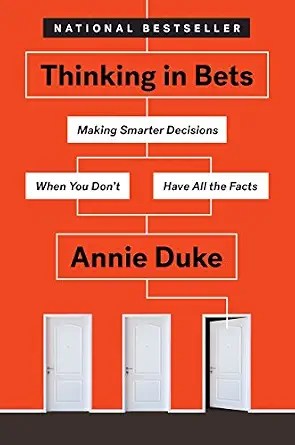
Thinking in Bets: Making Smarter Decisions When You Don’t Have All the Facts (2018) reframes decision-making as a probabilistic game of poker rather than a deterministic game of chess. Most decisions are made under incomplete information and luck, meaning a good process does not guarantee a good outcome, and a bad outcome does not mean a bad decision was made.
About the Author
Annie Duke is a former professional poker player, decision strategist, and author. She won a World Series of Poker (WSOP) bracelet and was the leading female money-winner in WSOP history before retiring from poker in 2012.
Before her poker career, Duke completed her undergraduate degree at Columbia University and conducted graduate studies in cognitive psychology at the University of Pennsylvania (under a National Science Foundation fellowship). Today, she serves as a decision consultant, corporate speaker, and co-founder of the non-profit Alliance for Decision Education.
Core Key Takeaways
- Life is Poker, Not Chess: Chess involves zero hidden information and minimal luck. Poker involves high luck and hidden information. Life operates like poker.
- Avoid “Resulting”: Evaluating decision quality based solely on the outcome is a severe cognitive bias. Great decisions can lead to bad outcomes (due to bad luck), and bad decisions can yield good outcomes (due to good luck).
- Decisions are Bets: Every decision is a bet on a future outcome, trading off alternative futures and resources (time, money, opportunity).
- Shift from “I’m Certain” to Probabilities: Saying “I’m 70% sure” creates emotional distance, reduces defensive stubbornness, and invites open updates to your beliefs.
- Truth-Seeking Requires Pods: Humans are wired for confirmation bias. Achieving objective decision-making requires a group or “decision pod” pledged to accountability, diversity of thought, and truth-seeking over social validation.
Chapter-by-Chapter Summaries & Key Actionable Steps
Chapter 1: Life Is Poker, Not Chess
- Core Concept: Evaluating decisions based strictly on results is called resulting. In chess, if you lose, you made bad moves. In poker or life, you can play a hand perfectly and still lose because of hidden cards and chance.
- External Insight: Daniel Kahneman (author of Thinking, Fast and Slow) emphasizes this as the “outcome bias”—our tendency to evaluate past decisions through hindsight, ignoring the uncertainty existing when the decision was made.
Key Actions:
- Separate outcome from process: When reviewing a past decision, evaluate only what you knew at the time you made it, not what happened after.
- Stop using “resulting” language: Eliminate statements like “That was a terrible decision” solely because the outcome was negative.
Chapter 2: Wanna Bet?
- Core Concept: When someone challenges your statement with “Wanna bet?”, your brain immediately pauses to audit its certainty. Most beliefs are formed passively (we hear something, believe it, and only rarely fact-check it later). Framing decisions as explicit bets forces you to quantify uncertainty.
Key Actions:
- Ask yourself “Wanna bet?”: Before committing to a firm belief, ask: “How much would I bet on this being true?”
- Express confidence in percentages: Replace binary statements (“This will work” / “This won’t work”) with probability ranges (e.g., “I’m about 60% confident in this scenario”).
Chapter 3: Bet to Learn: Fielding Outcomes
- Core Concept: Learning happens through a feedback loop: Decision → Outcome → Assessment/Learning. However, self-serving bias corrupts this loop: we credit our skills for good outcomes and blame bad luck for bad outcomes (while doing the opposite for others).
Key Actions:
- Audit your outcome attribution: Force a 50/50 review—for every win, identify the elements of luck involved; for every loss, identify the errors in your execution.
- Practice objective empathy: When assessing others’ mistakes, explicitly ask what luck or environmental factors contributed to their outcome.
Chapter 4: The Buddy System
- Core Concept: Fighting cognitive biases solo is almost impossible due to our blind spots. To improve decision quality, you need a “truth-seeking pod”—a small group of people committed to challenging each other’s assumptions constructively.
- External Insight: Ray Dalio calls this “radical truthfulness and radical transparency” in his book Principles, where decisions must withstand rigorous, believable dissent.
Key Actions:
- Form a decision pod: Partner with 2–3 colleagues or peers explicitly agreed to call out biases and test hypotheses without personal offense.
- Focus on accuracy over validation: Set group rules that prioritize discovering truth over comforting each other.
Chapter 5: Dissent to Win
- Core Concept: For a truth-seeking group to work, it must follow the principles of scientific exploration (Mertonian Norms): Universalism (judge arguments by merit, not speaker status), Disinterestedness (watch out for conflict of interest), and Organized Skepticism (encourage constructive dissent).
Key Actions:
- Separate the message from the messenger: Evaluate ideas independent of who proposed them (e.g., anonymize feedback or imagine an opponent proposed your favorite idea).
- Express dissent by asking permission: Use phrases like “Do you mind if I play devil’s advocate for 5 minutes?” to lower defensive walls.
- Lead with shared agreement: Validate the parts of an argument you agree with before introducing counter-evidence.
Chapter 6: Adventures in Mental Time Travel
- Core Concept: Our short-term emotional state (driven by the amygdala) frequently hijacks long-term decision-making—a phenomenon called temporal discounting. We make poor bets because we prioritize instant gratification or short-term relief over future well-being.
- External Insight: Suzy Welch introduced the 10-10-10 Rule, which Annie Duke adopts to bring future perspectives into current decisions.
Key Actions:
- Apply the 10-10-10 Rule: Ask how you will feel about a decision in 10 minutes, 10 months, and 10 years.
- Perform a Pre-Mortem: Before launching a project, imagine it failed catastrophically 1 year from now. Write down all the reasons why it failed so you can mitigate those risks today.
- Perform a Backcast: Imagine you achieved your ultimate goal 1 year from now. Trace backward step-by-step to outline the exact path that got you there.
- Set Ulysses Contracts: Create pre-commitments (e.g., automatic savings transfers, blocking distracting apps) that constrain your future self when temptation strikes.

